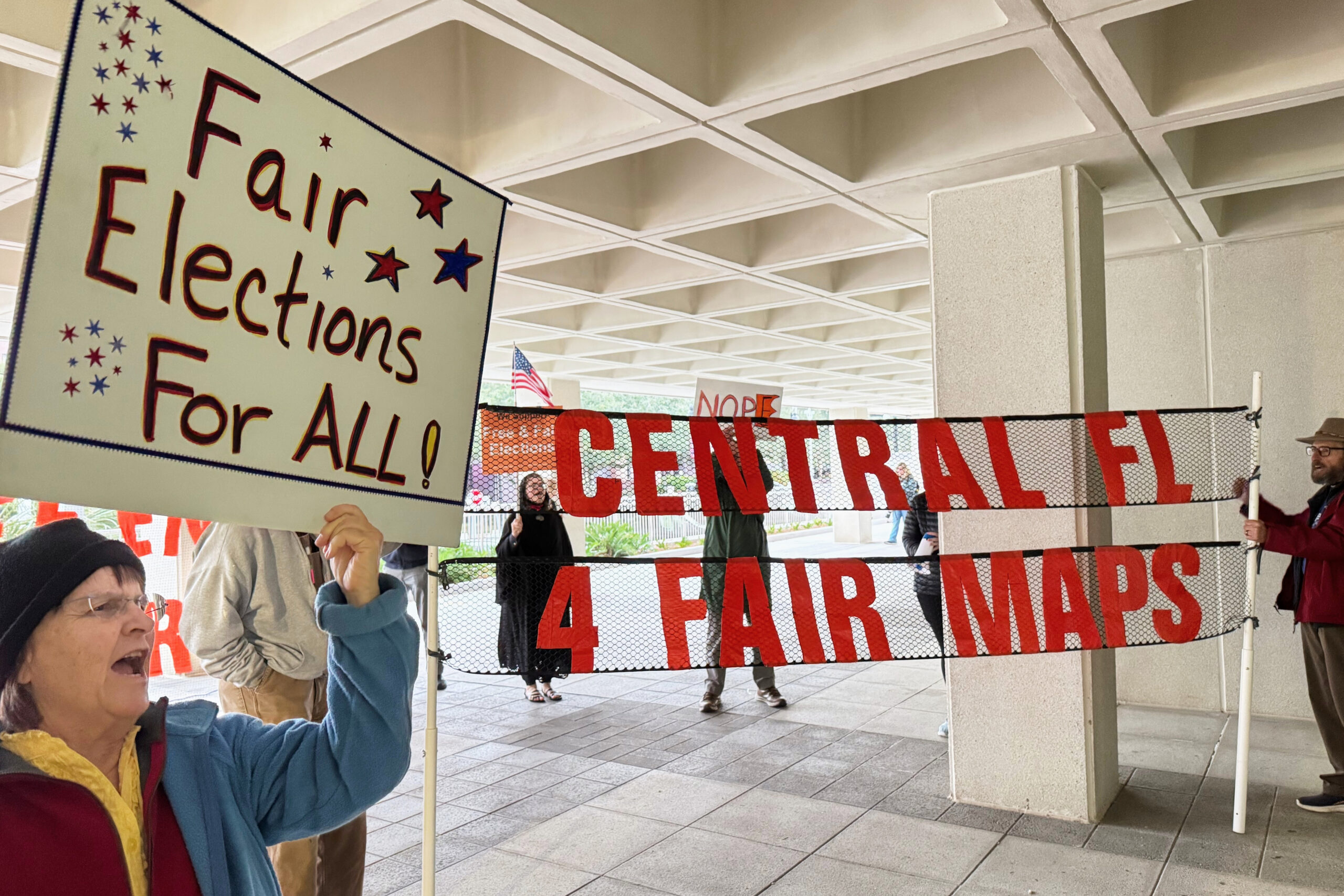
Florida voters and pro-voting group Equal Ground Education Fund filed a lawsuit Monday challenging the GOP’s new congressional gerrymander, urging a court to block the map for violating the state constitution’s ban on partisan gerrymandering.
The map was signed into law by Gov. Ron DeSantis (R), who led the unusual mid-decade redistricting as part of President Donald Trump’s broader effort to tilt the 2026 midterm elections.
Florida Republicans raced to enact the map with minimal public input and despite sharp criticism from Democrats — as well as unease within their own party.
SIGN UP TODAY Get updates straight to your inbox — for free Join 350,000 readers who rely on our daily and weekly newsletters for the latest in voting, elections and democracy.
The complaint alleges that the map is a partisan gerrymandering, in violation of the state constitution, which bans any partisan intent in redistricting. It cites testimony from the map-drawer, a DeSantis aide, who admitted to lawmakers this week that he had used partisan data.
“The 2026 Plan is, by traditional measures of partisan gerrymandering, one of the most extreme gerrymanders in American history,” the complaint reads. “It was not a redistricting proposal dressed up in the language of neutral principles. It was a partisan declaration, and it was presented as one.”
In 2010, Florida voters overwhelmingly passed the Fair Districts Amendment, placing strict limits on partisan gerrymandering. Florida is one of several states with such protections, including Utah, where a judge struck down a similar GOP map last year after finding it violated a voter-approved ban.
“We will not back down and allow Ron Desantis to violate Florida’s Constitution,” Nikki Fried, chair of the Florida Democratic Party, said after DeSantis signed the gerrymander into law. “These are unconstitutional and violate Florida’s 2010 Fair District Amendment. The fight has just begun.”
But the complaint argues Florida lawmakers ignored those constraints entirely.
The lawsuit lays out how the new map reshapes key regions — including Tampa Bay, Orlando and South Florida — to weaken Democratic voters by splitting them across multiple districts, a tactic known as “cracking,” and concentrating them into a smaller number of seats, known as “packing.”
“At every stage in the process, from its release to its final enactment, both the Governor and the Legislature made a mockery of the Fair District Amendment,” the complaint adds. “Statistics like these do not occur by accident. They are the product of deliberate choices, made by professionals with sophisticated tools and a clear partisan goal: to pack and crack Democratic voters with surgical precision and deprive Florida voters of a fair map guaranteed to them by the Florida Constitution.”
According to the complaint, the map could allow Republicans to win 24 of Florida’s 28 congressional seats — or roughly 86% of the delegation — even in elections where they receive far less than that share of the vote.
The plaintiffs also point to unusually direct evidence of partisan intent, including testimony from the map’s own architect.
“When the Governor’s map drawer, Jason Poreda, appeared before the Legislature, he acknowledged that he had drawn the 2026 Plan using partisan data,” the plaintiffs wrote. “When pressed on precisely how he used partisan data, and for which districts, Poreda acknowledged that partisan metrics were not limited to any particular district. Instead, they were “mixed in” with other traditional redistricting principles and applied across the entire map, including in particular in the ‘final balancing’ of a district.”
That admission, the plaintiffs argue, is direct evidence the map violates the state constitution.
Under Florida law, courts can strike down maps if partisan intent plays any role — not just a dominant one. As the Florida Supreme Court has previously held, “there is no acceptable level of improper intent.”
The complaint further alleges the map was driven by openly stated political goals.
“The 2026 Plan can only be explained by the same purpose that has been openly stated for months: to maximize Republican congressional representation,” the complaint continues.
It’s unclear, however, whether Florida courts will be as willing to enforce the law this time. Most justices on the state Supreme Court were appointed by DeSantis, and the court has recently signaled a more limited view of the Fair Districts Amendment’s reach.
DeSantis himself has openly boasted about the court’s shift.
“When I got elected, we had probably the most liberal supreme court in the country,” DeSantis told reporters while signing the state’s latest voter suppression bill into law. “Now I’ve put six [justices] on and we have the most conservative supreme court in the country.”
Still, the plaintiffs argue the law remains clear — and binding.
*The Elias Law Group (ELG) is representing plaintiffs in the case. ELG Firm Chair Marc Elias is the founder of Democracy Docket.