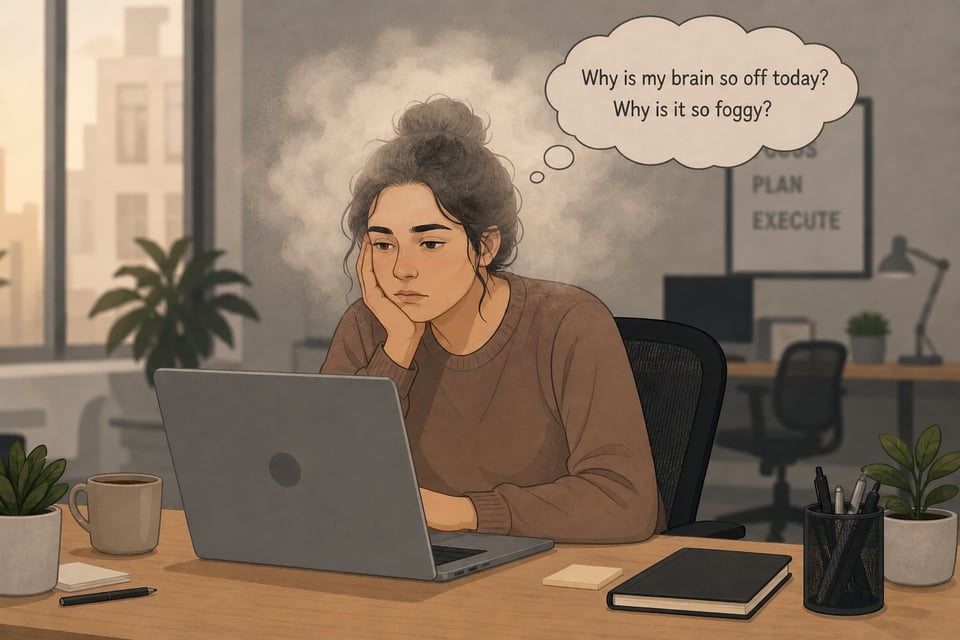
Brain Fog
It hits around 2pm. Sometimes 3pm.
You were sharp an hour ago. Now you're rereading the same sentence. Your eyes feel heavy. A simple decision feels harder than it should. You pour another coffee and wonder if you slept badly.
You didn't sleep badly. You just ate.
???? Your Brain Runs on Glucose — And Hates Instability
Your brain is the hungriest organ in your body. It accounts for about 20% of your total energy use despite being only 2% of your body weight.
And unlike your muscles, which can burn fat for fuel, your brain runs almost entirely on glucose.
That sounds like carbs are brain food. And they are — but only when glucose is stable. When it swings wildly up and then crashes down, your brain feels every bit of that drop.
Think of it like a power grid. Steady voltage keeps the lights on. A surge followed by a dip? Flickering lights, sluggish systems, things shutting down to conserve energy.
That flickering is what you feel as brain fog.
⚙️ What's Actually Happening Step by Step
Here's the sequence most people never connect:
You eat a carb-heavy meal. Glucose rises fast. Your pancreas releases a rush of insulin to bring it back down. Sometimes it overshoots — your blood sugar drops below baseline. Your brain, suddenly running low on its primary fuel, triggers a stress response.
Cortisol and adrenaline nudge your liver to release stored glucose to compensate. But in that gap — between the drop and the recovery — your brain is running on fumes.
That gap is brain fog. That gap is the 3pm slump. That gap is the reason you feel like a different person after lunch than you did before it.
And the sharper the spike, the deeper the crash.
???? Meet Kevin
Kevin is a project manager. Sharp guy, good at his job. But every day around 2pm he hits a wall.
He grabs a burrito bowl for lunch — rice, beans, corn, a little sour cream. Reasonable enough. But he eats it fast, at his desk, while catching up on Slack. By 2:30 he's in a meeting struggling to track the conversation. He blames the meeting. He blames his sleep. He books an earlier bedtime and drinks more coffee.
What Kevin doesn't realize is that his lunch — fast-digesting carbs eaten quickly with minimal fiber or fat to slow things down — is sending his glucose on a steep climb and an equally steep drop every single afternoon.
The fog isn't about willpower or sleep. It's metabolic.
❌ The Twist: Coffee Makes It Worse
The instinct when brain fog hits is to reach for caffeine. And it works — briefly.
But here's what's actually happening: coffee masks the crash without fixing the underlying glucose drop. It stimulates your nervous system and raises cortisol, which temporarily lifts energy. But it doesn't restore stable blood sugar.
An hour later the fog often returns, sometimes heavier. And if you've added sugar to that coffee, you've just started the whole cycle again.
Caffeine after a glucose crash is a band-aid on a problem that started two hours earlier at your plate.
????️ What Actually Keeps Your Brain Sharp
The fix isn't a supplement or a nootropic. It's upstream.
Slow your glucose rise at lunch — add fiber and protein to every meal, eat vegetables first, slow down while eating
Don't eat carbs alone — a sandwich without protein, a bag of chips, a granola bar on the go all spike fast with nothing to buffer the rise
Take a 10 minute walk after eating — your muscles act as a glucose sponge during light movement, pulling sugar out of your bloodstream before the spike peaks
Keep lunch moderate, not huge — a large meal diverts blood flow to digestion, which compounds the fog regardless of what you ate
None of this is complicated. It's just not what anyone teaches you.
✌️ Your Takeaway
Tomorrow at lunch, do one thing differently. Add a protein. Eat slower. Take a short walk after. Pick whichever feels easiest.
Then pay attention to how your 3pm feels. Your brain will give you immediate feedback.
???? Coming Up Next Week...
You know what causes the crash. Next week we're looking at the post-meal walk — why just 10 minutes after eating can do more for your blood sugar than an hour at the gym.
Not sure which meals are crashing you? That's exactly what GlucoSpike AI is built for. Log your meals, see your scores, and start spotting the patterns that are quietly wrecking your afternoons. Download the app on the App Store or Play Store and find out what your lunch is really doing to your brain.
See you next week,
— Team GS