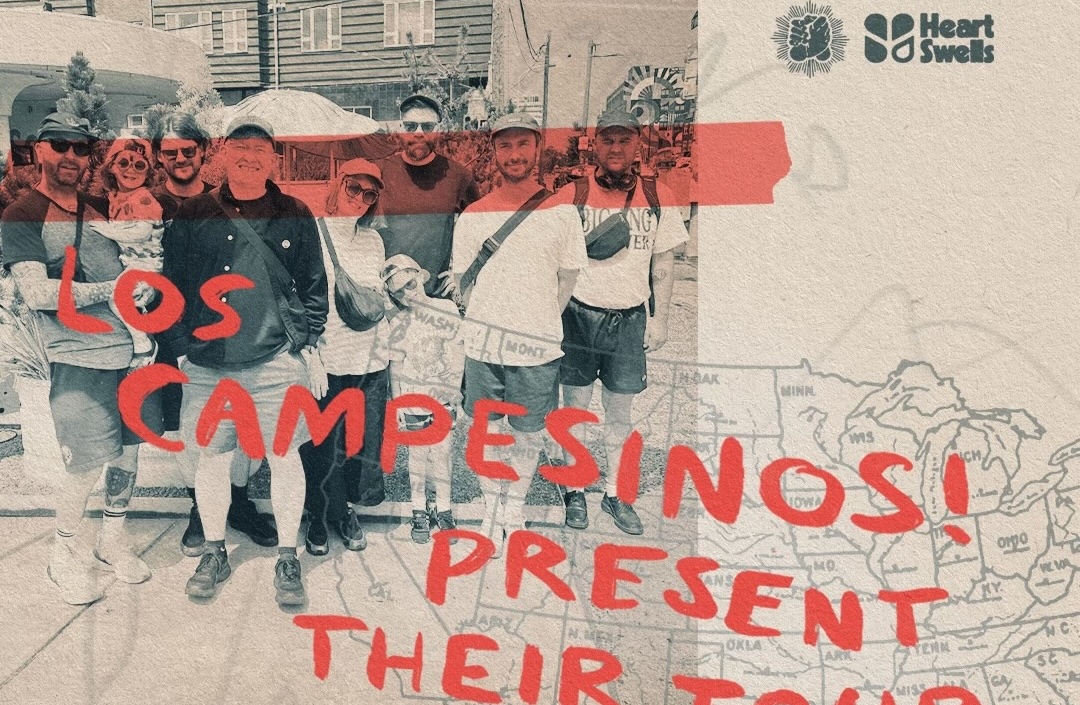
Beyond their reputation as one of the most consistently great indie pop bands of the past couple of decades, Los Campesinos! are also among the most transparent. Since going full-on DIY with their seventh studio album, 2024's All Hell, the Welsh band has been remarkably straightforward about the financial side of things. Today, in a guest essay crossposted with permission from the Los Campesinos! newsletter, frontman Gareth David shares exactly how much it costs him and his bandmates to tour stateside.
By now it’s widely accepted that the live industry is fucked for 99% of us. Be it artists struggling to cope with growing costs, or fans with diminishing disposable income being met with ever increasing ticket prices at arena and stadium gigs, from a gouging music industry.
Bands and Music Biz Insiders are often keen to express their plight, but so often what they say falls short of being interesting because it doesn’t include any detail or tell us anything we don’t already broadly know as music fans. In conversations like these, artists and others within the music industry are happy to express general frustration and worry at the state of the business, but are too shy to be specific. Part of the issue is that a lot of bands of a certain size don’t know the full reality of their finances because they are shielded from these details by management and labels (who are very often making more money from the project than those that are creating it). But another significant factor is that artists often feel they need to walk a performative tightrope. On one side they’re scared of damaging their perceived authenticity by revealing that they’re earning any money at all, and on the other they don’t want to impact their status and opportunities within the industry by revealing how little money that is.
The purpose of this piece is not to explain the situation for all touring bands, though doubtless a lot of the sums involved will be relevant to others. It’s certainly not intended to elicit any sympathy. It’s only to give an honest and accurate outline of the exact situation for Los Campesinos!. We publish this in our continued spirit of attempting to be transparent and honest about the music industry, and perhaps to outline to our own fans why we are unable to tour more frequently and widely. But I do hope that our continued forthrightness on these issues encourages other bands to speak more openly too.
When I write pieces like this they inevitably reach an audience outside of our fanbase , so I’m adding some important contextual details that people who are not familiar with LC! might be unaware of.
We are a seven-piece band from the UK with a fixed lineup, zero "session musicians."
We often travel with band members’ children .
We are self managed, and run our own record label.
We have day jobs, and use our holiday allowance to tour. Being in this band is not our primary income. We choose to tour because it’s fun.
We are aware that specific ideological decisions we make impact our ability to maximise the money we earn.
In June 2024 we embarked on a North American tour, between the announcement and release of our seventh studio album, All Hell . Below is our itinerary for the trip, alongside a number denoting the amount of people in attendance at the show. All shows were sold out except for Boston.
June 2024
14 - Fly/Arrive in NY
15 - Warsaw, Brooklyn NY (1,000)
16 - Paradise Rock Club, Boston MA (853)
17 - Union Transfer, Philadelphia PA (800)
18 - Black Cat, Washington DC (800)
19 - Day off
20 - The Opera House, Toronto ON (890)
21 - The Roxy, Cleveland OH (700)
22 - Thalia Hall, Chicago IL (914)
23 - Travel Day
24 - The Crocodile, Seattle WA (750)
25 - Aladdin Theater, Portland OR (630)
26 - Travel/Day off
27 - Great American Music Hall, San Francisco CA (650)
28 - The Regent Theater, Los Angeles CA (1,300)
29 - Fly home
Now let’s get into it...
INCOMING
Show fees explained
Typically the fee a band is paid for a show is based on a “Guarantee vs 80%” deal. This means there is a “guaranteed” minimum amount a band is paid (even if a show is poorly attended and loses the promoter money). But if the ticket income (after costs ) exceeds the guaranteed amount then the band is paid 80% of the show’s total profit. In a situation like this, the difference between the Guarantee and the higher fee a band is paid is called “overage”.
How much were our fees?
Guarantees varied from a high of $17,100 to a low of $5,500. Both of these shows sold out, instead earning us $21,743.80 and $10,853.68 respectively. Across the 11 gigs all bar one (Boston) sold out, meaning 12,687 of 12,787 available tickets were sold (99.2%) .
The primary factor that informs a fee is the ticket price. We deliberately keep our ticket prices as low as possible, in order to ensure our shows are accessible to all fans. The standard ticket price was $27.50. We also make 5% of all tickets available at a reduced price of $10 to enable low income fans to attend our shows . If our tickets were more expensive, the guarantees would be higher and we would receive more money (in theory, but we would be pricing out some fans who would then not be able to attend) .
The fees we were paid for these shows amounted to $149,037.74. The industry standard 10% commission ($14,903.77) was paid to our booking agent . An additional $4,687.65 disappeared in withholding taxes, and then there’s a miscellaneous $1,716.76 that came out of show fees to cover additional unbudgeted production costs that arose (there were occasions where extra stage risers or monitors needed to be rented from external companies).
Subsequently, we received a total of $127,729.53 (approximately £99,738.05) into our bank account for the performance of these 11 shows.
A really substantial amount of money, but let’s take a look at how that needs to be spent to enable the tour, and what we’re left with...
A sold out Thalia Hall, Chicago, to illustrate how hugely popular and successful our band is. Photo: Dan Marchewka
OUTGOING
Getting to America
In order to play shows in the United States, we need working visas. We’ve always travelled on year-long P-1 visas which allow “internationally recognized entertainment groups” to temporarily visit the US to perform. We need eight visas total, one for each band member, and an eighth for our Front of House engineer Paul. The cost of these visas totaled -£3,768.87. In addition to this we needed to pay for embassy appointments (-£1,426.80) and the postage required for our passports and visas to each individually be returned to us by courier (-£220.15). That means a total of -£5,415.82 on visa costs.
Of course we need to fly to the United States! So, flights for 7 band members and our FOH engineer Paul. BUT...Kim and Jason have two children (at this point aged 6 and 2) who apparently can’t be left home alone for the ~16 days that we’ll be away. So, flights for two kids as well. And wait a minute...who’s going to look after the children while Kim and Jason are sound-checking and performing two-hour long shows each night? So the kids’ Auntie comes along on (unpaid) childcare duties. Eleven return flights come to a total of -£7,237.30. That includes additional baggage costs for the musical equipment that we travel with (guitars, keyboards, pedal boards etc).
A further -£900 is spent on transport to and from the airport, pre and post-tour. A mix of National Express coaches, trains and a van hire/driver to transport our instruments from our storage in Cardiff. Plus -£182 on Heathrow hotels for those band members who live too far away from the airport to travel there on the morning of the flight.
Insurance! Travel Insurance for our touring party and the gear we’re flying with comes to a total of -£753.60.
So, before we set foot on US soil to begin the tour, that’s a -£14,488.72 outlay to get us there.
A very powerful visual metaphor for the expense of touring. Photo: Juliette Boulay
Tour Transport
The distances covered during this tour between shows (not to mention the fact that we are a total party of 12 adults and 2 children) mean our only option for travel is a sleeper bus (ie. A large bus that drives from show to show overnight, while we sleep on board in cabin bunk beds). The total cost for the bus (including fuel, driver wages etc) is -£45,850.07. This covers the 14 day duration of the 11 shows, plus “deadhead” days pre and post tour when the empty bus is driving between its Nashville base and the first and last tour stops.
This is obviously a huge outlay, but it is the only option for a band of our number. Touring in a van is not possible, due to a few factors , but even if it was, this would then incur different costs (like paying for hotels for 12 people every night and likely needing an extra person on tour to drive). I have budgeted this in the past and the van option ends up costing about the same as a bus anyway, even if it were possible.
Unfortunately the bus isn’t the only transport cost on the tour. As you can see from the itinerary, we play Chicago on a Friday night and then Seattle 2 days later on the Monday. It’s not possible to cover that 2,000 miles by road, in the approximate 40 hours between shows . So what happens is, after we load in to our Chicago venue on the Friday afternoon, the bus starts its drive without us. Meaning we all fly between Chicago and Seattle at a cost of -£3,937.40, plus -£344.52 in excess baggage.
Additional transport costs come in the form of large shuttle vehicles (transferring us and our gear from airports to hotels/venues and vice versa, when we do not have the bus) at -£667.34, and miscellaneous taxi costs (-£586.25).
Living the life of luxury on our tour bus in Portland, watching England v Slovenia.
Hotels
Even though for the most part we’ll be sleeping on the bus, we’ll need to stay in a hotel occasionally. Our bus driver needs a room every day in which to sleep and recuperate ahead of their all night drives. Sometimes a venue won’t have showers for us to use, so we’ll book a hotel as a “day room” for this purpose.
Additionally, we need accommodation for (1) the night we arrive in the US, and (2) the last night of tour because the bus will depart for its depot immediately following hotel drop-off after the show in LA. What’s more, we need to stay in a hotel after the Chicago gig, and the night before the Seattle show because as mentioned, the bus will be driving cross-country without us at that point!
All these hotel costs combined come to a total of -£6,312.59.
Equipment
Though we travel with our instruments, we have a full backline that we store in the US. Our gear is stored in Michigan, and needs to start the tour with us 750 miles from there in Brooklyn. It costs -£905.64 (UHaul hire, fuel, hotel) to get this gear to the first tour stop. We end the tour in Los Angeles and it costs -£2,184.41 to get the gear the 2,000 road miles back to Michigan.
And of course, we were briefly separated from our backline in Chicago, because the bus needed to leave before that show was played! So we had to hire backline here, at a cost of -£889.07. Thankfully the bus made the cross-country journey slightly quicker than anticipated, and arrived in time for us to make a saving by cancelling the same hire for the Seattle show.
Prior to, and during, the tour we needed to replace or renew a number of items of equipment. We had a couple of broken guitar cases, and an amp needed replacing. These costs came to around £3,750, but I’m not going to include them in the final maths as they’re not necessarily specific to this tour.. We’ll just add in a conservative -£400 for tour specific items like guitar strings, cables, tape, drumsticks etc.
Setting up our junk onstage at Black Cat, Washington DC
Crew Wages and Costs
Including our Front of House Paul, (but not including childcare), we travel with 4 crew members.
Tour Manager - In the UK and Europe we tour manage ourselves, but with additional logistics relating to touring in the US we really benefit from having that extra expertise. Joe advances the shows with the venues and promoters, coordinates road travel and accommodation and ensures the tour runs smoothly throughout.
Stage Technician - Or a ‘roadie’ as you might know them. Jarab’s responsible for leading the set up, pack down and maintenance of our equipment while on tour, in conjunction with band members and local crew, and responds to our needs and emergencies during the performance.
Merchandise seller - For a number of years we sold our own merch, but now we play to larger audiences this is not possible . An expert merch seller can produce an attractive merch stand, manage inventory and sell at volume quickly and efficiently.
We also paid photographers to shoot the shows along the way, but I have not accounted for these fees as I consider them more of a marketing than a tour expense. It’s now common, or even expected, for bands of a certain size to tour with photographers or videographers in order to constantly create new content and assets for marketing and social media.
Each crew member is paid for 16 days or more of work (including travel days), with their combined wages totalling -£18,596.42. All adults on the tour also receive a $20 per diem , equalling -£3,100. Another -£1,328.16 is expended for flights/trains to get the US based crew to the first gig, and home from the last gig.
Accountancy
Last and, yeh, least actually: on completion of the tour, we needed to pay an accountant to submit all of this data to the IRS. The small amount of money we owed, plus the accountant’s fees came to -£2,267.36.
And so our total expenses of the tour come to -£101,827.95.
Let’s deduct that from the £99,738.05 we received in show fees to see how much money we’ve made... oh dear -£2,089.90.
But wait, didn’t you read in the comment section a couple (million) times that “bands make all their money from merch these days”...
INCOMINGS PART 2
Merchandise
We sell a lot of merch. We sold 2,266 shirts on this run, but this isn’t a given. We sell a lot of merch for two main reasons. Firstly, because we have strong designs that look good and our fans want to wear them. But also because over the past two decades we have developed a devoted fanbase whose motivation to purchase something from the merch stand is as much to give us further financial support as it is to own a sick new shirt. This won’t necessarily be the same experience for newer bands.
Our merch sales from the 11 gigs totalled $111,978 (around £88,600). That’s nearly as much (89%) as we received in show fees! We toured with a handful of different shirt designs, a couple more items of "soft merch’"and some vinyl albums. This tour took place the month prior to the self-release of All Hell, so we were not able to sell that, but did have a number of LPs from our back catalogue, which we purchased from distributors.
Our shirts were priced at $35 . Our most popular shirt on this run was our USA ’94 aping tour date tee. This was a 3 colour print, front and back design, and came in at around $15.99 per unit to produce, so you’re looking at $14 gross profit per shirt sold.
Part of our Merch Stand on Night 1 at Elsewhere, Brooklyn.
The total cost of manufacturing/purchasing all of the merch we took on this tour, came to -£38,408.18. From the gross income we need to deduct 3.24% for credit card fees and we also paid a 7% commission to the company that provided us with the POS device and receives our merch payments (we do not have a USD bank account). Plus -$983.58 or so on shipping the merch from place of manufacture to the tour venues. None of the venues we played on this tour take a merch cut .
I appreciate the maths here get a bit messy, but merch income minus the associated costs equals £40,336.54 profit on merch!
So where does that leave us? We were at -£2,089.90 previously but when we add the profit of £40,336.54 from merch sales we’re left with a total tour profit of £38,246.64.
TO CONCLUDE
I know that a lot of you are now thinking “well, £40k divided by 7, that’s £5,500 each!”. But that’s never the case. That money goes on to funding the next tour or project. Because, something you might not have considered before is that the vast majority of outgoings listed above are paid before a penny of income has been received, and that’s the same for most projects. Meaning a band needs to have access to capital long before the tour (or album recording, or anything else) is going to take place in order to be able to afford to embark on it in the first place. And who has access to capital? Major label acts that still choose to rip their fans off with exorbitant ticket pricing, and rich kid bands that can always return home to their parents.
So for LC!, touring is expensive and packed with financial risk, but marginally possible. Though it’s not the small amount of money the band earns that makes it worthwhile, it’s our love and passion for playing shows and hitting the road together. The same motivation we had when we first started touring twenty years ago.
SQUAD
(Published with permission from Letters From Los Campesinos!)