Your support helps us to tell the story Read more Support Now From reproductive rights to climate change to Big Tech, The Independent is on the ground when the story is developing. Whether it's investigating the financials of Elon Musk's pro-Trump PAC or producing our latest documentary, 'The A Word', which shines a light on the American women fighting for reproductive rights, we know how important it is to parse out the facts from the messaging. At such a critical moment in US history, we need reporters on the ground. Your donation allows us to keep sending journalists to speak to both sides of the story. The Independent is trusted by Americans across the entire political spectrum. And unlike many other quality news outlets, we choose not to lock Americans out of our reporting and analysis with paywalls. We believe quality journalism should be available to everyone, paid for by those who can afford it. Your support makes all the difference. Read more
Romanian lawmakers ousted Prime Minister Ilie Bolojan's pro-European government in a no-confidence vote on Tuesday, putting at risk the country's sovereign debt ratings, its access to EU funds and the stability of its currency.
Mr Bolojan had led a minority government since late April when the leftist Social Democrats – the largest party in parliament – called for his resignation, walked out of the four-party coalition, and teamed up with the far-right opposition to file the no-confidence vote.
Tuesday's no-confidence motion garnered 281 votes, above the 233 needed to pass, the official parliamentary count showed.
Centrist President Nicusor Dan, who nominates the prime minister, said he expected a new pro-European government to be created within a "reasonable" amount of time, even though Bolojan's Liberals and another junior coalition ally ruled out further talks with the leftists.
Although a snap election looks unlikely, financial markets are concerned that the turbulence could mean Bucharest wavers in its commitment to narrowing the European Union's biggest budget deficit.
Romania's leu currency fell to a record low against the euro ahead of Tuesday's vote.
The current coalition came to power 10 months ago with a view to containing the gains of the far right after a series of polarising elections, and it had begun to reduce the deficit, narrowly avoiding a ratings downgrade from the last rung of investment grade.
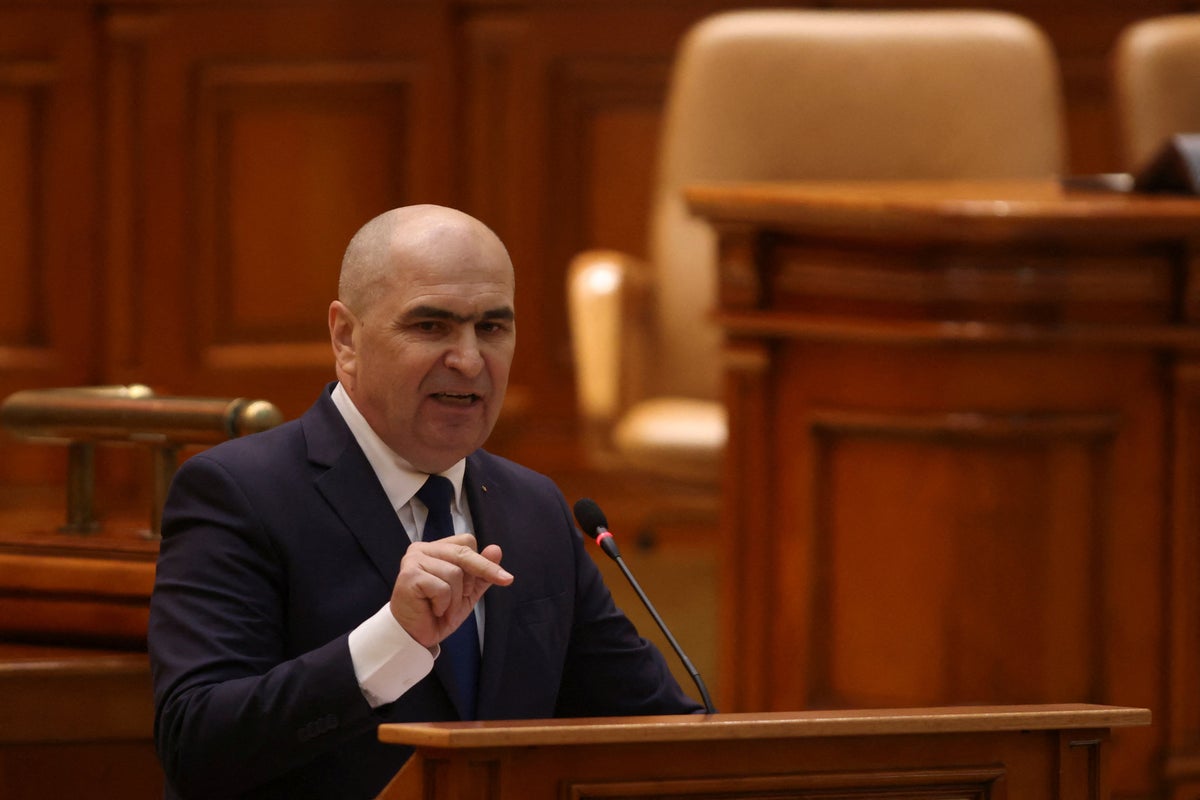
open image in gallery Although a snap election looks unlikely, financial markets are concerned that the turbulence could mean Bucharest wavers in its commitment to narrowing the European Union's biggest budget deficit ( Inquam Photos/Octav Ganea via REUTERS )
But the Social Democrats – without whom a pro-EU majority cannot be achieved – have repeatedly clashed with Bolojan as his austerity measures have hit their voters and patronage networks, while their popular support has bled away to the far right.
Nevertheless, opinion polls show Bolojan is the most popular politician in the ruling coalition.
'Do you have a plan?'
"Can anyone say how Romania will function from tomorrow, do you have a plan?" Bolojan asked lawmakers before the vote.
Romania's next parliamentary election is not due until 2028. It has never held an early election and analysts say the likelihood of one now is small as the opposition hard-right Alliance for Uniting Romanians (AUR) leads in opinion polls.
The Social Democrats (PSD) have often said they would rejoin a pro-EU coalition under a different premier. Bolojan's party leaders reiterated on Tuesday after the vote that they would no longer collaborate with PSD, even though some senior party members have pushed for reconciliation.
Junior coalition member Save Romania Union (USR) has also ruled out a new coalition with the PSD.
"There is life after the no-confidence vote," PSD leader Sorin Grindeanu told reporters. "We want to keep broadly this coalition."
A Romanian Liberal member of the European Parliament, Siegfried Muresan, called the alliance between the leftists and AUR in support of the no-confidence motion "anti-European".
"The formation of a new government will become their responsibility," he told Reuters.
Bolojan will stay on as interim premier with limited powers until a new government is approved by parliament.
Romania must continue to shrink its deficit as well as implement reforms in order to tap some 10 billion euros worth of EU recovery and resilience funds before an August cutoff date.