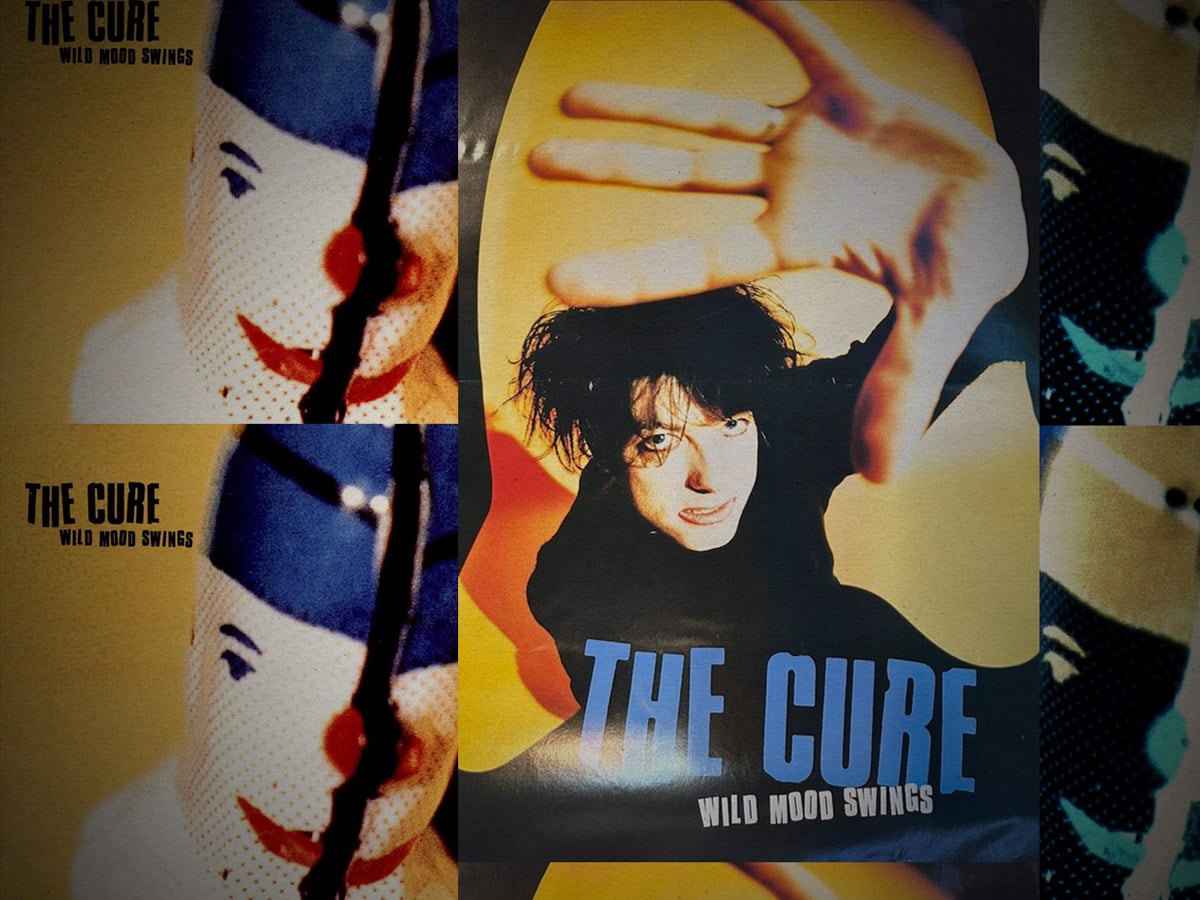
30 years of ‘Wild Mood Swings’: Exploring The Cure’s flawed gem of the 1990s
For the first time since their late 1970s debut, The Cure struck a creative and cultural wobble when dropping Wild Mood Swings 30 years ago.
The preceding 15 years must have surpassed all expectations. Landing in the punk and new underground with their ‘Killing an Arab’ single as teens, Robert Smith fronted and captained the eternally shifting hit factory with effortless dexterity, able to swerve The Cure into sharp stylistic U-turns from Pornography’s gothic pummel, ‘The Lovecats’ jazzy pop cheer, The Top’s piquant psychedelia, and Kiss Me Kiss Me Kiss Me’s sprawling romanticism, pulling the little Crawley band from Sussex to alternative MTV stars by the 1980s’ end.
They entered the 1990s at the peak of their powers, The Cure dropping their most successful album yet in 1992 with Wish, as well as making sonic sense with the day’s indie-jangle and shoegaze cohort with Wish’s shroud of reverb and effects textures, Smith reportedly listening to Chapterhouse’s ‘Mesmerise’ for aural guidance. There was also an unwitting marker for the band around this time. There’ll be little dispute among fans that the second single, ‘Friday I’m in Love’, stands as The Cure’s last bona fide gem and one last hurrah of their classic era, and longtime members Boris Williams and Porl Thompson called it quits, with David M Allen counting his last co-production credit after nearly ten years, all forming a chapter close.
“…we’d really done as much as we could,” Smith told journalist Paul Freeman at the time. “In some ways, in the back of my mind, I was slightly unsure as to what we could achieve, because we all knew each other so well. So the fact that it all kind of fell apart was a good thing. It was one of those haphazard, serendipitous things that worked in our favour.”
‘Disintegrating’ personnel and a studio step into the unknown added time to the sessions for Cure LP number ten. Split across the stately locales of Etchingham’s Haremer Hall and later OK Computer birthplace St Catherine’s Court in Bath, work began late 1994 and continued into 1996, embracing in earnest digital Cubase software, boldly bringing in live brass and string sections for the first time, and pushing the bandmembers to contribute further song ideas, “no matter how silly it was.” Such novel approaches rubbed off positively on The Cure, creating together and hanging out with no deadline in the spirit of the new chapter of the band’s evolution.
Credit: Album Cover
A lot was changing outside those manor house studios, however. Shoegaze’s introspective swirl and the alternative rock that beamed from the States that Smith was so comfortable in gave way to the United Kingdom’s cultural bloom partway through the decade, its Britpop musical expression rejecting the Seattle flannel and looking back to the swinging era 30 years earlier for Union Jacked guidance. Out went earnestness, sensitivity and esoteric influences; in came lad culture, a rock conservatism, and the Gallagher brothers’ gobby two-fingers emblematic of the Naughty Nineties’ irreverent cool.
Where would The Cure stand in this new zeitgeist? For the first time, Smith et al found themselves sidelined, a new generation of bands and their eager music press were suddenly struck them with the ‘old hat’ tag for the first time since their days as a teenage punk band. Such perceptions were fed by the arrival of Wild Mood Swings on May 6th, 1996, which met with a critically mixed reception that generally labelled The Cure’s LP return after four years as lacking the vitality they once possessed, bogged with a leaden lack of focus, in need of an edit, and looking tired next to the Britpop competition.
30 years on, Wild Mood Swings’ merits shine brighter through its flaws and blemishes. It’s true that the album’s too long, a hefty 14 tracks that start mushing together at the end with indiscernible and forgettable gloom, but had there been a zealous trimmer cutting the affair down to nine or so cuts, their tenth LP effort could have been a contender. Opener ‘Want’ achieves all the stirring drama the final clump of songs attempts to capture within its brooding intro alone, ‘This Is a Lie’ and ‘Jupiter Crash’ spell some of the dreamiest acoustic wanders in the band’s entire canon, and the bold ideas entering the studio are thrillingly realised on ‘Gone!’, a swaggering big band jazz thumper brimming with all the inventive creative crackle coursing through the studios amid their ‘up in the air, let’s try anything’ jump into the unexpected.
The loss of hip cache was met with wry humour. “Reviews really don’t bother us,” bassist Simon Gallup quipped to Circus. “We feel very much at home now that the British press hate us once again. We found it a bit disconcerting when we released Wish, and we were suddenly the British journalists’ favourite band.” The spotlight’s attention elsewhere didn’t instil any insecurities in Smith, harbouring a less-than-thrilled relationship with Britpop’s pining for yesteryear and happy to feel some ease from all the pressure that came with their mega stardom stature for the last decade or so.
Wild Mood Swings now stands as a curious entry in The Cure oeuvre as well as an odd document of the era, both scooping up its carefree spirit with the copious experimentation conjured while also misreading the room in its commitment to the record’s more ruminative skulks mined on ‘Treasure’ and ‘Bare’. Such a wobble served The Cure well, however. The Britpop party would soon grow stale and plod on limply with the hangover dregs like Travis and Coldplay, while Smith’s pop sidestep reenergised The Cure story with a new impetus, dropping 2000’s Bloodflowers and riding out the 1990s’ choppy waters as one of the world’s biggest bands once again into the 21st century.