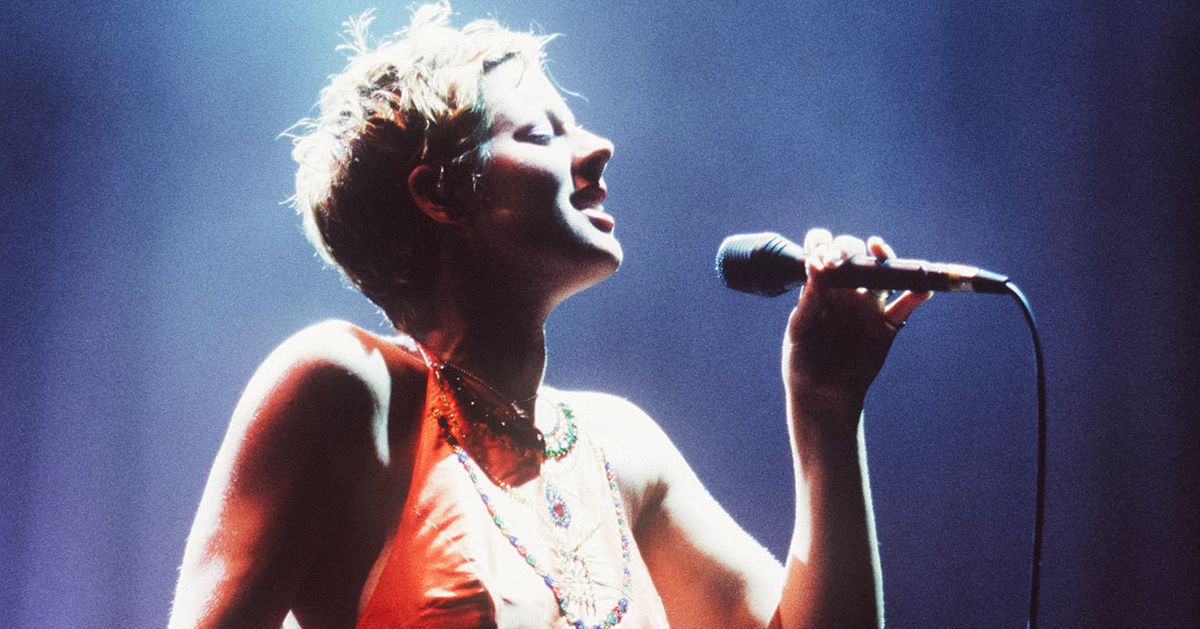
“I’m happy to be a part of it. I’m happy to offer any advice if I can if I’m asked. But the younger generation needs to carry it forward now.” Photo: Steve Granitz/WireImage
Lilith Fair was born out of a desire that came from being in a weird, lonely job. Sarah McLachlan, having an epiphany about how poorly female musicians were treated in the 1990s, took it upon herself to create a festival where they could share the same stage together and prove their collective power in the industry — with a bonus being that “a lot of us have truck-driver mouths, and we’re able to have a really good time without pretense or preciousness or hierarchy.” The traveling music festival had three successful iterations in 1997, 1998, and 1999, and its history and legacy is documented in Hulu’s Emmy-eligible film, Lilith Fair: Building a Mystery. (McLachlan is joined by a dream blunt rotation of feminists including Sheryl Crow, the Indigo Girls, Bonnie Raitt, and Olivia Rodrigo.) But an attempt to recapture that magic by reviving the festival in 2010 was a failure, which McLachlan believes is enough evidence to prove it would be a relic of a bygone era if it were attempted in 2026.
“I think it would be very threatening to a large demographic,” she says. “It would be very enticing to a large demographic too, but it’s an incredibly polarizing world right now. One could argue that’s all the more reason to do it, but that wasn’t the reason to do it in the first place.” If Lilith Fair somehow returned from its mythological grave, McLachlan is emphatic that a new torchbearer would have to do the work to make it happen. But will anyone take her up on the challenge?
You’ve spoken about feeling lonely as a woman in the music industry in the ’90s. What were your attempts to find connection and community prior to creating Lilith Fair?
We were constantly pitched against each other as women in our jobs. When we went to radio stations, they would always say, “Well, we really love your song, but we can’t add you this week because we added Jewel or Tracy Chapman or Tori Amos.” Why is there just one slot allotted this week for these artists who are women and making different kinds of music? It never made sense to me. But also, I rarely got the opportunity to talk to any other female artists because I was on the road all the time.
When you’re touring, you’re never in the same city at the same time because you’re typically playing the same type of venues. So there was very little overlap and opportunity to spend time with other women who were doing my job, other than when I had women opening up for me, which I consistently did once I was actually able to warrant an opening act. I remember being at the Junos, which is our Canadian Grammys, and seeing a bunch of artists that I respected and hadn’t met before and got a moment with. I was like, Oh, I want more of this.
The four test shows you all did in 1996 were smash hits, but you still had to convince the appropriate parties that it wasn’t a regional success and business could be set up for it. There was even a derisive term, “pussy package,” about several women sharing the same bill. What was the fight like to make your dream a reality?
My business partners at the time were the ones making all the phone calls, getting told “no,” and getting the suggestions that it was just a regional success. The reason we went with those four markets was because we had great promoter relationships there, and those promoters believed it was a possibility. But also to try to scale it for people who didn’t necessarily know us as well or simply had these general biases against the possibility of it. It all comes down to money, right? They’re like, “You have this unproven thing.” It’s like, well, no, we just proved it in four markets, which are diverse and in different parts of the country, so it’s obviously viable.
Those business partners were doing that hard piece of convincing managers, agents, and promoters to take the risk — and the promoters finally agreed. But they were all very much like, “You’re taking all the risk.” It’s insane we agreed to those terms, but we believed in it. It was like, Well, this is young and dumb. Fake it until you make it. How can this fail? We just believed in it, holy, and that was enough to see it through.
You couldn’t get a water sponsorship for the first festival because the companies only targeted men.
That was the general sentiment back then. The world was marketing toward men. It speaks to the general consensus of women as second-class citizens or women in no positions of power. It’s like, Women don’t drink water?! In hindsight, it’s ridiculous. It was wild watching the documentary, because I tend to glaze over a lot of the more negative aspects of things and remember the happier stuff. I definitely had a little bit of PTSD watching this going, God, right. I forgot about the bomb threat.
What were other unexpectedly stupid moments of sexism you encountered during that inaugural year?
The most prevalent attitude and statement that I heard over and over and over — and this was mostly from male radio disc jockeys who had a big presence at the press conferences — was when they asked me the question, “Why do you hate men?” And I was like, “What? What does celebrating women have to do with hating men?” I was so young. I was brought up to not have an opinion and keep your opinions to yourself — be a good girl, be kind, be polite, and don’t make any waves.
I had no media training at all and no witty, quick comebacks. I was so baffled by this. I was like, How do I even answer a question that doesn’t even deserve an answer? Well, honey, that says way more about you and your ego than anything else. I would have lots of quippy comebacks now. But yeah, that attitude was so strange to me — that men felt so threatened because we were all banding together, sharing a stage, and celebrating each other and our successes. It was pure joy and positivity, and it was just baffling that there was so much resentment, anger, and vitriol.
There’s a brief moment in the documentary where you’re admiring a photo of Medusa and say, “She’s a nice reminder to me.” I’m curious, especially with your love of mythological figures like Lilith, how she was a grounding figure for you.
That was reclamation. That was my nickname in junior and high school. It was derogatory. I had long, curly hair, and maybe I didn’t wash it enough; I don’t know what the reason was. I got called Medusa, and the boys would walk down the hall, see me, make a big scene, and say they were turning to stone and fall to the ground. I refused to let it define me, but at the same time, it was really hurtful, and it got me down. So as an adult, I realized I could reclaim her and use her power — not to turn men to stone, but it was a nice reminder to not take what people say and allow it in. Don’t allow it to taint your sense of self or your direction or your passion or your purpose. So she was kind of my little quiet mentor along the way.
Could there have been a parallel universe where you called it Medusa Fair?
I did bring her name up in conversations. But when one of my dearest, oldest friends mentioned Lilith to me and I admitted I had no idea who she was, she was like, “Oh, do I have a story for you.” And I was like, “Well, that’s perfect; how can we not use Lilith?” What an incredible archetype of feminine power.
You converted Sandra Bernhard and Chrissie Hynde into seeing Lilith Fair’s vision after they expressed criticism, and they went on to perform at the festival and admit they were wrong. Were there other critical artists you tried to sway but weren’t as successful?
I’m sure there were, but I would have a hard time remembering now. Truthfully, I didn’t read a ton of the press because I was too busy. I was wearing ten hats and felt like I was holding onto the tail of a deranged animal: What calamity is going to happen today? Who’s not going to show up? The few I did read, especially the scathing ones, I was like, Did you come to the same show I was at? Because that’s not how I felt.
There were even some scathing articles written about the festival by female journalists. That really hurt me, because I’m like, Hey, we’re supposed to be supporting each other. When you’re the only woman in a room full of men, you’re there trying to forge your path, but also trying to survive in that world. There’s a fine line you have to walk to stay in that club, to be part of that world. So for both female artists and journalists, I was like, “You just have to come. If you come and see it, if you feel what’s happening, you’ll forget about all that outside noise. You will feel the connection. You will feel the power of this matriarchy that has been created. We all want and crave this sisterhood.” There’s a ton of power in that. Chrissie in particular walked in and went, “This is a bunch of delicate little flowers, they’re in long petal skirts, and what the hell am I doing here?” But hanging out with us backstage, she realized we’re real people.
I laughed when you flashed Chrissie onstage and she fell to her knees in hysterics. That woman doesn’t break for anything.
I felt such pride in that. She was a tough nut to crack, but I cracked her.
Emmylou Harris talked you out of including men on the lineup when you began to consider it. Can you tell me more about the conversation you two had and how she managed to recenter you when you started to doubt yourself?
I have to admit that I was never seriously considering it. I was saying these things out loud because I was under so much pressure every day, mostly at the press conferences. I would always be asked, “Why don’t you include men?” So one time I just felt like responding, “We’re now considering including men.” After that particular press conference, Emmylou took me aside and very firmly and calmly said, “You cannot do that. What you’re creating here is in its infancy. It’s so beautiful. Stay the course.” And I said, “You’re right. I don’t even know what I was thinking. I’m just under so much pressure to do it.” I needed the voice of someone who’s gone through so much more than I had, in an even harsher time, who had so much wisdom. I needed that little reminder.
Besides that, what would you consider to be your most significant “this is my festival and I’ll do what I want” moment?
It was about tabling and pro-life people. Those folks wanted to come in and table. They said, “Well, you’re supposed to be inclusive of all things female. Why don’t you have us represented?” I didn’t know how to handle that. So my three partners were like, “Tables got assigned four months ago. There’s no more space. You have to show up early to the party to even get in.” But they kept pushing so hard.
That was the other thing — you’re either too feminist or not feminist enough depending on who you’re talking to, and trying to understand how to best defend that. One of the most important things I learned from it is you can’t be everything for everybody. You just have to stay true to your own belief system and also know your beliefs can shift a little bit once you become more educated on things. I’m firmly pro-choice. Again, I look back at listening to my mother tell me, “Don’t have an opinion. Don’t say anything that’s going to cause any trouble.” But I thought to myself, This is kind of the hill I’m going to die on. Those people aren’t welcome here. It was the first time I really felt that way. It was a powerful moment of feeling like I’m allowed to take a stand and speak publicly about what I believe in. I might get flak for it, but I’m still going to do it.
There’s archival footage of Sinéad O’Connor talking about her Lilith Fair experience and one quote stood out to me: “It just happens that they’re all women artists and nobody’s really making a big statement.” It’s so her — sharp and succinct. Do you agree that there wasn’t actually a big statement being made?
I do. I thought it was a very quiet statement that we didn’t need to scream from the top of the hills. It wasn’t about “We are women, hear us roar.” It was more about, We’re all women doing this crazy job. How amazing is it that we can support each other and champion each other in this situation without being overtly banging on a book saying, “This is how we hate men”? I’m not being very articulate, but it’s an apt statement and very true.
Was there a defining moment when you felt the festival took on a life of its own and you fully understand the magnitude of it?
When we got on the cover of Time. That’s aging me, but that was sort of a “Holy shit, we’ve arrived” moment. Then a bunch of music magazines covered us. I had never been on the cover of any magazine before, and all of a sudden there was this huge media buzz about us. The very first time we did a gig, we sold out to 16,000 people. That was also the moment when I realized we had something special. Listen, I didn’t know what it would become. I wasn’t trying to create a movement. I see a movement like that now with Brandi Carlile championing young female artists and Taylor Swift having women open up for her.
I’m not saying it’s because of us, but you see more and more women choosing to celebrate each other as opposed to back then when we were essentially in competition with each other. I mean, we’re all in competition with each other, but it was for a very, very, very narrow slice of the pie. Though we still have a long way to go in a lot of industries, I think the music industry has opened up because women now have so much power. You look at Beyoncé and Taylor Swift as two prime examples of epic success. The power that they wield and the way they choose to wield it is incredible.
McLachlan performing at Lilith Fair one year apart. From left: Photo: Bob Berg/Getty Images Photo: Ebet Roberts/Redferns McLachlan performing at Lilith Fair one year apart. From left: Photo: Bob Berg/Getty Images Photo: Ebet Roberts/Redferns
Sheryl Crow and Jewel performed at Woodstock ’99 during Lilith Fair’s third year, which was pretty much the antithesis of everything your festival stood for. Was there a sense of disappointment, or even betrayal, that they chose to participate in both festivals?
Not at all, because how would you possibly know that was what it was going to become? As an artist, to not do a festival as huge as Woodstock would seem like a massive misstep if you had the opportunity to play it. I don’t think any of us had any idea how negative an environment it would be until after the fact. It goes to show you: What are the intentions?
I’m not judging the folks who put Woodstock ’99 on. I’m just saying there were a lot of things that went very wrong. There were also a lot of really aggressive, disenfranchised sentiments with young white men at the time. I’m sure social analysts would have a much better time explaining it all, but yeah, it was kind of a perfect storm, and we were the antithesis to that. So the juxtaposition became even more noticeable.
You brought Lilith Fair back in 2010, but it didn’t succeed. You offered the theory that it didn’t embody the world existing during that time. If you were to revive it in 2026, what reception do you think it would get?
Imagine the war against us. We thought we had it bad back then. I know full well I would have a significant bullseye on my back. Really, look at the climate we’re living in. Everything is now a political statement, and it was a bit of a perfect storm back in 2010, too. Ticket prices were through the roof. It was just after the crash of 2008, so people were holding on to their money. Many of my fans were now married with kids with a mortgage and jobs and not quite as excited to go sit in a hot field all day when they could barely arrange child care.
My motives weren’t any different, but that wasn’t the same for my three business partners. There wasn’t enough due diligence done in how the market and our audiences had changed. It felt a little disingenuous to me, but I didn’t come to that realization until way too far down the road. Live Nation told us in March, “You cannot do this. Pull the plug.” But I wasn’t made aware of that conversation, so it was very unfortunate that I wasn’t included. I wasn’t aware that we were losing our shirts until we got out there and lost our shirts.
Wait, how were you not included in those conversations?
My business partners excluded me.
Was that a relationship ender for you?
It was part of it.
I like to think that someone like Olivia Rodrigo, who appears in the documentary and discusses Lilith Fair’s influence on her, could be a torchbearer for a future revival.
You’re absolutely right. That’s my thing: It needs to be someone of today, someone who’s relevant and coming up in the world, to champion something like this. I’m happy to be a part of it. I’m happy to offer any advice if I can if I’m asked. But the younger generation needs to carry it forward now.
I recently had a conversation with Liz Phair, Carrie Brownstein, and Corin Tucker about their upcoming joint tour, and they all arrived at a similar thought for the motivation behind it: There are fewer and fewer female musicians of their era who are, simply, still around and performing. It’s a lot easier to stop. What has kept you going?
I love music. I love playing live. I feel like it’s a huge part of why I was put on this earth. I get to live my purpose every night when I’m onstage. There’s a communion that happens in this reclamation of self and a beautiful energy that’s shared. It’s like a church. It’s a spiritual thing for me to get up in front of an audience with my band, bare my soul, and play these songs that I put my blood, sweat, and tears into. It’s being part of something bigger than myself. Music is such a beautiful bridge, and we need opportunities to connect on a really human level.
I’m touring in America in a few months. Some of my friends are like, “What are you going to America for?” I get it. But my job as a musician is to keep lines of communication open and remind people of our shared humanity. It sounds egotistical, but I feel like that’s a role musicians have. If I can make a Republican and a Democrat sit in the same room together and find some shared commonality where they’re not sitting in different corners raging at each other, then there are ways forward.
Dare I say there are millions of Democrats and Republicans who have cried to your ASPCA commercial?
What can I say — I’m creating opportunities where we can find ways to be human together.
Related