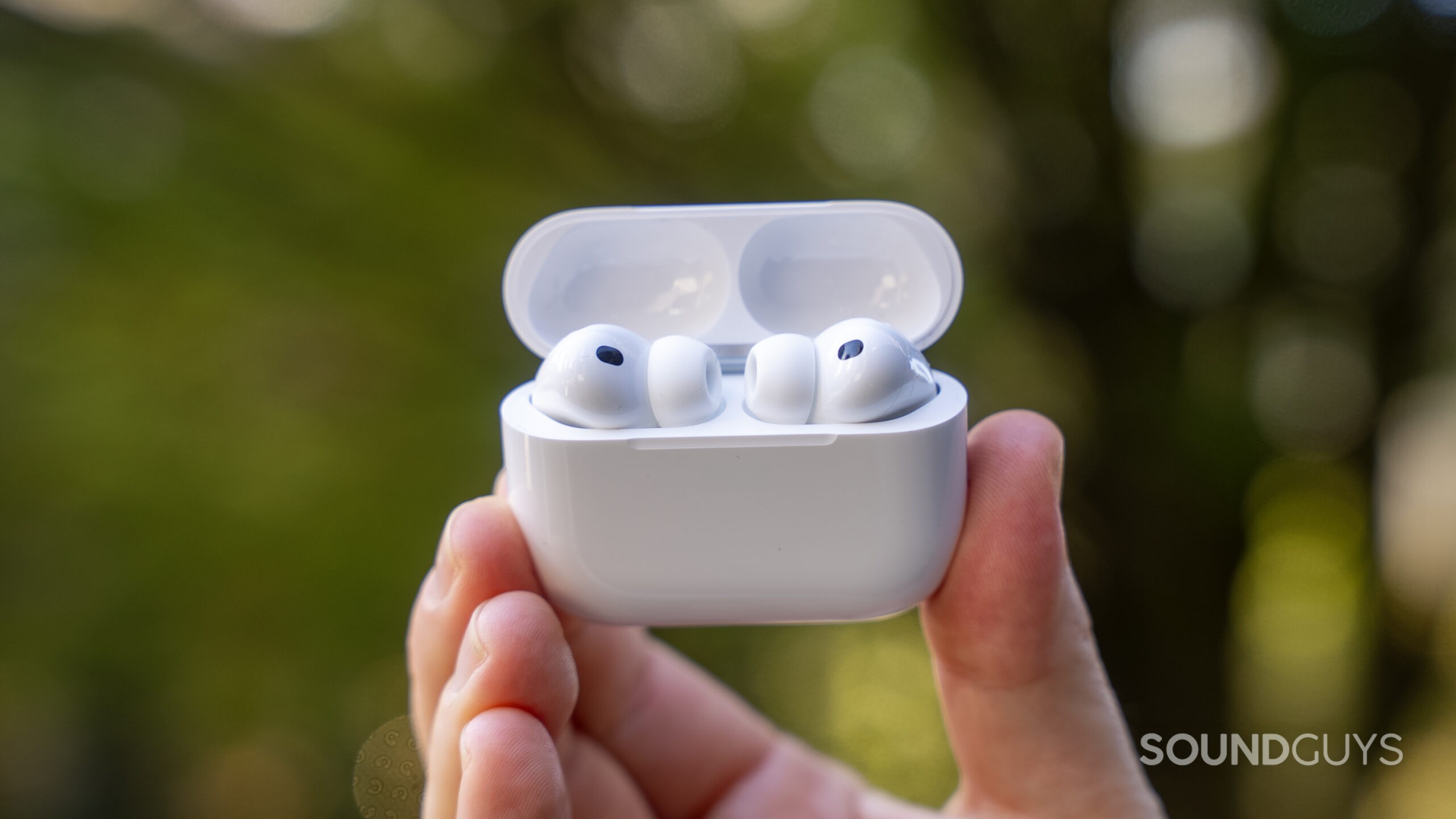
Harley Maranan / SoundGuys
According to a Bloomberg report, Apple’s camera-equipped AirPods are in the final stages of development and nearing mass production. The earbuds will look mostly like AirPods Pro 3, just with slightly longer stems to house cameras in both the left and right buds. Those cameras feed visual data to Siri so it can answer questions about whatever you’re looking at.
Apple calls this visual intelligence, but in reality, it’s a camera that goes everywhere AirPods go, which, if you’ve ever owned a pair, is basically everywhere.
Do you want cameras in your AirPods? 240 votes Yes, the AI features are exciting 6 % No, I don't want cameras in my ears 89 % I'm not sure yet 5 %
A light nobody will see
The Apple AirPods Pro charging case has a single LED indicator.
To Apple’s credit, the company thought about privacy. The new AirPods will feature a small LED indicator that lights up when visual data is being sent to the cloud. It’s a nod to the same principle behind the MacBook’s green camera light: a simple, legible signal that something is watching.
There’s just one problem: these are earbuds. The LED is going to be tiny; it’s on a device sitting inside someone’s ear canal, and most people wouldn’t know to look for it even if they did. Meta faced enormous criticism over the privacy implications of its Ray-Ban smart glasses, a product where the cameras are at least visible if you know what you’re looking at. AirPods are small, ubiquitous, and worn by hundreds of millions of people who’ve spent a decade treating them as invisible. A blinking light smaller than the head of a pin is doing a lot of heavy lifting here.
Unlike Meta glasses, nobody looks twice at AirPods — and that's the problem.
I’m not knocking on Apple specifically, because this is a structural problem with ambient AI cameras in general, and one that a single LED certainly isn’t going to solve with earbuds. Meta glasses at least look like something. They’re a distinct piece of hardware. People have learned to recognize them as a recording device. AirPods are socially invisible. After a decade of normalization, nobody looks twice at them. That makes them a significantly more problematic vector for this kind of behavior. So what is Siri actually going to see?
Chase Bernath / SoundGuys Do you want Siri to always be listening and seeing while wearing AirPods?
Apple’s stated use cases are sensible enough. Point your ears at a fridge full of ingredients and ask what to make for dinner. Use landmarks to get more intuitive directions. Get reminded about something based on what the camera picks up. These are all useful ideas in theory, and, to be fair, ambient camera AI could be genuinely helpful for people with visual impairments.
But AirPods go everywhere. They go to the gym, to the office, to the doctor’s office, to your bedroom, and to the bathroom (don’t lie, I know you wear your earbuds in there). Every space you’ve ever worn headphones in is now a space with a camera in it. Apple’s visual intelligence features may be pointed at your groceries, but the camera doesn’t take the day off when you’re not actively querying it.
Every space you've ever worn AirPods in is now a space with a camera in it
The company says the cameras capture low-resolution imagery and aren’t designed to take photos or video. Still, the hardware limits are a moving target, and the history of Apple’s software restrictions being worked around — through jailbreaks, API exploits, or third-party apps — is long. The camera exists on the device, and I wouldn’t be surprised if someone finds a way to use it to record photos and videos.
There’s also a less dramatic but equally real concern: even when the cameras work exactly as intended, every visual query presumably creates a data trail on Apple’s servers. What you looked at, when, and where, all correlated with Apple’s existing location data. The threat model for camera AirPods isn’t just one bad actor with a gadget. It’s what happens to that data at scale, who has access to it, and what a breach would look like. It was always going to be Apple
Razer already put cameras into a pair of concept headphones.
Camera-equipped audio wearables aren’t a new idea, just a niche one. Earlier this year, I went hands-on with Razer’s Project Motoko, an over-ear headset with dual first-person cameras built into the earcups, designed to work with ChatGPT, Gemini, and other AI platforms. It was convincing as a concept. It was also very clearly a product for early adopters willing to strap something that looks like a gaming headset to their head all day.
As with anything Apple does, every other company is going to follow.
As with anything Apple does, every other company is going to follow. Camera-equipped AirPods mean camera-equipped headphones and audio devices are soon to be the new norm. Incoming CEO John Ternus has been telling employees they’re about to “change the world again.” Maybe. But the iPhone solved obvious, painful friction in people’s lives. Camera AirPods solve — what, exactly? The inconvenience of having to hold your phone up to ask ChatGPT something?
So far, this looks like a solution in search of a problem — one that I think may end up causing more social and privacy problems than it solves.
You might like
Follow