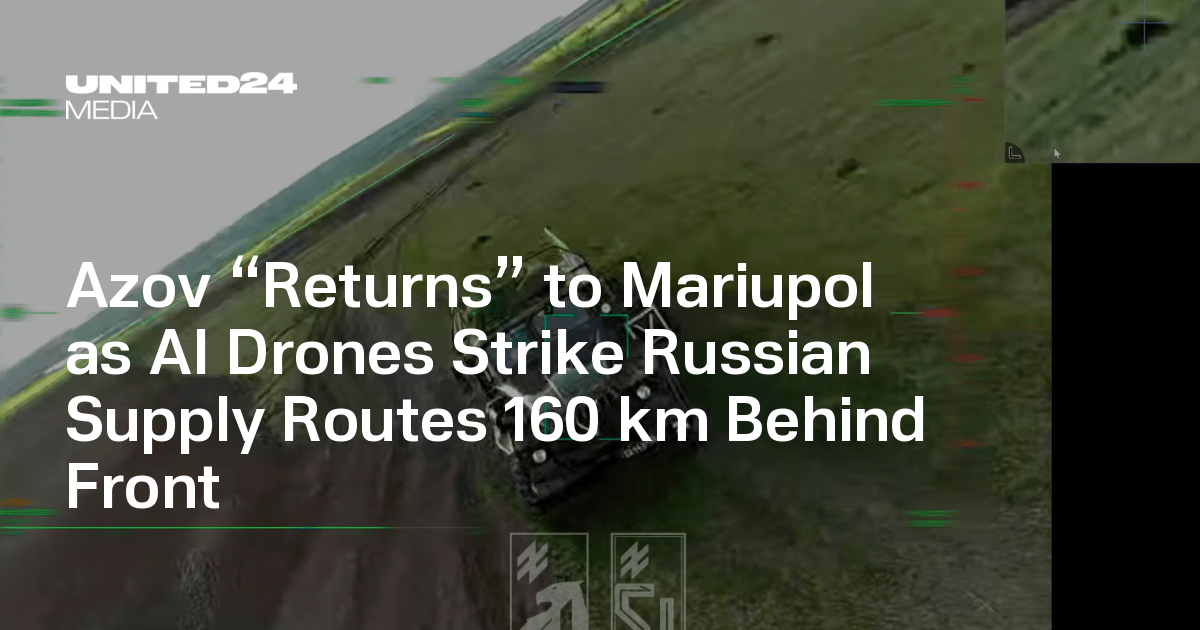
Ukraine’s 1st Corps of the National Guard “Azov” says it has expanded its deep-strike drone operations against Russian military logistics, targeting supply routes leading toward occupied Mariupol with AI-assisted suicide drones, according to a press release shared with UNITED24 Media.
The newly released footage marks the third installment published that documents what Azov describes as a sustained drone presence deep behind Russian lines.
We bring you stories from the ground. Your support keeps our team in the field. DONATE NOW
After previously targeting logistics hubs around Donetsk, Ukrainian drone operators are now focusing on roads and transport corridors connected to Mariupol.
“Azov has returned to Mariupol. For now—through a reconnaissance-strike system,” the corps said in a statement accompanying the videos.
Azov returns to Mariupol. For now, through reconnaissance-strike systems.
Pilots of First Corps Azov of the National Guard of Ukraine patrol roads up to 160 km deep behind the line of contact.
In the cameras of reconnaissance-strike drones: Mariupol and enemy military targets.… pic.twitter.com/9QcTBiZr6I — First Corps Azov of the National Guard of Ukraine (@azov_media) May 8, 2026
According to Azov, drone crews are now patrolling roads at distances reaching up to 160 kilometers from the line of contact. The footage shows repeated strikes against Russian military trucks, fuel tankers, and vehicles reportedly transporting ammunition and personnel.
The unit says Russian air defenses have so far struggled to intercept the drones, despite operators maintaining visual contact with targets during attacks. In many cases, Russian drivers allegedly abandoned vehicles after identifying the incoming threat.
Azov also emphasized that the drones’ high-resolution video systems allow operators to distinguish military targets from civilian traffic, reducing the risk of accidental strikes.
The final segment of the released footage featured a drone flight over the territory of the Azovstal Iron and Steel Works, once the site of one of the most intense battles of the Russian siege of Mariupol in 2022.
“Azov has returned to its native city and controls it from the sky, methodically destroying enemy logistics deep in the rear,” the corps stated. “There are no longer safe routes for the occupiers.”
Previously, reports emerged that Azov was using Hornet suicide drones equipped with elements of artificial intelligence to target Russian logistics around Donetsk. The same drone interface visible in those earlier videos can reportedly also be seen in the newly released Mariupol footage.
The Hornet is a fixed-wing loitering munition developed by the US company Perennial Autonomy, owned by former Google CEO Eric Schmidt.
The drone is designed for long-range strikes against military equipment and troop concentrations. Its exact range remains undisclosed, though estimates place it at more than 100 kilometers.
The system reportedly uses AI-assisted targeting and Starlink satellite terminals to maintain stable communications during operations in contested electronic warfare environments.
Earlier, at least two large fixed-wing drones attacked targets in Grozny, the capital of Chechnya.
One of the drones reportedly struck a Russian military base in the Khankala district on the outskirts of Grozny, where the headquarters of Russia’s 42nd Guards Motor Rifle Division is located.
Discuss this article: PERPLEXITY CHATGPT CLAUDE