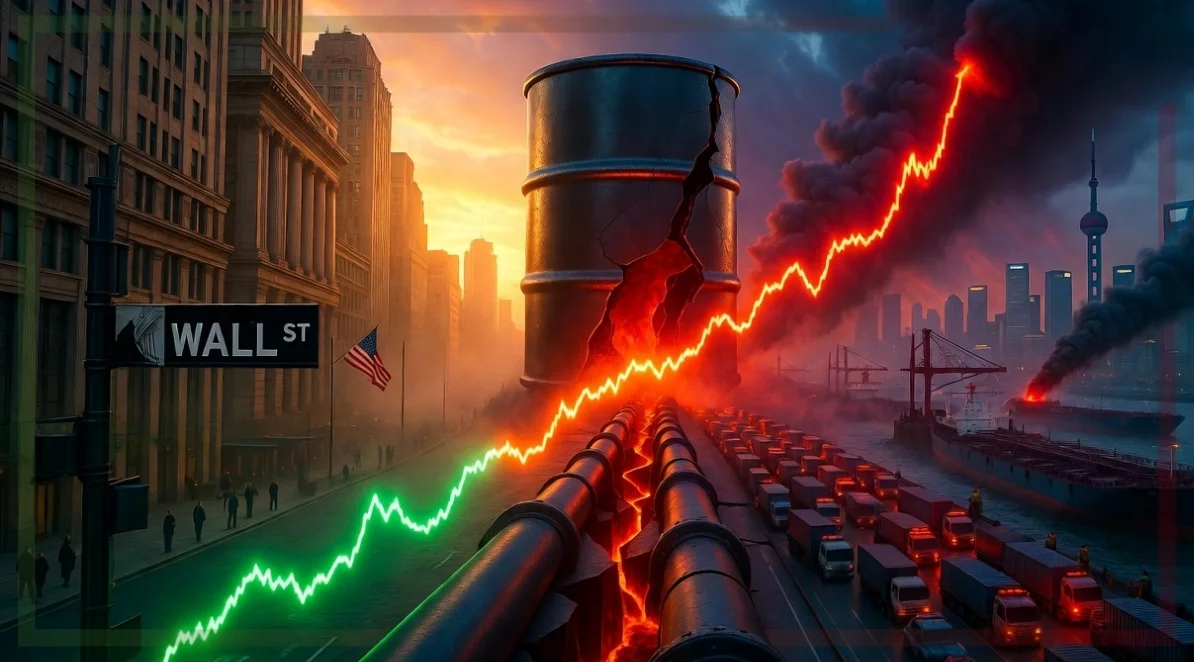
The oil market is sending two completely different signals. Oil futures suggest stability, but physical barrels and refined products are already trading at crisis levels. This growing disconnect is fueling serious concerns that widespread oil futures complacency could be risking global supply chains and credit markets and potentially setting up the next major supply shock.
Goldman Sachs recently warned of a disconnect in the oil markets, offering potential scenarios of what the rest of 2026 could look like, not just for the crude market, but refined products, such as jet fuel and petrochemicals. The potential paths the rest of 2026 might take range from a mere economic hiccup to catastrophe.
On March 20th, the International Energy Agency (IEA) released a report, stating that the conflict in the Persian Gulf “has created the largest supply disruption in the history of the global oil market.”
Despite this grave assessment, the oil futures market has remained fairly optimistic over the past few months. Prices have gone up, but not in unprecedented ways. Meanwhile, physical spot prices have risen considerably more, creating a divergence with the futures market that has reached historical proportions.
How the Trump NACHO Trade Is Creating an Illusion of Oil Market Stability
Thus far, the Trump Administration has been effective in quelling investors’ fears of a prolonged disruption of oil flow through the Strait of Hormuz, which Wall Street traders have elegized as NACHO (“Not A Chance Hormuz Opens”). However, the US military’s “little excursion” in Iran has extended into May, and the future market outlook for oil prices in 2026 has become harder to rationalize.
In an April 26 note, Goldman Sachs commodity analyst Daan Struyven raised the firm’s forecast for late-2026 oil prices, increasing Brent crude to $90 per barrel and West Texas Intermediate to $83. Goldman has also reported multi-year lows in oil inventory across the world.
Despite these lows, overall crude supply is still relatively strong. However, much of the world’s inventory is not tradable due to refining bottlenecks and geopolitical limitations. Given this reality, shortages are already being felt in specific products, including jet fuel, naphtha used in petrochemicals, and liquefied petroleum gas essential for plastics and chemical production.
Peter Zeihan, a geopolitical strategist, described the implications last week on his YouTube channel:
“We’re looking at a shattering of global petrochemical supply chains outside North America, because most of the world is still designed to turn oil into naphtha and that oil simply isn’t available at the right price anymore.”
A Split Market: Paper vs. Physical
A sharp divide has opened between financial oil markets and real-world supply conditions. Futures prices for Brent crude currently hover around $100–$102, while physical sales—actual barrels delivered—have surged to $138–$140, particularly for diesel in Asia, which reached 141.30 on Wednesday.
Each respective market is influenced by different inputs. Physical markets’ pricing reflects immediate constraints: rerouted shipments, stranded tankers, and longer transport routes around Africa. The Asian market, which depends heavily on oil coming out of the Strait of Hormuz, has borne the brunt of these constraints.
Meanwhile, futures markets rise and fall based on a different host of speculative factors, including President Trump’s often contradictory late-night posts on Truth Social, which seem purely for market manipulation, rather than anything approaching an accurate assessment of the situation.
Trumpworld insiders are making hundreds of millions on every announcement, with a $1.7 billion short on oil placed one hour before Wednesday’s bombshell report in Axios, after which crude plunged 7%.
Why the Oil Market Disconnect Exists and What It Signals
Several factors are driving this gap between the futures market and spot trading.
First, investors may be overly optimistic about the positive effects born from the release of oil from strategic reserves. While it was announced in March that the US would loan up to 172 million barrels of oil from its Strategic Petroleum Reserve (SPR) to producers, the influx of SPR oil to the market hasn’t lowered spot prices in a substantial way. The world consumes on average 103 million barrels of oil a day, meaning the US’s SPR barrels committed for release would not power the world for two full days.
Second, algorithmic trading, increasingly influenced by prediction markets, also plays a major role in futures markets. Algos often prioritize statistical models and technical signals over fundamentals and physical supply signals.
Third, futures traders have been quick to optimistically embrace political announcements, no matter how vague or uncorroborated, as signs of imminent de-escalation, even when missiles are still being fired. Moreover, futures pricing suggests an expectation that the supply chain will return to conditions before the war began, which does not reflect realities on the ground or in the water.
As Zeihan notes, “The United States has a structural advantage because it uses natural gas instead of oil for petrochemicals while Europe and Asia can’t easily switch without rebuilding their infrastructure.”
Fourth, there has also been a miscalculation about the ability of U.S. producers to offset major disruptions going forward. Given the tightening of the world supply, Bob McNally, of Rapidan Energy Group, believes global energy hoarding will now become the norm, which will keep oil prices elevated.
The Looming Inflation Threat from Diverging Oil Markets
Analysts increasingly describe the futures market disconnect from what’s happening on the ground as a “broken” market, in which prices fail to reflect the severity of underlying supply issues. That being so, many analysts expect futures prices to eventually rise and converge with higher physical market levels.
If that correction occurs, the consequences could extend beyond energy markets, potentially triggering renewed inflation, as higher fuel costs ripple through global supply chains. Even without a significant move in the futures market, inflation could very well rear its ugly head anyway, given the already stressed petrochemical sector in Asia, the region responsible for over 50% of the world’s manufacturing.
Meanwhile, the specter of an economic recession is also present. The Asian economy is expected to see tepid growth in 2026 due to oil stress. A decrease in travel and flight cancellations is expected in the United States for the summer. Even before the Iran war began, prominent voices were predicting the possibility of stagflation in 2026. Now, it is that much more likely.
When Will Reality Hit the Oil Futures Market
Some analysts predict that physical spot trading and oil futures are both set to get substantially more expensive. The thinking goes that the rosy predictions of the futures market are incorrect. But, because futures market pricing currently suggests way lower prices in the near future, it has had the ancillary effect of suppressing current spot prices.
This happens because of both supply and demand. In the case of demand, it behooves buyers of oil, if they can wait, to buy oil once it’s cheaper. Conversely, it behooves oil producers to sell now while the price is high. These two forces, pushing and pulling against one another, work to keep the spot price low. But when true scarcity kicks in, which it could this summer, both the futures and the spot market will skyrocket.
If and when that happens depends on whether there is a lasting peace in Iran and how bad the infrastructure in the Persian Gulf has been damaged. For the time being, it seems the futures market and physical spot prices will remain divergent.
At some point, the market will have to choose between the story it’s pricing and the reality it can no longer ignore.
Author: Tim Tolka, Senior Reporter
#Crypto #Blockchain #DigitalAssets #DeFi
The editorial team at #DisruptionBanking has taken all precautions to ensure that no persons or organizations have been adversely affected or offered any sort of financial advice in this article. This article is most definitely not financial advice.
See Also:
This Oil Company Is The Biggest Winner of The War in Iran | Disruption Banking
While Oil Hits $100, Satellites Just Found a New Climate Disaster in the Gulf | Disruption Banking