“When you sign a piece of paper or their iPad for them, that is a contract. Heads up. Don’t ever sign anything that a driver hands you during the course of your initial agreement, that is extending the contract.” - Reddit commenter on Cintas and Unifirst
Last month, a company called Cintas purchased its main rival Unifirst, in a $5.5 billion deal. Unless you’re a small business owner or work in corporate procurement, you probably don’t know these companies. But though you haven’t heard of them, you’ve almost certainly seen their products, or even worn them. They rent uniforms and facility supplies to 1.5 million businesses, from bakeries to hotels to medical labs. So if you encounter someone wearing a work uniform, or you wear one yourself, well, that’s likely Cintas or Unifirst.
Most business and political reporting focuses on dramatic changes like the war in Iran, or speculative questions around artificial intelligence. But as we look at the American economy, it is deals like Cintas-Unifirst, and the companies and contracts they involve, that structure the experience most of us have. And there are a few reasons why this deal matters, from that perspective.
First, it affects millions of people in an understated but profound way. Clothing is immensely personal, even uniforms we are forced to wear for work. The itchiness, the comfort, the smell or just basic tackiness, it stays with us. Reddit is full of employees and employers talking about how the Cintas and Unifirst clothes they received didn’t fit, weren’t laundered, or otherwise caused problems. And they are mad in a way that other parts of work don’t as much affect them.
Indeed, one of the all-time greatest movies about the corporate workplace, Office Space, has an entire subplot about a waitress at an Applebee’s style restaurant, played by Jennifer Aniston, who is constantly harassed by her manager because she’s not enthusiastic enough about her outfit. The corporate uniform is a statement of values, or control.
Employers understand this dynamic. No one cares about the color of your dumpster, but if your supplier can’t get your people the Carhartt workwear they love, or if an employee is allergic to a chemical used in cleaning a uniform, it can be a problem. But it goes far beyond employee preference. Clothing is also a critical industrial input. When a firm needs a flame resistant uniform for people working electrical boxes, or no buttons or pockets for a food service company, that’s what they have to find.
Another reason Cintas-Unifirst is worth understanding is because it’s one of those “strategic mergers” that Wall Street absolutely loves. And these are happening all over the place, maybe with one story in the Wall Street Journal, if that, and no analysis of what it will mean for anyone but investors. Just look at how ebullient Jim Cramer was on CNBC, a sort of bat signal for market power, when it was announced. Cintas, he said, is “one of his favorite” companies buying its “competitor” Unifirst.
“Under the Biden administration, the chance of this deal going through was slim to none. Under this administration, if a merger flew in the window they’d sign it. I think that this is one where it’s going to be a really fundamental company that is in this industry that will dominate millions of customers. It’s a fantastic deal.”
These words should raise eyebrows.
The companies have $11 billion and $3 billion of annual revenue, respectively, so it’s not tiny. There are also quiet politics here; Cintas is owned by a Cincinnati billionaire family with ties to Trump.
A final reason to look at the deal is because facility supply and uniform rental looks like a classic economic termite, too small to notice for most businesses until they are trapped. And it’s exactly where financiers grab leverage, and squeeze. It’s interesting because it looks like coercive contracts and shoddy service are fundamentally baked into the business model. It is unusual to have a company with this many angry people complaining about companies on Reddit. And my industry sources tell me that this stuff is common.
#1: “They are absolute monsters. We are being sued by them for an extremely large sum of money because we canceled their garbage fraudulent contract. We sent cancellation notices warned them three times that we weren’t happy with their service and they have spent an incredible amount of energy in time to try and collect this money we don’t have. Criminal.“ #2: Noticed our cintas bill was getting more expensive each week even though we weren’t changing our order. Dove deeper and noticed there were all sorts of “new” loss charges being added. They said it’s industry standard to add 10% of the number of each item, each week, as “loss” at the ‘market price’ of replacing the item. I pushed back that it was never mentioned upon sign up, and was definitely not noted in our contract. They sent us our signed contract, and yes, the only ones they had told us about were loss charges for the black aprons. None for towels, microfibers etc. They have admitted their error. They refunded me the almost-$500 wrongly charged and they will not charge me loss charges for anything but black aprons going forward. #3: We’ve just been tricked into signing a 5yr renewal that I am nearly positive was faked and we didn’t actually sign. So....Anyone have any advice about getting out of this or a success story? #4: We had a very similar experience and it wasn’t nearly as simple as just not using them for us, despite them missing things in our orders for months. They threatened to sue and we ended up having to settle, it was complete bullshit and absolutely: fuck Cintas. Good luck! #5: I’m a tech turned shop owner and let me give you a little insight. The uniform companies are a racket like anything else. They basically force you into crazy long contracts for the service and once you’re locked in, it’s insanely hard to break that contract. So they don’t really give a fuck. I think I need to have 5 written, official complaints before I’m allowed to even think about termination of the contract. Which basically means they can provide as shitty a service as they want because if you want out, you have to pay to leave them.
I’ve done a number of interviews with people who advise customers from Cintas and Unifirst, and what I’ve found is a story that’s more interesting than just a standard merger. I also contacted the companies, though they didn’t respond.
This merger has to do with a classic problem enabling bad deeds - unfair contracts that cannot be reviewed in court. And in fact, the increasing ability to engage in coercive contracting is now structuring American business, including multi-billion dollar mergers.
The Background
So what exactly do these companies do? Both Unifirst and Cintas offer basic services for businesses, renting industrial uniforms, logo mats, toilet paper, mops, towels, restroom supplies, as well as offering first aid and safety products, eye-wash stations, safety training, fire extinguishers, and sprinkler systems. There are economies of scale here; these guys have garment manufacturing plants, hundreds of laundry facilities, thousands of delivery trucks, and warehousing and distribution centers. They measure employees for it, have maintenance departments, and have industrial cleaning capacity.
There are two basic lines of business - industrial facilities products, providing for manufacturing plants, restaurants, bakeries, automotive, pretty much anything not sterile. And then there is providing for clean rooms, which means garments in pharmaceuticals and aerospace. While linens for a hotel can be done by someone with access to a laundry, the clean room business is capital intensive, since you can’t use a standard washing machine for clothing used to manufacture in sterile pharmaceutical labs.
In 2010, Cintas signed an exclusive deal with workwear brand Carhartt.
There are also two classes of customers. There are big and medium size firms that operate in multiple cities, and there are small businesses who have just a few dozen employees.
So what’s the point of the merger? Well, pricing power. Unifirst has rental coverage in 44 states, Cintas in 48, so much of the country just dropped from three viable companies to two. And while there are some regional players, such as Alsco, they usually are limited to a few kinds of business, like linens in hotels or hospitals. For true national coverage, pricing governance, and enterprise account management, there are only three. And this merger is already impacting pricing; I had one source tell me that the day the merger was announced, he was negotiating a deal between Unifirst and Cintas. Unifirst immediately said that its offer “expires at midnight tonight.”
That same source told me that after the merger, they expect Cintas to have 45-55% of the market, and Vestis will have 15-20%, with everyone else splitting the rest. A merger consolidating that much of the market is almost certainly illegal, since anything over 30% is presumptively unlawful.
This acquisition, while the largest so far, is also a standard trend in this industry, as it is in most of America. The Bork revolution in antitrust hit uniform rentals in the 1980s, changing a mom-and-pop industry of thousands of firms into one with just 800 by the early 1990s. Cintas was a prime mover in this consolidation phase, and the list of companies it acquired is long. It bought Industrial Towel and Uniform (1980), Maryatt Industries (1993), Cadet Uniform Services (1995), American First Aid (1997), Uniforms to You (1998), Unitog (1999), Omni Services (2002), Kamp Fire (2003), Cleanway Industries (2011), Chemtron (2011), Metro Door (2011), DunnWell (2013), ZEE Medical (2016), and G&K Services (2017). And those were only the major ones. Between 1997 and 1999, for instance it bought 65 smaller companies.
Eddie Ferguson, who runs a consulting firm called Uniform Bright, told me that this industry has further shrunk to 200-300 today, with just three national companies - Cintas, Unifirst, and Vestis. “There’s been a ton of consolidation in that field with zero improvement,” said one commenter on Reddit. “And customers are taking notice.”
Big Business Hates Hiring People Even If It Saves Them Money
But why exactly are these companies so dominant? There are certain aspects of these businesses that require capital, like cleaning pharmaceutical outfits. But there aren’t, or shouldn’t be, high barriers to providing linens and soap. If there’s high profit margin there, you’d think there would be new entrants into the market.
Why aren’t there? The answer, interestingly, are two things that reordered American business. The first has to do with big companies, and it’s something that happened in the procurement world after the financial crisis. Corporations decided to thin out their employment ranks, and they did layoffs in procurement. The net result was that big companies would negotiate upfront with suppliers, but they no longer had the staff to actually track invoices and spending later on.
Prior to the crisis, a procurement employee would track $10 million of spend, today it can be up to $200 million per procurement employee. That means most big companies just aren’t going to catch a company putting an up charge for “luxury mats” or toilet paper replacement, or figure out whether missing uniforms a supplier claimed you lost were in fact lost. And since no one is really tracking anything on the customer end, when a vendor tells them “you lost 10,000 clean room uniforms pay us $2 million or renew the contract for another five years,” by far the easiest thing to do is renew it rather than fight.
And this dynamic gets down to an incentive problem in the corporate world. Procurement specialists are given bonuses when a contract with a supplier is signed, based on expected future savings. However, whether those future savings then manifest is irrelevant. In fact, it’s better to not have those savings, because then a few years later you can just sign another contract promising those same savings, and get that bonus again. It’s a light form of fraud. The result is that American corporations are massively inefficient, because they just don’t want to hire people to do work, even if it saves them money.
But from the perspective of a vendor, this dynamic fosters an incentive to consolidate. They are the only ones tracking “wearer assignments, garment quantities, pickup and delivery frequency, repairs, replacements, inventory continuity, and billing,” so it’s hard for customers to switch. And that makes revenue more durable, and mergers more likely to foster pricing power.
But what about the little guy? A person who owns a small business does pay attention to the money going out the door, so the incentive problem there is different.
The Contract Problem
The power of uniform suppliers in this case has to do with something wildly common in American business - long-term contracts with deeply asymmetrical terms that cannot be challenged in court. These are often boilerplate, and as Ferguson told me, they include “long initial terms, evergreen provisions, narrow notice windows, strict cancellation requirements, unilateral price-escalation language, and billing structures that are difficult to unwind cleanly once the account is operational.”
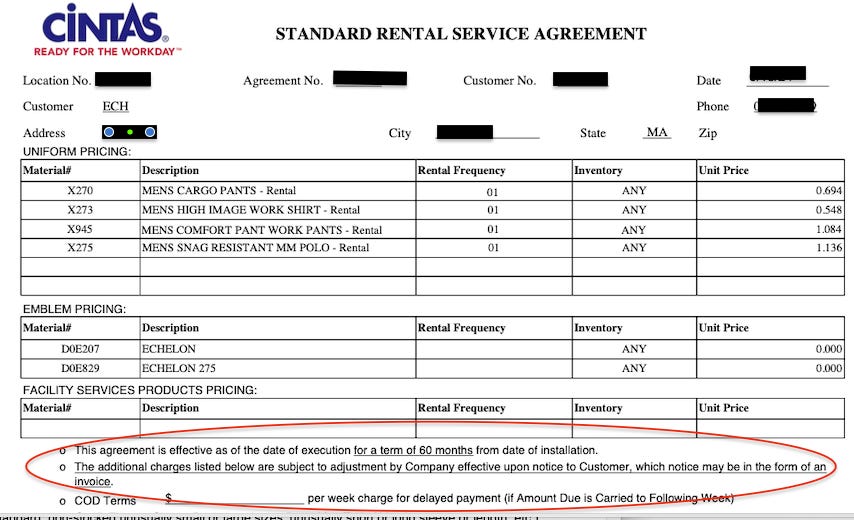
I actually got a copy of a contract, and I’ll walk you through it.
If you look at the part I circled in red, it says that after a business signs a contract term of 60 months, with Cintas, the company can immediately increase prices. Here’s the specific sentence.
“The additional charges listed below are subject to adjustment by Company effective upon notice to Customer, which notice may be in the form of an invoice.”
So one common tactic from these companies is to offer ridiculously low prices for things like mops, ones that no small rival could offer. Then immediately after getting a customer to sign a five year contract, they raise prices. Customers can reject the price hike within ten days, but they often don’t realize it has happened until after the ten days has passed, because they just get an invoice - which is the notification of the price hike - and put it on a stack of stuff to deal with later.
There’s more. The contracts usually last for 5 years, and they automatically renew, usually with price increases, unless the customer sends Cintas a notification in writing between 90 and 180 days before the end of the contract. If you’re the owner of, say, a bakery, looking at the fine print of a contract to map out exact windows when you can redo your contract for mop rentals isn’t a high priority, and these companies know that. So usually the contracts just renew.
To pull out of a contract, a customer must document harms by registered letter, and Cintas has a chance to cure them. Reddit commenters frequently note the arbitrary nature of the curing process. And if a company sends back some uniforms because business is slow, it must still pay at least 75% of what’s been tacked on to its invoices.
Even the most fastidious business owner might have trouble figuring out what they are paying and getting. As Ferguson told me:
In this industry, providers often do not rely solely on a simple base price. Revenue may be generated through per-piece charges, service charges, delivery-related charges, inventory-related charges, loss claims, replacement charges, minimums, and escalators. In my opinion, this means that margin quality may depend not just on operational efficiency, but also on the provider’s ability to design, preserve, and enforce a pricing architecture that extracts increasing value from an account over time, especially where switching friction is high and competitive alternatives are limited.
What happens if you just say “eh screw it these guys aren’t holding up their end of the bargain?” Well if a customer cancels without permission, the company must pay damages based on the latest, usually highest, prices.
You No Longer Have a Right to a Jury
Such a contract is pretty aggressive, and the service and quality is often, if Reddit and more sources are to be believed, not what was promised. But if you try to fight these companies over any of these terms, they will use the most powerful part of this contract - the arbitration clause.
Any dispute or matter arising in connection with or relating to this agreement shall be resolved by binding and final arbitration.
Such a clause means you can’t take them to court, instead you have to use a secretive process called binding arbitration, where a private arbitrator holds a trial-like event, and then issues a ruling. The proceedings are kept secret. That means there are few public records of how this industry operates, because the trials that would otherwise expose it have no public records. And though there’s no data because everything is kept private, the deck is likely stacked against the customer.
Before she ran the Federal Trade Commission, Lina Khan wrote a 2014 story on this problem. As Khan noted, “Judges are paid from public taxes; arbitrators are paid by whoever is retaining them. Sometimes both parties split the cost equally; often companies will offer to cover the entire thing. Either way, critics say the chance of repeat business can give arbitrators an incentive to rule in a company’s favor.”
These clauses are now everywhere. A number of readers sent me a recent example, which is Bank of America simply adding an arbitration provision unilaterally.
Indeed, the rise of arbitration is one of the most remarkable and understated changes in the American legal environment fostering oligarchy. The Supreme Court, in a series of opinions going back to the 1980s but accelerating in the 2010s, expanded corporate rights to impose forced arbitration clauses in contracts. When you click on something, you have consented to forego your right to sue for civil rights, labor, antitrust, or other harms. That is why most of the legal claims I’ve seen for Cintas end up with a dismissal by the court as the dispute goes to arbitration.
Are There Larger Lessons?
The merger of Cintas and Unifirst is an interesting story, and there are standard dynamics here suggesting it’s a dangerous combination. But fundamentally the monopolization going on in this industry is not a function of the actual physical elements of production or even the consolidation. It’s driven by contract law. As Ferguson put it, “the supplier contract is often central to the commercial strategy, not a minor background document.”
This week, I had a conservative antitrust lawyer Ashley Keller on Organized Money, who specializes in exploiting weaknesses in arbitration strategies by large businesses. What he said is that the increasing amount of scams coming from corporate America are driven by these arbitration clauses. In corporate America, the risk of harming or defrauding Americans has gone way down, because you can just force consumers, workers, or suppliers to sign away their right to go to court.
I’ll close this piece by noting there is actually hope here. The Democrats, when they had the House in 2019, passed a bill to roll back arbitration agreements over civil rights, labor law, and antitrust. A few conservatives, like then-Rep. Matt Gaetz, supported them. That means they could do it again if they win the midterms. On the right, there is increasing litigation against big business from conservative plaintiff lawyers, and Justice Clarence Thomas has written opinions arguing the Federal Arbitration Act should be radically rolled back. There really is no legitimate reason to take away the rights of millions of businesses, and hundreds of millions of workers, investors, and consumers, from getting redress in court.
But then, a lot of stuff in America makes no sense. The fact that doing laundry for small businesses could turn into a monopoly is one of them.
(I contacted Unifirst and Cintas with questions, but didn’t hear back. As always, if either firm wants to respond, I will append their statement to this essay.)
Thanks for reading! Your tips make this newsletter what it is, so please send tips on weird monopolies, stories I’ve missed, or other thoughts. And if you liked this issue of BIG, you can sign up here for more issues, a newsletter on how to restore fair commerce, innovation, and democracy. Consider becoming a paying subscriber to support this work, or if you are a paying subscriber, giving a gift subscription to a friend, colleague, or family member. If you really liked it, read my book, Goliath: The 100-Year War Between Monopoly Power and Democracy.
cheers,
Matt Stoller