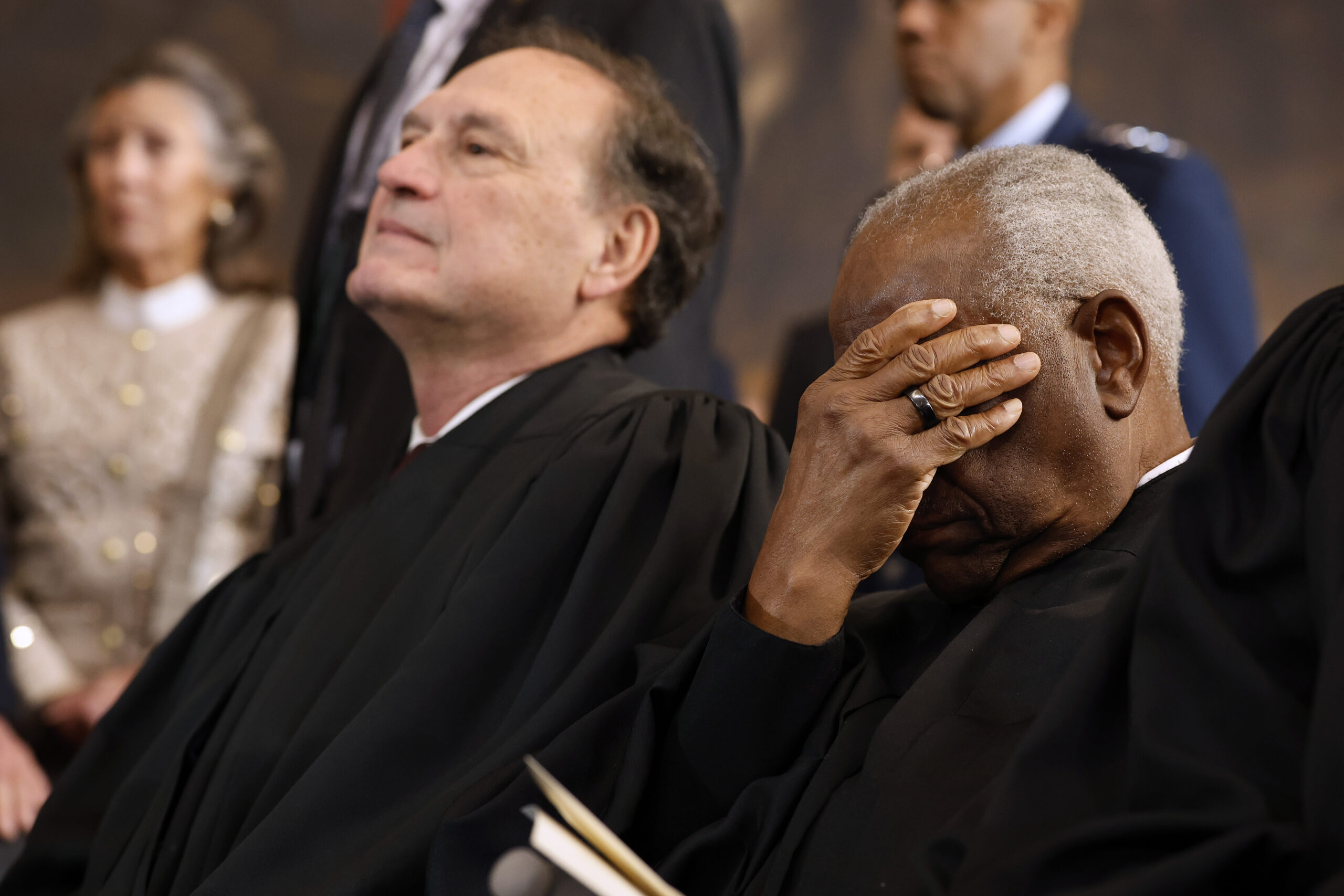
U.S. Supreme Court Justice Samuel Alito leaned on an erroneous claim that Black voter turnout now tops white voter turnout, in his Callais v. Louisiana ruling that gutted the Voting Rights Act, reports The Guardian.
Alito wrote in the ruling that “present-day intentional racial discrimination” must now be proven in claims that state congressional maps rob minorities of opportunities to vote for their preferred candidates.
He further claimed that Black voters now have higher voter turnout rates than white voters, in his opinion that the Voting Rights Act no longer needs to correct for historic voter suppression and obstruction against minorities.
However, The Guardian found that Alito was relying on a faulty data methodology to arrive at that conclusion. Instead of comparing the turnout rates of those actually eligible to vote, Alito based his analysis on the total population over the voting age of 18, regardless of voter eligibility.
SIGN UP TODAY Get updates straight to your inbox — for free Join 350,000 readers who rely on our daily and weekly newsletters for the latest in voting, elections and democracy.
“[The DoJ approach] is misleading because they’re including ineligible voters in the denominator,” University of Florida voting expert Michael McDonald told The Guardian. “If I wanted to manipulate the numbers in a way that was favorable to the government’s interest, I would be using voting age population.”
Alito wrote in his ruling that “Black voters now participate in elections at similar rates as the rest of the electorate, even turning out at higher rates than white voters in two of the five most recent Presidential elections nationwide and in Louisiana.”
When using total voting-age population numbers in Louisiana, it shows that Black voter turnout edged white voters in the 2016 election 60.9% to 60.8%.
However, when controlling for those ineligible to vote – due to incarceration, felony status, lack of citizenship, or because they aren’t registered – white turnout exceeds Black turnout by much wider margins.
The U.S. Department of Justice also argued that racial turnout rates have reached parity in its amicus brief for Callais, in support of gutting the Voting Rights Act.
“Roughly 60 years after Section 2’s enactment and 40 years after the “results” test’s adoption, there is no adequate justification for nationwide race-predominant districting, let alone as a means to enforce the right to vote free from racial discrimination,” reads the brief. “As this Court has observed, by 2004, the racial gap in voter registration and turnout had largely disappeared, with minorities registering and voting at levels that sometimes surpassed the majority.”
Alito appears to have embraced this logic. However, the reality of at least the last ten years paints a different picture. There was a brief moment in 2012 when Black voter rates leapt white rates, largely driven by the historic campaign of Barack Obama, who became the first Black president.
However, in the years afterward – and notably since SCOTUS struck down a different section of the Voting Rights Act in the 2013 Shelby County case – the racial gap in turnout rates has consistently widened, in favor of white voters.
The Brennan Center for Justice found that the gap between Black and white voter turnout grew from 2012 to 2020, even when accounting for socioeconomics and region – with some of the most pronounced gaps found in the South where Black voters are concentrated.
“Wider now than at any point in at least the past 16 years, the gap costs millions of votes from Americans of color all around the country,” reads the Brennan report. “Perhaps most worrisome of all, the gap is growing most quickly in parts of the country that were previously covered under the preclearance regime of the 1965 Voting Rights Act until the disastrous Shelby County ruling.”
Meanwhile, the Union of Concerned Scientists found similar pervasive racial turnout gaps when examining several counties in battleground states from the more recent 2020 and 2024 elections.
“In the 2020 election, majority-White precincts had an average of about 79 percent registered turnout while majority-Black (about 61 percent) and majority-Hispanic (about 58 percent) had considerably lower registered turnout rates,” reads the report. “In 2024, we found a similar pattern—majority-White precincts had an average registered turnout rate of about 75 percent, while majority-Black and majority-Hispanic precincts had average registered turnout rates around 55 and 53 percent, respectively.”
The UCS found similar disparities in these counties even when just accounting for the overall voting age population.