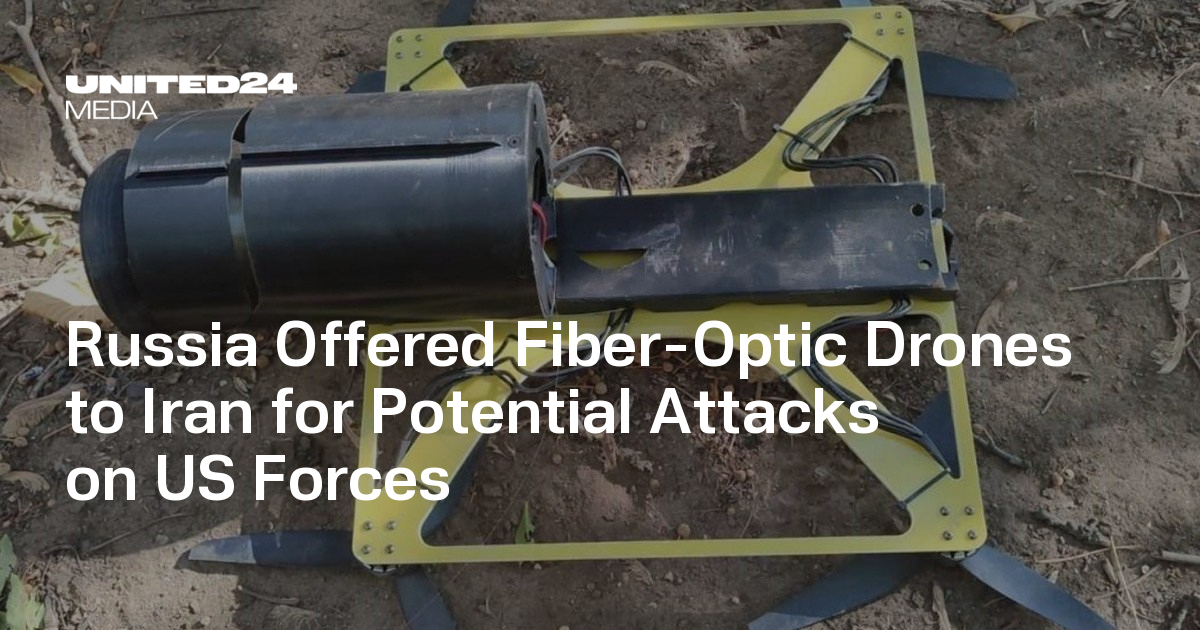
Russia proposed supplying Iran with thousands of fiber-optic drones designed to resist electronic warfare systems as part of a contingency plan tied to a potential conflict with the United States in the Persian Gulf.
We bring you stories from the ground. Your support keeps our team in the field. DONATE NOW
According to The Economist on May 8, the reported proposal was prepared by Russia’s Main Intelligence Directorate (GRU) during the early stages of the Israel-Iran war, when US military intervention against Iran was reportedly being considered in Washington.
The 10-page document allegedly outlined plans to transfer up to 5,000 short-range fiber-optic drones alongside longer-range strike systems equipped with satellite guidance. The report states that Russian leader Vladimir Putin personally proposed training Iranian operators to use the drones against US military personnel.
According to The Economist, the document included maps and operational diagrams focused on islands near Iran’s coast, including Kharg Island, which hosts one of the country’s main oil export terminals.
One illustration reportedly described how drone teams trained by Russia could launch swarms of five to six drones from concealed positions to target US amphibious landing ships.
The report also stated that GRU planners considered recruiting drone operators from among approximately 10,000 Iranian students studying at Russian universities, as well as from Tajik nationals and Syrian Alawites linked to the former government of Bashar al-Assad.
Regional intelligence officials familiar with the document reportedly considered it “plausible,” although they could not independently verify its authenticity or confirm whether the plan was implemented.
Christo Grozev, an investigator specializing in Russian intelligence operations, told The Economist that the proposal aligns with other evidence suggesting Moscow has sought to expand military cooperation with Tehran during the regional escalation involving Iran, Israel, and the United States.
The article noted that fiber-optic drones have become increasingly prominent during Russia’s war against Ukraine because they are connected to operators through physical cables rather than radio signals, making them resistant to electronic jamming systems. Such drones are capable of striking targets at distances of several dozen kilometers.
The document also referenced satellite-assisted targeting systems and covert support measures intended to complicate potential US military operations while maintaining plausible deniability for Russia.
Earlier, according to The Jerusalem Post on April 6, Russia reportedly provided Iran with intelligence on 55 Israeli energy infrastructure sites that could be targeted in potential strikes, including major power plants and regional substations, as Moscow and Tehran expanded military and intelligence cooperation.