Drop a needle of length $L$ onto a hardwood floor with floorboards of width $W$. On average, the needle crosses $2L / \pi W$ lines between floorboards, a classic result of Buffon. But that $\pi$ in the formula means there’s a circle hiding somewhere. The trick to finding it? Bend the needle into a noodle.
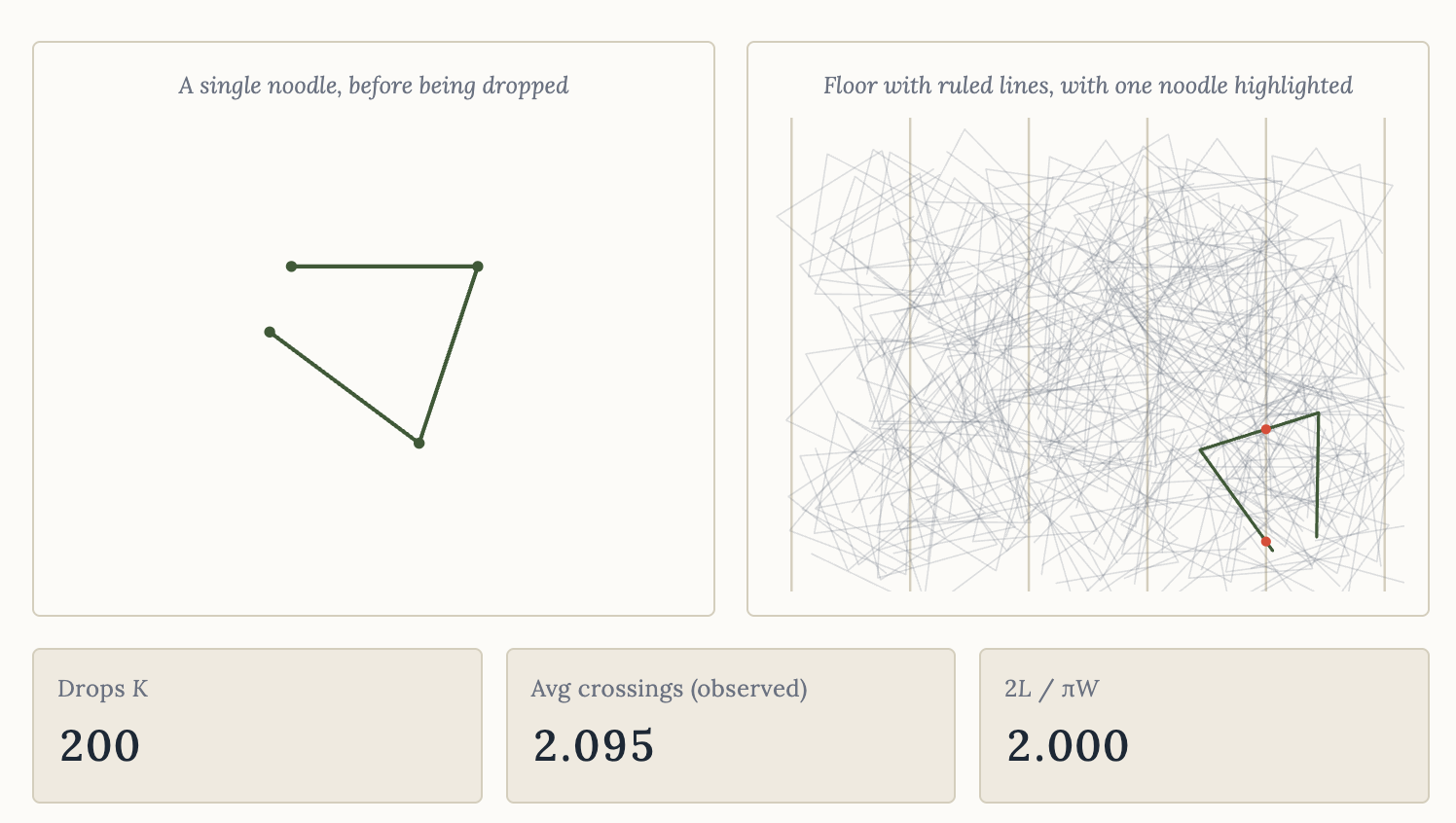
A single noodle, before being dropped Floor with ruled lines, with one noodle highlighted Drops K 0 Avg crossings (observed) — 2L / πW — Total turn Θ° 75° Segments N 4 Length L/W 2.0 Drops K 200 Reset Needle (Θ = 0°) π-circle
From needle to noodle#
The usual approach to Buffon’s problem involves a double integral. Respectable, but this hides the circle at the heart of the solution, and frankly, I don’t love doing integrals. Instead, we’ll derive the result by going from a straight needle, to a curvy noodle, to a circle. All we need is some basic geometric reasoning and probability.
Let’s fix some notation. Add ruled lines on $\mathbb{R}^2$ spaced $W > 0$ apart, and choose a line segment of length $L>0$ at random. Let $X_1$ be the number of ruled lines that this random line segment crosses. We want to compute $\mathbb{E}[X_1] =: f(L)$ as a function of $L$.
Now suppose we drop two needles with lengths $L_1$ and $L_2$, and let $X_1$ and $X_2$ be the number of lines that each needle crosses. By linearity of expectation,
$$ \mathbb{E}[X_1 + X_2] = \mathbb{E}[X_1] + \mathbb{E}[X_2] = f(L_1) + f(L_2). $$
Linearity of expectation requires no independence assumption. In particular, we could weld the two segments together, and the equation would continue to be true. Joining the two segments end-to-end gives $f(L_1 + L_2) = f(L_1) + f(L_2)$, which holds for all lengths $L_1$, $L_2$. Since $f$ is non-negative and increasing with $f(0) = 0$, we deduce that $f(L) = c L$ for some constant $c \ge 0$ that we need to determine.
We can then “bend” the needle into an arbitrary polygonal line with $N$ segments, each of length $L/N$. With $X_i$ the number of crossings on the $i$th segment, we find
$$ \mathbb{E}[X_1 + \dotsb + X_N] = N f(L/N) = c L, $$
that is, the average number of lines that a polygonal line strikes depends linearly on its length. Taking a limit gives us Buffon’s noodle: throw an arbitrary curve onto the plane, and the average number of lines it intersects is proportional only to its length.
The special circle#
Only the value of the constant $c$ remains. Consider a circle of radius $W/2$. With probability one, this circle crosses a single ruled line twice; the alternative, being tangent to two lines, occurs with probability zero. (Try it out in the widget above!) This means that
$$ \mathbb{E}[\text{\# intersections with $W/2$-circle}] = 2. $$
This means that $cL = 2$ for this special circle; since $L = \pi W$, we conclude that
$$ c = \frac{2}{\pi W} $$
which completes the proof.