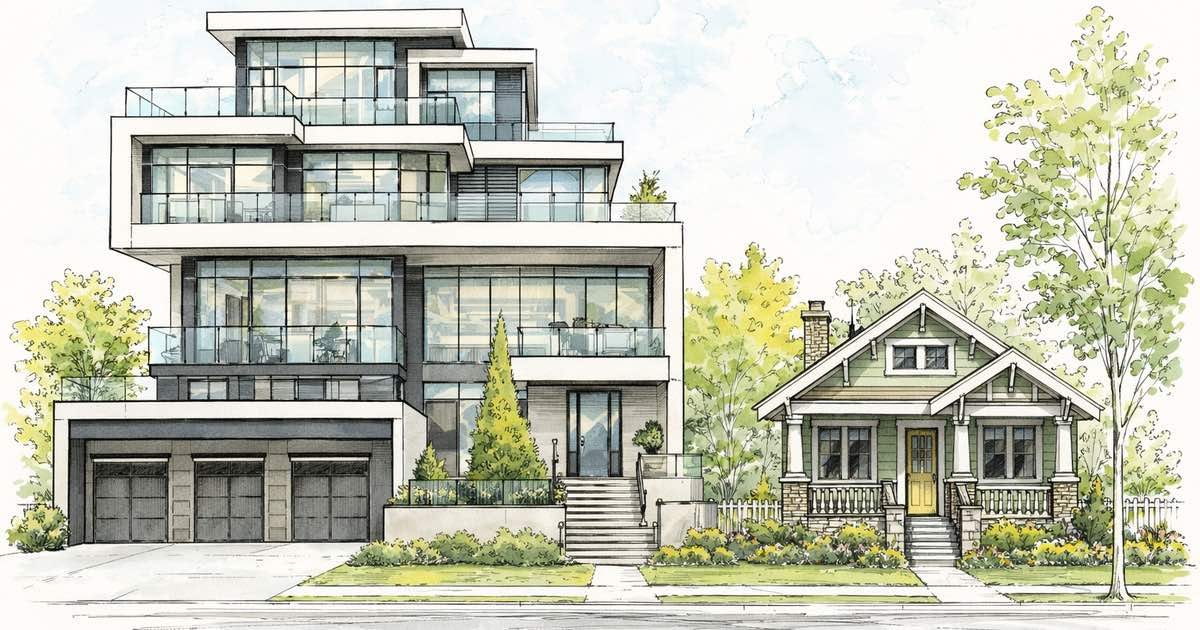
My neighborhood in Denver is experiencing a kind of slow strangulation. Today, the neighborhood is mixed-income with a range of families from different backgrounds. A decade ago, it was lower income than it is today, and two decades ago, lower still. Aka, we’re gentrifying.
But the gap between new and old residents is becoming extreme. People who have lived in the neighborhood for 10 years are often in homes that cost $300k and have a mortgage of around $1000/mo. Those houses now typically sell for $600-700k. My wife and I bought one of those homes and repaired it because we felt lucky to live here, and could stretch to afford that. But we’re weirdos. What mostly happens here is that those homes are bulldozed and replaced by McMansions that cost $3-4 million. So, the neighborhood is “10x-ing,” not in a nice way.
This is the redevelopment trend across the entire city of Denver since 2019 — but it has gotten notably worse since 2022, with new houses coming in even larger and more expensive.
I don’t hate the super-rich. But I’m not one, and I’ve found myself squarely in their blast radius. This has become even more personal recently, as the house next door (a split-level ranch) is being torn down soon to be replaced by a land yacht.
It’s depressing to feel like an endangered species, watching the place around you slowly go extinct. In another 10 years I expect this neighborhood will be exclusively decamillionaires. We’re conducting a real-time experiment to determine how many burger joints and art galleries can be converted to exotic skin treatment clinics.
As you all might guess, this is especially challenging for me to sit with, because I lean “classical liberal/libertarian.” I think we got here by blocking organic, incremental growth for decades, so instead of gradual change we have a false equilibrium until development pressure builds up to the point of a radical break. I’m not keen on trying to freeze the status quo under even thicker amber.
And I’m actually fine with the house next door being torn down. Candidly, it’s ugly. But I’d like to see new homes sold at prices I could conceivably afford.
Now, if we allowed more units on the lot, that might be possible. A developer could likely fit 3-4 nice cottage homes on that lot, sell them for $500-700k, and make a profit. The people moving in next door would have tiny yards, but they’d probably share my preference for burger joints over face spas. But that isn’t allowed. Our zoning is single-family, and the lot can’t be split. At these land prices, that means the options are McMansion or bust.
So I grapple with this question: is there a way to adjust, and ideally liberalize, our zoning code that would make it more likely for new homes to be sold at price points closer to existing homes in the neighborhood?
Denver’s attempt
Many people in Denver share my concerns, and the city is considering action. There’s a plan in development called “Unlocking Housing Choices” that aims to do something like what I’ve suggested above. Try to make the zoning and financial math align so that developers will build more, smaller homes, instead of only mansions.
Strategies from Denver’s “Unlocking Housing Choices” Phase 1 project.
The first concept is to limit the size of new buildings, but offer more space in exchange for more units. To greatly oversimplify, developers make money primarily based on how much square footage they can sell multiplied by the sale price per square foot. In theory, if we change the rules so developers can sell more square footage by splitting it among more units, that should tip the scales toward multi-unit projects rather than giant single units.
The second concept is to incentivize retention of existing buildings by allowing substantial new construction behind them. Basically, let people cash in on their backyard. This is a significant expansion of the accessory unit rules we have today, and the city’s concept art suggests that it would allow backyard cottages larger than the existing homes (a big change).
The third concept is to allow more units if one unit is deed-restricted to be permanently “affordable.” This is basically the same logic as the first proposal — let developers sell more square footage if they do something residents want: in this case, deed-restrict part of the square footage to be priced below market rate.
I’m generally “warm” to each of these ideas.
The first proposal (to be restrictive on the size of individual units and permissive about the unit count) is the most direct way to stabilize prices in a neighborhood. I think this is a good idea, but it will be difficult to fine-tune the building-size ratios so that it’s usually more profitable for developers to convert expensive land into multiple units rather than palatial homes. I’m also not sure how much residents will feel like this addresses their preference for “maintaining the character” of the neighborhood. If you’re starting with 1,500 square feet, going to 3,500 is mathematically less drastic than going to 5,000, but it’s still a huge change. An Adaptive Code approach could be a more elegant solution.
The second proposal would actually have the most “juice” in terms of both making residents happy and being viable for developers. From the point of view of existing residents, leaving the house in front as-is mostly “preserves the character,” while building large cottages in the back is a fairly straightforward development project. The financial viability of that would mostly be determined by how large the cottages can be, and I think many people would be surprised by how often the “backyard cottage” ends up being much larger than the existing house that was “preserved.” But, overall, I think this is a good idea.
I’m skeptical of the last proposal. I don’t think it’s inherently a bad idea, or that adopting it will cause a problem; I just think that, at today’s construction prices, we’d likely have to let developers build multiple extra units to break even on one deed-restricted “permanently affordable” unit, and I doubt that we’ll agree to ratios that would achieve that goal. Variations on rent control and “inclusionary zoning” have a poor track record. But as long as this is an option for developers, not a requirement, then I think it’s fine to try it and see if we can find ratios that result in subsidized units being built.
What I don’t see in any of the proposals so far is streamlining and expediting permitting for developers who pursue the path the city wants: more, less expensive homes, rather than fewer, more expensive homes. Being able to quickly and predictably pull a permit is an extremely powerful incentive. Denver could, and should, develop pre-approved plans and streamlined approvals for the kinds of housing it wants to see: ideally, a property owner should be able to walk into city hall and leave with a permit the same day if they’re building the kind of housing that the city explicitly wants to see built.