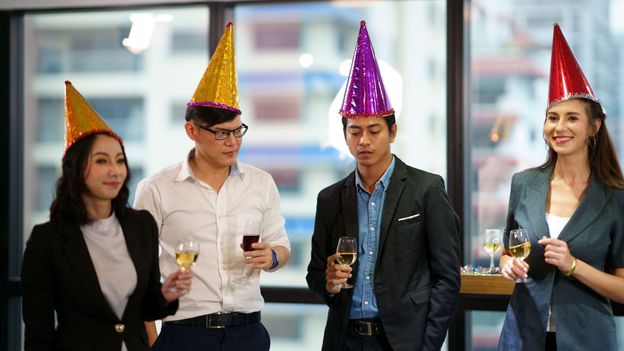
It is a truth universally acknowledged that there’s nothing better than a pizza party, except maybe an ice cream social. Field trips are super fun, too. And you can’t beat a good extra-curricular activity.
They’re the best, that is, if you’re in the third grade. If you’re an adult being forced to attend a team-building exercise, go to a post-work happy hour or celebrate in a conference room with your colleagues lest you be seen as ‘not a team player’, they’re mostly the worst.
For more than two years, a complete shake-up of office culture has effectively banished the forced fun of the pre-pandemic era. Many people have attended some kind of virtual team-building activity or Zoom happy hour, of course. But workers have by and large been spared the mandatory monthly birthday celebrations, afterhours drinks and outings to obstacle courses.
And now, even as some companies call employees back to the office, ‘fun’ at work isn’t what it used to be. In a hybrid environment, it’s tough to get everyone together. Plus, a pandemic-driven priority realignment means many people want to be home with their families as quickly as possible after work – morale-boosting laser tag be damned.
But while the compulsory office party may have had its last gasp, a new kind of work fun is more important than ever. Events that people actually want to attend are a helpful way to facilitate team bonding, and to give those who’d prefer to remain mostly remote a good reason to re-join their colleagues. Smart companies are working to identify the types of ‘fun’ workers actually like: the things they’ll show up for because they want to, not because their arm’s twisted.
No patience for parties
For decades, companies have – for better or worse – been working to make their offices fun places to be, says Paul Lopushinsky, founder of Vancouver, British Columbia-based consultancy Playficient.
“Over the last 20, 25 years, we’ve seen the rise of these perks no one was considering before,” says Lopushinsky. Think bean bag chairs, colourful lounges, arcade games and ping-pong tables as well as common areas with beer and cold brew taps. “We call it ‘the Kindergarten office’, where it looks more like a kindergarten classroom than a workplace. It started with the major tech companies, and that’s the culture people started to copy.”