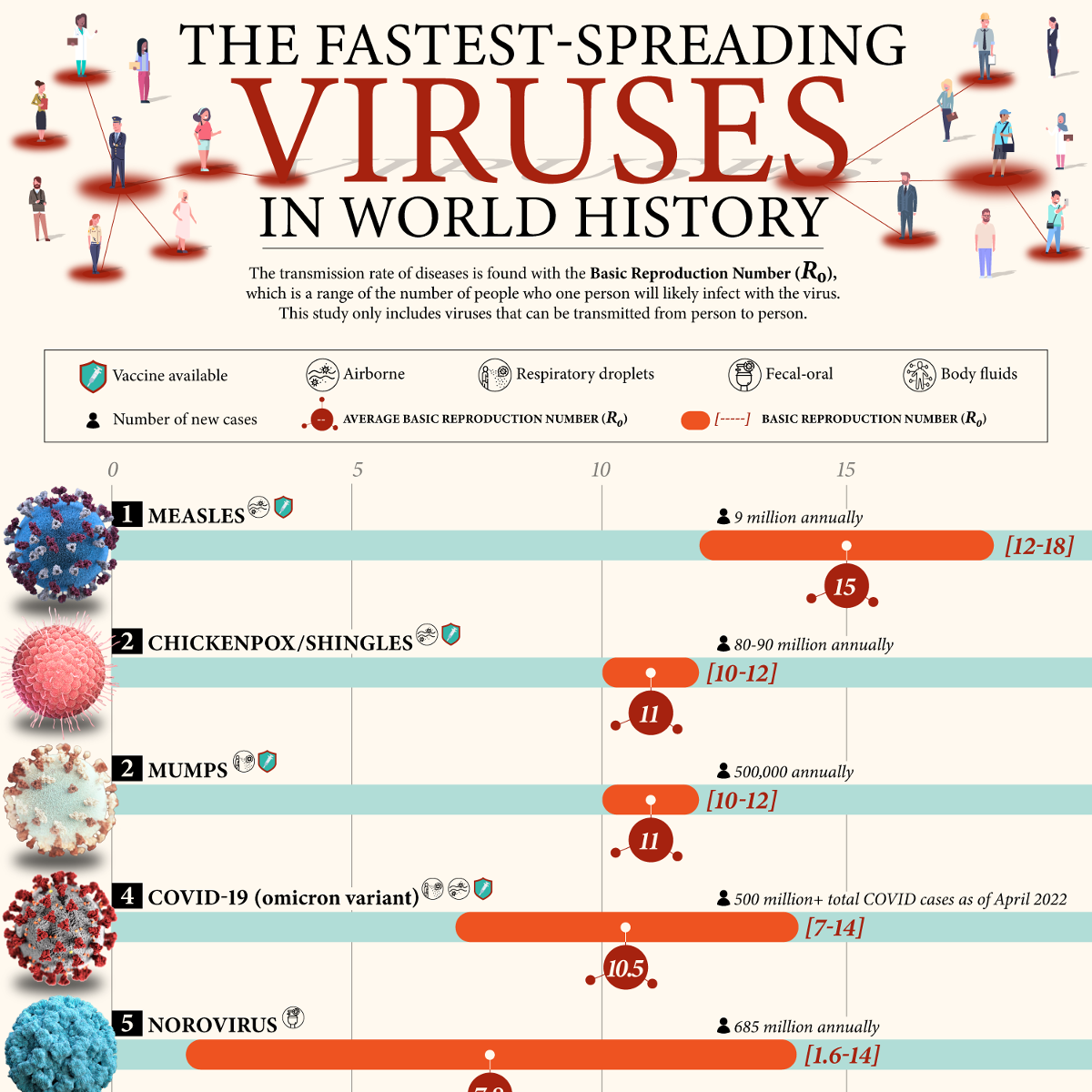
Which viruses in history were the fastest to spread throughout society? The NY Requirements team compared the basic reproduction number (R0) of 26 different viruses that require human-to-human transmission to see which were found to spread to the most people during the height of the virus outbreak. The basic reproduction number is a range of the number of people that one person will likely infect with the virus, a commonly used unit to compare the transmission rate of diseases. These infectious viruses can be spread through various methods of transmission, such as respiratory droplets, airborne, fecal-oral, or body fluids.
In addition to the basic reproduction number of these virus superspreaders, our team also found the number of new cases of each virus, whether it was during a major outbreak or the number of new cases that are contracted annually. We also examined the transmission method of the virus and whether or not a vaccine for the virus is available. Continue reading to see which diseases throughout history were found to be the fastest-spreading viruses of all time.
What Is the Fastest-Spreading Virus in History?
The fastest spreading virus in history is measles; its basic reproduction rate is 12–18, meaning that that many people that will likely be infected by one person with the disease. Measles is a highly contagious disease that is easily spread by airborne transmission through coughs and sneezes from those infected. The measles vaccine has been around since 1968 and is said to have prevented an estimated 23.2 million deaths between 2000 and 2018. While the vaccine for measles is widely available, roughly 9 million people around the world are still diagnosed with the virus each year.
The 10 Viruses That Spread the Fastest
Measles has a basic reproduction rate (R0) of 12–18 people, with an average R0 of 15. Chickenpox/Shingles has a basic reproduction rate (R0) of 10–12 people, with an average R0 of 11. Mumps has a basic reproduction rate (R0) of 10–12 people, with an average R0 of 11. COVID-19 (Omicron Variant) has a basic reproduction rate (R0) of 7–14 people, with an average R0 of 10.5. Norovirus has a basic reproduction rate (R0) of 1.6–14 people, with an average R0 of 7.8. Smallpox has a basic reproduction rate (R0) of 3.5–10 people, with an average R0 of 6.8. Rubella has a basic reproduction rate (R0) of 6–7 people, with an average R0 of 6.5. COVID-19 (Delta Variant) has a basic reproduction rate (R0) of 5–7 people, with an average R0 of 6. Polio has a basic reproduction rate (R0) of 5–7 people, with an average R0 of 6. Hepatitis B has a basic reproduction rate (R0) of 1–10 people, with an average R0 of 5.5.
Which of the Fastest-Spreading Viruses Have Vaccines?
Which of the contagious viruses included in our study have vaccines available? A majority of these infectious viruses have a vaccine available today, but for some viral strains, that wasn’t the case during the height of a deadly outbreak.
Transmissible Viruses With Vaccines
Measles
Chickenpox/shingles
Mumps
COVID-19
Norovirus
Smallpox
Rubella
Polio
Hepatitis B
SARS
Influenza
Hepatitis A
Rotavirus
Transmissible Viruses Without Vaccines
Hand, foot, and mouth disease
HIV/AIDS
Common cold
Hantavirus
Ebola
Marburg
Nipah virus
MERS
Vaccines are tools that benefit the overall health of society and have been used for decades to slow, and at times even eradicate, some of the fastest-spreading and deadliest diseases known to mankind. The first vaccine ever created was for smallpox, which helped to eradicate this deadly virus that was still infecting 50 million people annually up through the 1950s, just before the smallpox vaccine was created.
Which Strain of COVID-19 Spread the Fastest?
The strain of COVID-19 that has spread the fastest is the Omicron variant, with a basic reproduction number of 7 to 14 people. Through our research, we discovered that the transmission rate of COVID seemed to speed up with each new strain of COVID-19 that began to spread around the world. While it is too difficult to determine the number of people each specific variant of COVID-19 has infected, a total of more than 500 million people around the world have been infected with COVID-19 as of April 2022. Below is a list of Covid variants ranked by their basic reproduction number, or how fast they spread throughout society during the pandemic.
The Fastest-Spreading COVID-19 Strains
Omicron Variant: basic reproduction rate (R0) of 7–14 people, with an average R0 of 10.5 Delta Variant: basic reproduction rate (R0) of 5–7 people, with an average R0 of 6 Alpha Variant: basic reproduction rate (R0) of 4–5 people, with an average R0 of 4.5 Original COVID-19 Strain: basic reproduction rate (R0) of 2–3 people, with an average R0 of 2.5
When it comes to these highly transmissible viruses, health professionals can take action to prepare for them, such as using infection control and barrier precautions to maintain a safe environment.
The Fastest-Spreading Viruses