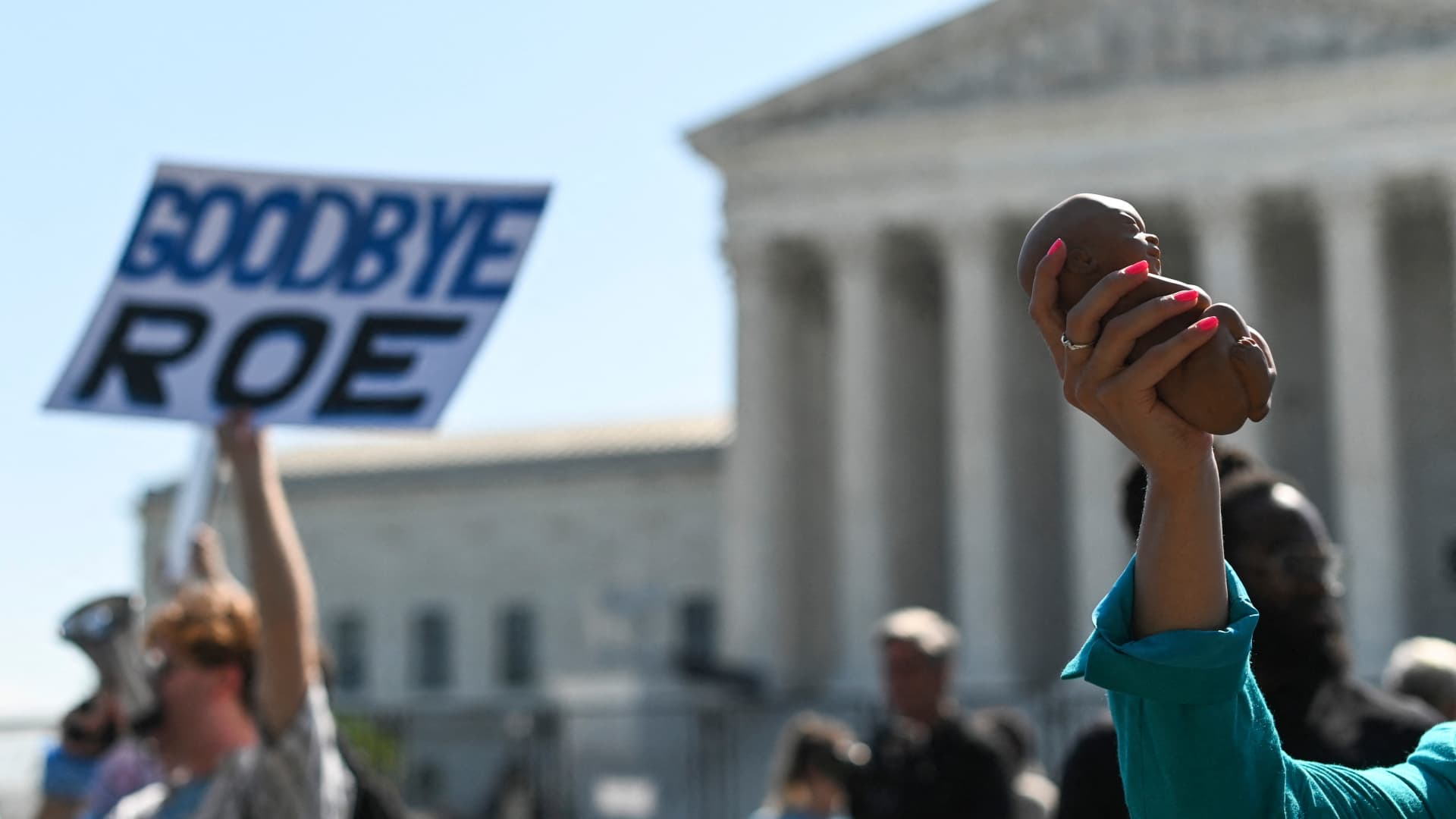
The Supreme Court in a 6-3 decision on Friday overturned Roe v. Wade, the landmark ruling that established the constitutional right to abortion in the U.S. in 1973.
The court's controversial but expected ruling gives individual states the power to set their own abortion laws without concern of running afoul of Roe, which had permitted abortions during the first two trimesters of pregnancy.
Almost half the states are expected to outlaw or severely restrict abortion as a result of the Supreme Court's decision, which is related to a highly restrictive new Mississippi abortion law.
Other states plan to maintain more liberal rules governing the termination of pregnancies.
Supporters of abortion rights immediately condemned the ruling, abortion opponents praised a decision they had long hoped for.
Read the Supreme Court decision overturning Roe v. Wade here
Justice Samuel Alito, as expected, wrote the majority opinion that tossed out Roe as well as a 1992 Supreme Court decision upholding abortion rights in a case known as Planned Parenthood v. Casey.
Alito was joined in that judgment by the five other conservatives on the high court, including Chief Justice John Roberts, whose support for overturning Roe had long been in doubt.
The majority also included three justices appointed by former President Donald Trump: Neil Gorsuch, Brett Kavanaugh and Amy Coney Barrett.
The court's three liberal justices filed a dissenting opinion to the ruling, which quickly drew protestors to the Supreme Court building on Capitol Hill in Washington, D.C.
"We hold that Roe and Casey must be overruled," Alito wrote.
"The Constitution makes no reference to abortion, and no such right is implicitly protected by any constitutional provision, including the one on which the defenders of Roe and Casey now chiefly rely — the Due Process Clause of the Fourteenth Amendment," Alito wrote.
"That provision has been held to guarantee some rights that are not mentioned in the Constitution, but any such right must be 'deeply rooted in this Nation's history and tradition' and 'implicit in the concept of ordered liberty."
"It is time to heed the Constitution and return the issue of abortion to the people's elected representatives," Alito wrote.
In their scathing joint dissent, the court's liberal justices wrote, "The majority has overruled Roe and Casey for one and only one reason: because it has always despised them, and now it has the votes to discard them. The majority thereby substitutes a rule by judges for the rule of law."
"The majority would allow States to ban abortion from conception onward because it does not think forced childbirth at all implicates a woman's rights to equality and freedom," said the dissent by Stephen Breyer, Sonia Sotomayor and Elena Kagan.
"Today's Court, that is, does not think there is anything of constitutional significance attached to a woman's control of her body and the path of her life," it said. "A State can force her to bring a pregnancy to term, even at the steepest personal and familial costs."
The decision came a day after the Supreme Court in another controversial ruling invalidated a century-old New York law that had made it very difficult for people to obtain a license to carry a gun outside of their homes.