"They were talking a lot about continuing to rebuild inventory positions, straightening out their supply chains through the balance of the year, even into the first part of next year," Holzgrefe told CNBC. "Maybe things have slowed a bit, but customers are still continuing to re-sort their supply chain position to more effectively to achieve their goals in their respective businesses."
A recent survey of customers by SAIA, a trucker for Starbucks, Home Depot and Lowe's, found the majority of companies are still working to figure out their next step and what the "new normal" is for their business, according to CEO Fritz Holzgrefe.
U.S. trucking CEOs expect to maintain pricing power even with volumes softening in the second half of 2022 as retailers, manufacturers and consumers adjust to disruptions from Covid lockdowns, the Russia-Ukraine war and inflation.
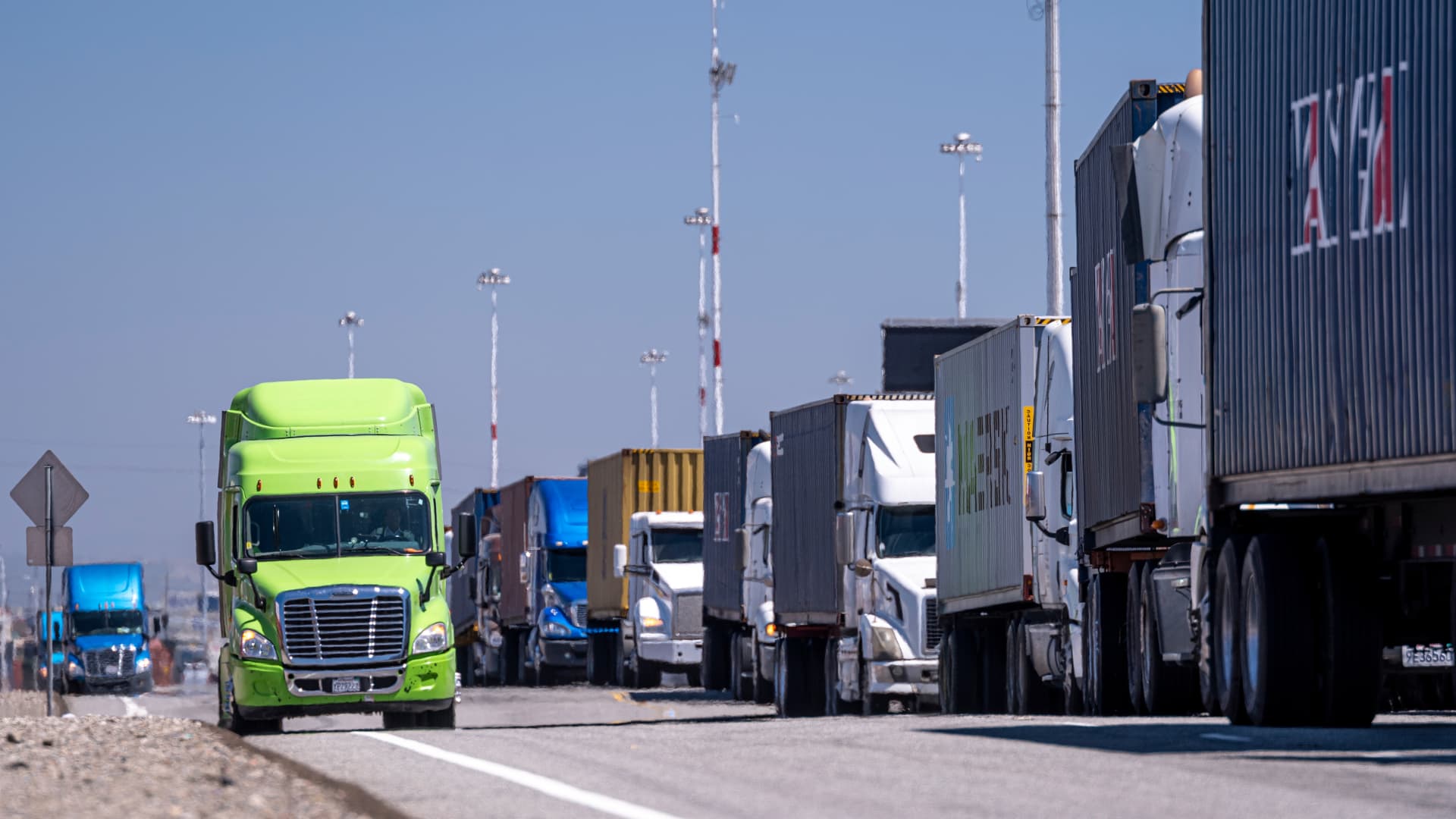
Trucks at the entrance to the Port of Oakland in Oakland, California, US, on Thursday, July 14, 2022. Truckers servicing some of the US's busiest ports are staging protests as state-level labor rules that change their employment status begin to go into effect, creating another choke point in stressed US supply chains.
The supply chain is improving and past the worst, according to Derek Leathers, CEO of Werner Enterprise, which moves freight for Walmart and Target. But, he warned, headwinds for truckers will keep rates well above prepandemic levels for the rest of 2022.
"You'll see rates hold up for the remainder of the year. Our cost increases are real. Our customers understand that," Leathers said. "We're talking large scale successful winning brands like [Amazon and Walmart] and many others that know the reliance on their carrier is a competitive advantage. They want good quality transportation, on time, every time safely. To do that they work with large well capitalized carriers."
Trucking stocks have been some of the best performers in July, while the S&P 500 has gained more than 7% this month. SAIA and ArcBest are up over 20%, while Werner Enterprises, Knight Swift and JB Hunt have increased over 10%.
Earlier this year there were concerns about a "freight recession" because of falling rates in the so-called spot market for trucking. According to the most recent data from Evercore ISI, those rates are down more than 11% year over year. The spot market provides on-demand freight transportation, and pricing varies based on supply and demand.
Spot trucking saw a boom at the height of the pandemic as companies adjusted to snarled supply chains and were willing to pay historic rates to transport goods during the e-commerce boom. However, the majority of trucking is still done through contracts with carriers and their customers like large retailers.
The leading companies in the three major segments of trucking make the majority of revenue from contracts — Knight Swift (full truckload), FedEx (less than truckload) and JB Hunt (container shipping) — have reported double-digit rate increases in their most recent earnings.
"We believe the contract rates will hold up. We believe contract rates are going to be at a place that is going to allow trucking companies to be remarkably profitable." Deustche Bank transportation analyst Amit Mehrotra told CNBC.
He also expects demand to be slightly lower but stable for the rest of 2022. "I think the inventory issues that major retailers like Target are reporting is more of a reflection of changing buying patterns, rather than a significant withdrawal of consumer spending," Mehrotra said.
The chief executive of one of the largest trucking brokerages in the United States is also watching consumer spending.