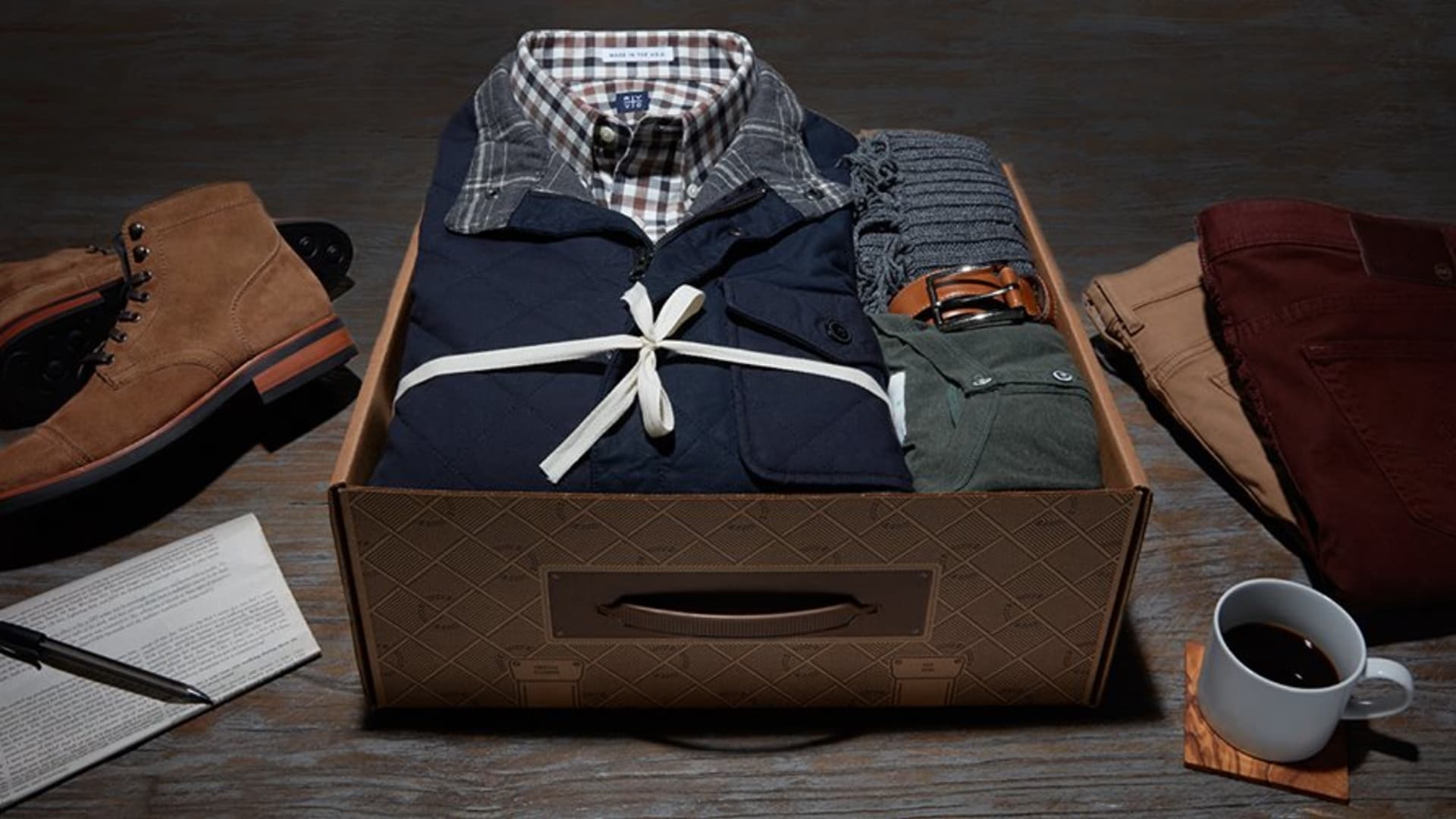
A selection of men's clothes packaged by Trunk Club, which was shuttered earlier this year after Nordstrom bought the personal styling service in 2014. Source: Trunk Club
After earning a master's degree a decade ago, David Hill wanted to amp up his personal style and signed up for the Trunk Club, which promised to mail him boxes of clothing tailored to his tastes as often as he liked. Hill would visit the company's Chicago showroom to meet with a stylist and pick outfits he could wear to the office or for special occasions. The stylist helped him design a custom suit and sent handwritten notes to check how he was liking his clothes, turning Hill into a loyal customer. Then the Covid-19 pandemic hit. "At the beginning, they were trying to tell me to buy sweatpants and joggers," he said. But Hill, 41, no longer needed new clothes since he was working from home and barely going out, and he canceled his subscription. Not that long ago, major retailers were scrambling to get in on the subscription craze sweeping the apparel industry. But then the pandemic upended daily routines and made shopping behaviors far less predictable. Now, some analysts and investors are questioning the appeal of these types of businesses and their ability to hold onto customers, who often sign up during a big life change but eventually lose interest. After acquiring the Trunk Club in 2014, Nordstrom announced in May that it was winding down the business and focusing on its in-house personal styling services. Rockets of Awesome, which curates boxes of clothing for kids, started running low on funding early this year as it hunted for a buyer. Stitch Fix, one of the best-known services in the space, was gaining traction in the years leading up to the pandemic but is now losing money and subscribers. The subscription business model was appealing to apparel companies because it offered a predictable revenue stream based on regular membership fees. But companies are realizing that squeezing profits out of the playbook is harder than they thought.
Fading interest
Stitch Fix's struggles to turn a profit during the Covid-19 pandemic underscore how difficult it can be to run a subscription-based business, especially when consumers' tastes are a moving target. The company charges a $20 styling fee when a customer starts the styling process with boxes of clothing called "Fixes" that they might like. The money can later be applied toward items customers decide to keep from a box, which can be delivered every couple weeks, every month, every other month or every three months. Edward Yruma, a managing director and senior research analyst covering the retail industry at Piper Sandler, said people often sign up for subscription services when they're excited about a big change, such as starting a new job, losing a lot of weight or becoming pregnant. But he said that excitement often fades, making it difficult for companies to hold onto customers. According to the analytics firm M Science, new customers account for a predominant share of sales at Stitch Fix, but their spending generally drops off over time. Roughly 40% of Stitch Fix's revenue has been generated by new customers since its fiscal first quarter of 2020, the firm found. "There definitely seems to be box fatigue," Yruma said. Over time, he noted companies are also realizing the drawbacks of the subscription business model, "People return too much stuff with these boxes, and you just can't drive enough profit from it." David Bellinger, an executive director at MKM Partners, said he thinks Stitch Fix's active client count may have peaked in its August-to-October quarter, when the company reported a record 4.18 million active customers. "This puts into question the longer-term membership potential," Bellinger said, noting that inflation and other macroeconomic challenges could bring more cancellations. In the company's most recent quarter ended April 30, Stitch Fix said it lost 200,000 active clients, bringing its total count to 3.9 million. Its net loss ballooned to $78 million, from a loss of $18.8 million a year ago. The company announced it was laying off 15% of its salaried workers, or about 330 people. To attract new customers, Stitch Fix expanded the rollout of its "Freestyle" option last fall that lets shoppers buy single items from its website without signing up for a plan or paying a styling fee. But the company is still trying to ensure people know the option exists. "We are in the midst of a transformation and we know not every day or every moment will be easy," Stitch Fix CEO Elizabeth Spaulding, who took the reins from founder Katrina Lake in August 2021, wrote in a memo to employees in June. A spokeswoman said Stitch Fix avoids describing itself as a subscription company because it allows customers to select the cadence at which they receive boxes of clothing. In November 2017 when it went public, Stitch Fix fetched a market valuation of more than $1.6 billion. Its market cap is now less than $800 million. The company's push to turn a profit comes as consumers say they're trying to cut back their spending on subscription plans overall, according to a survey by Kearney, a consulting firm. The firm found earlier this year that 40% of consumers think they have too many subscriptions. People reported spending the most on streaming plans, followed by music and video subscriptions, gaming, food memberships, and beverage boxes. Shopping subscriptions, which includes fashion, came after those categories.
A changing consumer