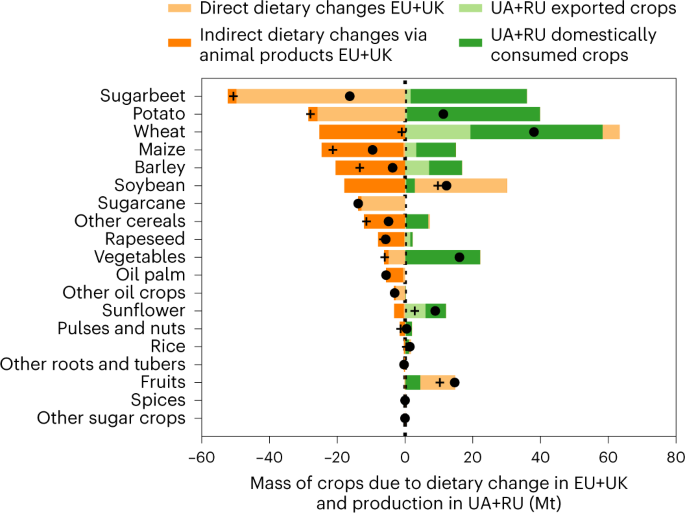
We found that a shift to a planetary health diet in the European Union and the United Kingdom would save a large proportion of crops, mainly by reducing the overconsumption of additive sugar and animal products (Fig. 1). These savings alone would be sufficient to compensate for almost all UA + RU food exports (Fig. 1) (S1), but, to fill all production including food consumed domestically (S2), a small amount of further cultivation of specific crops on the spared agricultural land would be required. In terms of specific crops, the reduction in EU + UK sugar intake fully accounts for all lost UA + RU production (S2). There is a large saving in wheat due to reduced animal feed (see animal-related crops saved in Fig. 1). Dietary change on its own does not result in sufficient savings to offset all UA + RU wheat production (S2): 65.2% of wheat (38.1 Mt) would have to be produced on spared land. However, the saved wheat from such an EU + UK dietary shift (20.2 Mt) would be sufficient to cover the 19.4 Mt of wheat exports lost from UA + RU (S1) and some of this saved wheat, when redirected to international markets, would make up for the shortfall (S2). Given that prices are set on global food commodity markets, the reduction in demand could reduce prices. There are further large savings in maize, barley, sunflowers and rapeseed from the reduction in animal product consumption, and potatoes through reducing direct consumption. While EU + UK dietary change would yield large savings in rapeseed compared with UA + RU production, it would be insufficient for sunflower demand, and some substitution would be necessary.
Fig. 1: Crop change due to dietary change in the European Union and the United Kingdom and total production of crops in Ukraine and Russia. Dietary change drives both direct and indirect effects: direct via the direct reduction in consumption of some food types and indirect via the feed used for animal products that are subsequently consumed. The crosses indicate the net change relative to exports, and the circles relative to production. Source Data Full size image
Land requirements associated with EU + UK food consumption equate to 115 Mha of cropland and 74 Mha of pasture, with around 60% (68.7 Mha) of the cropland being used in animal agriculture. The share of cropland feeding livestock is larger than the global average (∼40%) since the European Union and the United Kingdom together consume more animal products per capita than the global average and have a strong export market in high-value animal products18. As such, there is an opportunity from dietary change to save 70.7 Mha of agricultural land, close to the size of France and the United Kingdom combined (S0). To replace all UA + RU crops (S2), 25.2% of this spared land would be needed. Around 12.9% of the saved land would be required to replace exports only (S1) (perhaps keeping prices stable). Other work suggests the global crop area would need to increase by 11.1 Mha to replace Ukraine grain crop exports alone, similar to our estimates6. If all spared land was restored to antecedent natural vegetation, we would see a broad swathe of environmental benefits, including reductions in emissions (0.25 GtCO 2 e yr−1) and blue water consumption (7.9bn m3 yr−1) (S0) (Supplementary Fig. 2). There is an additional carbon sequestration opportunity, defined as a one-time committed mass of carbon that is restored over the long term16,19, of 38.3 GtCO 2 e (23.1 GtCO 2 e aboveground (AGBC), 10.8 GtCO 2 e belowground (BGBC) and 4.4 GtCO 2 e soil organic carbon (SOC)) (S0) (Supplementary Fig. 2). Replacing exported crops only (S1) would offset these total benefits by 1% of blue water, 16.3% of carbon sequestration and 4.1% of greenhouse gas (GHG) emission savings (Supplementary Fig. 3). Replacing all UA + RU crops (S2) would offset more benefits, reducing the total savings by 48.4% for blue water, 54.5% for carbon sequestration and 10.0% for GHG emissions (Supplementary Fig. 4).
EU + UK dietary change would reduce 2.1% of global agricultural fertilizer use and 23.4% of EU + UK fertilizer use, split by 2.5 Mt nitrogen (N), 0.7 Mt potash (K 2 O) and 0.5 Mt phosphate (P 2 O 5 ) (S0) (Supplementary Fig. 5). Replacing just the exports (S1) would offset these savings by 39.7% of N, 42.3% of P 2 O 5 and 10.9% of K 2 O (Supplementary Fig. 6). Replacing all UA + RU crops (S2) would offset total savings by 85.8% for N, 86.6% for P 2 O 5 and 72.7% for K 2 O (Supplementary Fig. 7).
Regionally, benefits would be located predominantly in the European Union and the United Kingdom with large amounts of agricultural production, especially with respect to crops for animal feed and pasture (savings are a combination of population, consumption shifts and specializations in production). From a per-capita perspective, EU + UK countries and countries which see regular EU + UK agricultural trade with lower population densities see the largest benefits (Fig. 2). For instance, Ireland would see the largest mitigation of GHGs, with 2691 kgCO 2 e yr−1 per capita (S0). Another interesting example is cattle rearing in Botswana which exports mainly to the European Union and the United Kingdom. Botswana would increase the most carbon sequestration, with 466 tCO 2 e per capita (S0).
Fig. 2: Per-capita changes in net blue water consumption, net GHG emissions and net carbon sequestration due to dietary change in the European Union and the United Kingdom after replacing all UA + RU crops (S2). a–c, Per-capita changes in net blue water consumption (a), net GHG emissions (b) and net carbon sequestration (the sum of AGBC, BGBC and SOC) (c). All maps are shown in Robinson projection. Source Data Full size image
Dietary change from current diets to the EAT-Lancet diet would not only benefit planetary and human health but could also help absorb interruptions in the international food supply. Such a dietary shift in the European Union and the United Kingdom can fill the gap in UA + RU crop production while reducing fertilizer use, water consumption and GHG emissions, and increasing carbon sequestration. A planetary health diet with a high proportion of nutrient-dense crops could help build more resilient and sustainable agrifood systems in the long-term20,21. Such shifts imply large changes in agricultural employment worldwide as changes in consumption ripple through supply chains. Future work would benefit from high-resolution global employment data both spatially and by crop and could explore how planetary health diets transform agricultural employment across the world.
However, there are many social barriers to the widespread adoption of such diets which may include expense, cultural norms and knowledge about healthy diets. It is not clear whether plant-rich diets are more or less expensive than alternatives, but it is clear that current subsidies artificially reduce the cost of animal-rich diets both directly in monetary terms and indirectly as externalities22. Yet even lower participation rates in planetary diet adoption can make a large difference. If the European Union and the United Kingdom reduced meat consumption 20%, the saved crops could replace most crops exported by Ukraine and Russia except for sunflower (covering only 11% of UA + RU exports), wheat (33%) and barley (72%) (Supplementary Fig. 13). If 50% of people engaged in a planetary diet shift, the saved crops would account for almost all crops exported by Ukraine and Russia (except wheat and sunflower) and would yield a considerable environmental dividend. However, harnessing these opportunities will require a just transition that ensures economically accessible and culturally appropriate food for different groups within and across the European Union and the United Kingdom23,24.
Agriculture currently occupies a large proportion of land, for example, reaching >70% in the United Kingdom25. At present, there is very limited scope for increasing land for cultivation across the European Union and the United Kingdom (even if this was desirable while considering environmental factors). The dietary shift explored here as a response to UA + RU supply shocks could open substantial amounts of land for other uses. However, this may result in a steady state as land is taken out of production, limiting the ability of farmers to flexibly respond to future shocks with increases in production. A simple approach would be to continue with some of today’s food security policies but at a far lower level. For example, a few targeted subsidies could maintain a small percentage of the saved land as available cropland that could be brought into production (at a lower level than the European Union’s current Common Agricultural Policy)26. For comparison, as of 2019, 6% of arable farmland (6.1 Mha) was kept fallow in the 27 EU states27, while the dietary changes investigated here for these countries (not including the UK) would result in a 29% reduction (30.5 Mha). Keeping one-fifth of freed arable land available for further cultivation would allow for the absorption and rapid response to perturbations from food shocks of a similar size as all UA + RU crops, improving resilience overall. Further benefits of such a plant-based shift include many that are seldom modelled holistically: lower probabilities of pandemics, reduced emergence of antimicrobial resistance, limitation and potential reversal of biodiversity loss, improved access to nature, better water quality, improved animal welfare, better air quality, among others11,13,15,28,29.