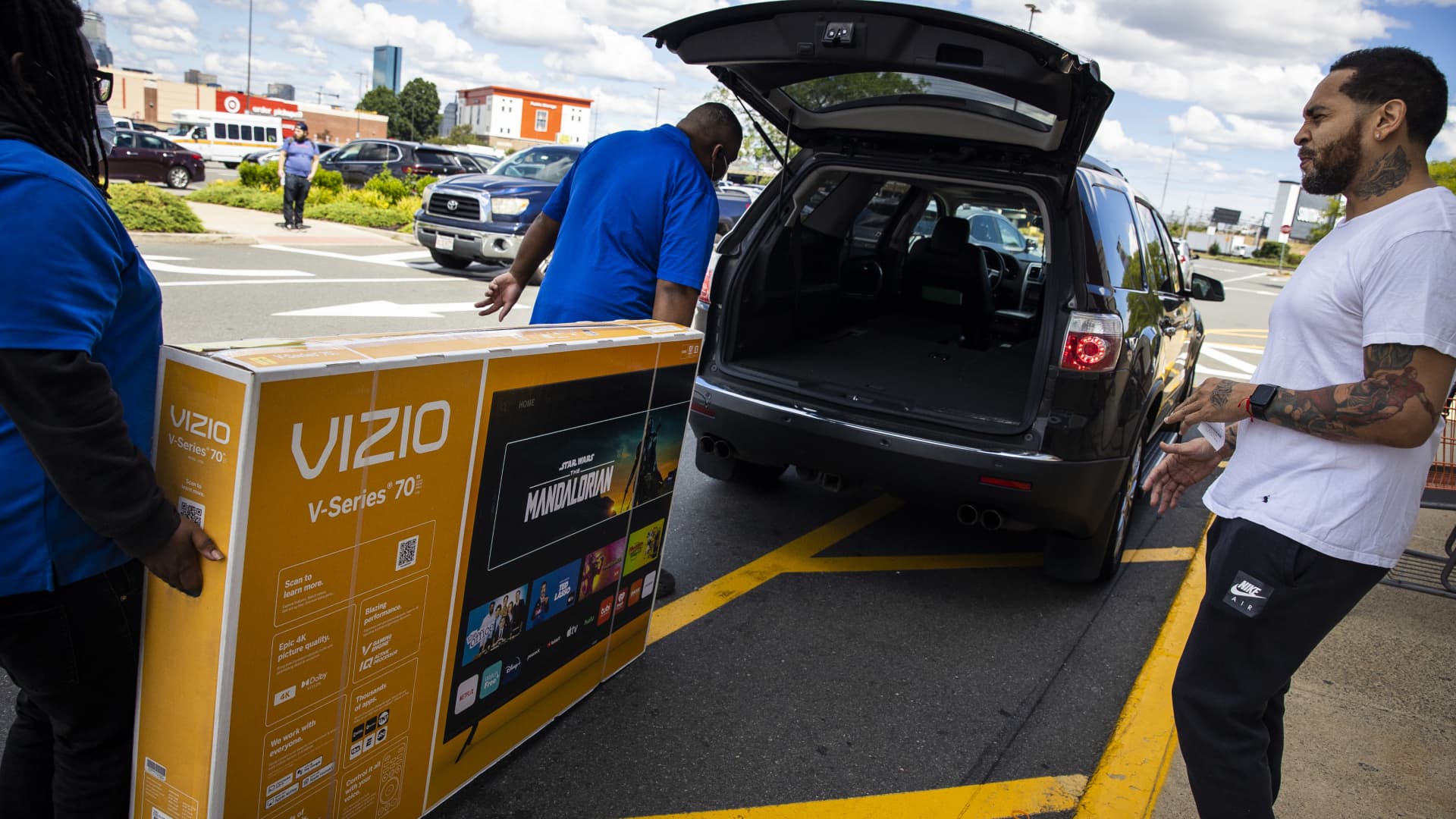
A customer watches as Best Buy employees load his new television into his car during the state's sales tax free weekend, beginning on Saturday.
Best Buy on Tuesday surpassed Wall Street's expectations for quarterly earnings, as inflation-dented demand for pricey consumer electronics came in better than feared.
The consumer electronics retailer, which had cut its forecast this summer, reiterated its outlook for the holiday quarter. It raised its full-year forecast to reflect the beat, saying it expects comparable sales to decline about 10%.
Shares of the company closed more than 12% higher on Tuesday. The stock is trading around $79 after hitting a 52-week low of $60.78 in October. Still, the shares are well off their pandemic highs from a year ago.
Here's how the retailer did for the three-month period ended Oct. 29 compared with what Wall Street was anticipating, according to a survey of analysts by Refinitiv:
Earnings per share: $1.38 adjusted vs. $1.03 expected
$1.38 adjusted vs. $1.03 expected Revenue: $10.59 billion vs. $10.31 billion expected
While Best Buy's quarterly results were better than expected, demand is down from the heights of the pandemic, when consumers turned to its stores for home theaters, computer monitors, kitchen appliances and more while working, playing and cooking at home.
Net sales for the fiscal third quarter declined by about 11% from $11.91 billion year over year in the third quarter. Net income fell to $277 million, or $1.22 per share, from $499 million, or $2 per share, a year earlier.
On a call with investors, CEO Corie Barry said sales declined across most of Best Buy's product categories — with the largest decrease in computing and home theater. However, she said, compared to the same quarter in 2019, its computing revenue is 23% higher and its appliances revenue remains 37% higher.
Even as consumers paid more for groceries, gas and housing, she said the retailer "saw relatively consistent behavior from our purchasing customers." But she added shoppers have a lot of interest in sales events.
"Across consumers, we can also see that savings are being drawn down and credit usage is going up," Barry said on the investor call. "And value clearly matters to everyone."
Best Buy is staring down a more uncertain sales environment this holiday season. Some inflation-pinched consumers are pulling back on discretionary items and spending more money on necessities and experiences. The company joined other retailers in slashing its outlook this summer. It said at the time that it expects same-store sales to drop by about 11% for the 12-month period ending in January.
A month after Best Buy warned of slower sales, it cut jobs across the country.