Since the start of the pandemic, public health officials have warned people about the high risk associated with going to restaurants and bars. Earlier in the pandemic, these venues were shuttered. But now, they’re back, with zero restrictions and limited outdoor dining due to colder weather and the sunsetting of relaxed pandemic-era regulations.
When entering a crowded restaurant off Pearl Street the weekend before Halloween, Jimenez immediately noted a lack of open windows or doors to let air circulate.
“The meter is reading 1,060, which is definitely not great for a place where people are eating and talking without masks,” Jimenez said.
On a recent visit to the college town of Madison, Wisconsin, Daley documented the highest level he’s seen to date. It was more than 3,500. That was in a crowded piano bar inside an older building; windows and doors were not cracked open. As it filled up with college-aged students and mostly 20-somethings, there was barely an N95 mask to be seen.
The number soared as more people entered the bar.
Don’t judge a book by its cover, Jimenez warned, however. Even if a restaurant or bar looks crowded, there may be other factors in play.
“It’s hard to know what they’re doing with the ventilation systems. Sometimes it's always the same,” Jimenez said while in a basement bar in Boulder. “Some ventilation systems, when there are more people, they run them stronger, so it's hard to predict. That's why measuring is a good thing, you know?”
Air quality is part of a ‘vaccine-plus’ approach to ending the global pandemic, say hundreds of scientists
Experts from more than 100 countries described indoor air quality as critical to ending the COVID-19 pandemic as a public health threat, in a study published in the journal Nature. Jimenez was one of the co-authors.
The paper states “current evidence guided the panelists to near-unanimous agreement that SARS-CoV-2 is an airborne virus that presents the highest risk of transmission in indoor areas with poor ventilation.” It said governments should regulate and incentivize preventative measures, like ventilation and air filtration, and high priority should be given to preventing transmission in the workplace, educational institutions and commercial centers.
It called the virus a “persistent and dangerous global health threat,” and urged a “vaccine-plus” approach, which also includes increased masking, testing and treatment. The study included 57 recommendations by 386 multidisciplinary experts from more than 100 countries and territories. The experts carried out what’s called a Delphi study, which challenges experts to find consensus on answers to complex research questions.
“Unfortunately, COVID-19 is not yet over,” Jimenez said, in a press release from CU. “But there are many things we can and should be doing about it here in the U.S. and across the world, and a high priority should be paying attention to and taking action by cleaning our indoor air.”
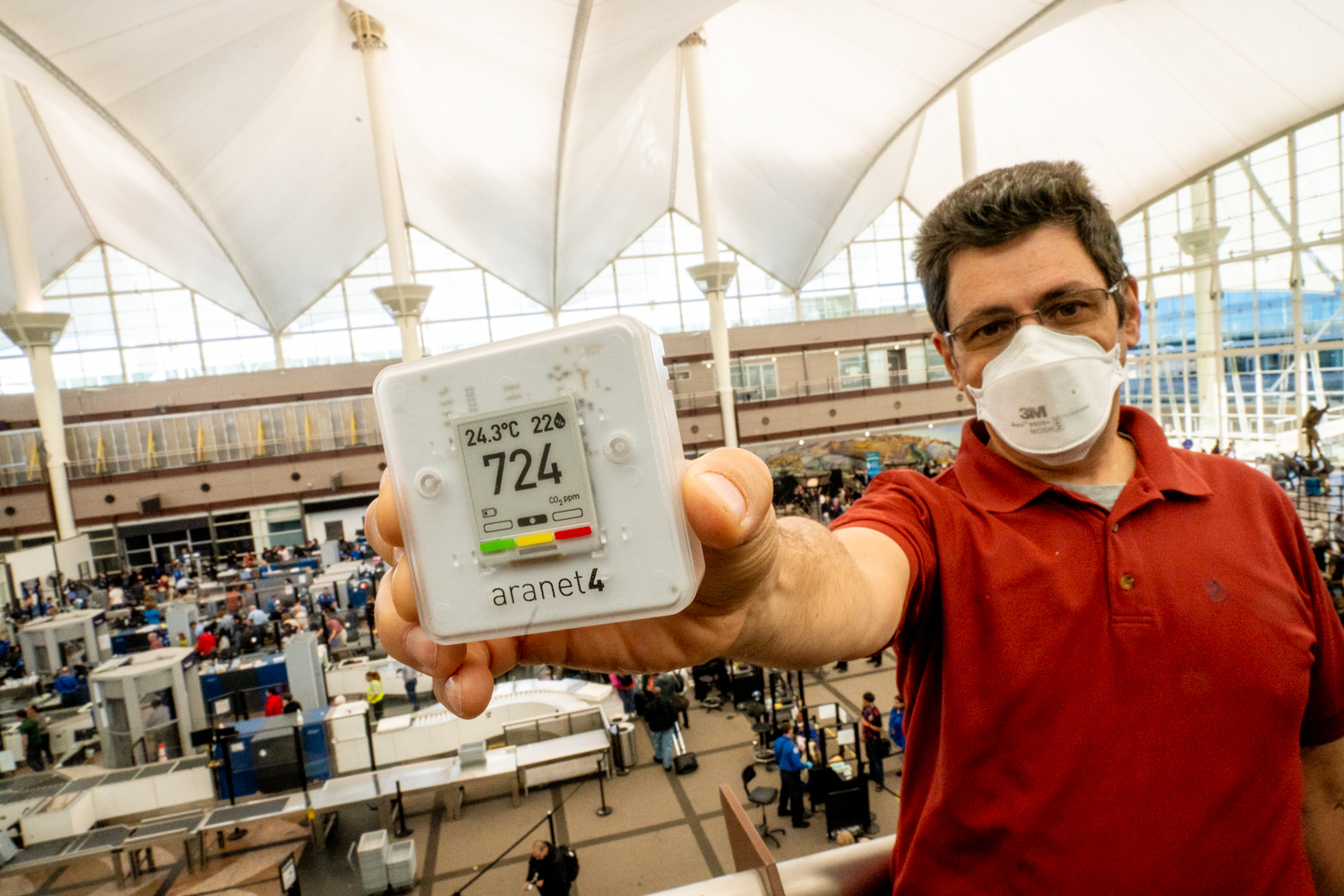
Hart Van Denburg/CPR News Jose-Luis Jimenez is a CU Boulder professor whose expertise includes aerosols, atmospheric chemistry and disease transmission. At Denver International Airport on Monday, Oct. 18, 2022.
A push for better indoor air quality at DIA
The crisis has sparked new efforts and reforms aimed at improving indoor air quality, including Japan, Taiwan, South Korea and Belgium, said Jimenez.
Lawmakers in Belgium passed a ventilation plan requiring publicly accessible places, like bars, restaurants, cinemas, theaters and gyms, to monitor air quality and have a visible CO2 monitor. That sensor could not be immediately near a door or window, which would lower readings but not reflect the true levels in a space, according to The Brussels Times.
The push to alert the public about indoor air quality has become a global movement. Jimenez’s dream is to have a CO2 monitor in every building, every plane, every train so people can see for themselves.
Denver International Airport currently monitors CO2 levels at all spaces in the Airport Office Building, the main terminal and concourses, said public information officer Stephanie Figueroa.
And more is to come on that front. Concourse B and new expansions in concourses A and C have a monitoring system “which will automatically trigger fresh air” to be introduced in the HVAC system once the CO2 level exceeds 900-1,000 ppm, she wrote in an email. The main terminal building and concourses A and C will have an automatic system to introduce fresh air as part of upgrades related to its a new environmental performance contract it announced a few weeks ago had begun construction.
DIA is also installing new CO2 sensors all around the airport as part of renovations there and will post readings on thermostats the public can see, she said.
For its part, RTD said it agrees that CO2 monitoring gives an indication of the ventilation capability in a space and that that is an indicator or air quality.
Senior public relations specialist Laurie Huff said the agency’s trains are well ventilated and readings on a CO2 monitor “don’t correspond directly to risk of infection” – it corresponds to the number of people breathing in the space. Several other factors need to be looked at “to understand what is happening to the air inside a bus, plane or train, including but not limited to circulation or movement in the vehicle, filtration, temperature and humidity,” Huff wrote in an email.
Hart Van Denburg/CPR News Jose-Luis Jimenez uses a carbon dioxide measuring device as a proxy for air quality on an RTD A Line train headed to the Denver International Airport on Monday, Oct. 18, 2022.
On its website, RTD addresses air quality on light rail, commuter rail and buses, as well as the underground bus concourse at Union Station.
On commuter rail lines, like the A-line to DIA, the website states the HVAC system exchanges the air within each rail car “about every four minutes – or 15 times per hour – with the doors closed, an estimate determined by a vehicle engineer.” Additional fresh air is introduced into the passenger compartment each time a commuter rail train stops at a station and the doors open.
Each car includes two HVAC rooftop units that run independently of each other in the event that one fails. With both rooftop units running, 3,800 cubic feet per minute of air is supplied to each car, 29 percent of which is fresh, 71 percent recirculated, according to the site. This air is supplied using overhead ducting and registers that run the length of the car and returned to each unit in the ceiling near the passenger doors on each end.
Bottom line?
"The more people in close proximity, the higher the risk," Huff said. "RTD can lower this risk somewhat with ventilation and filtering, but we will not eliminate it. The amount of risk each person is willing to take is a personal decision."