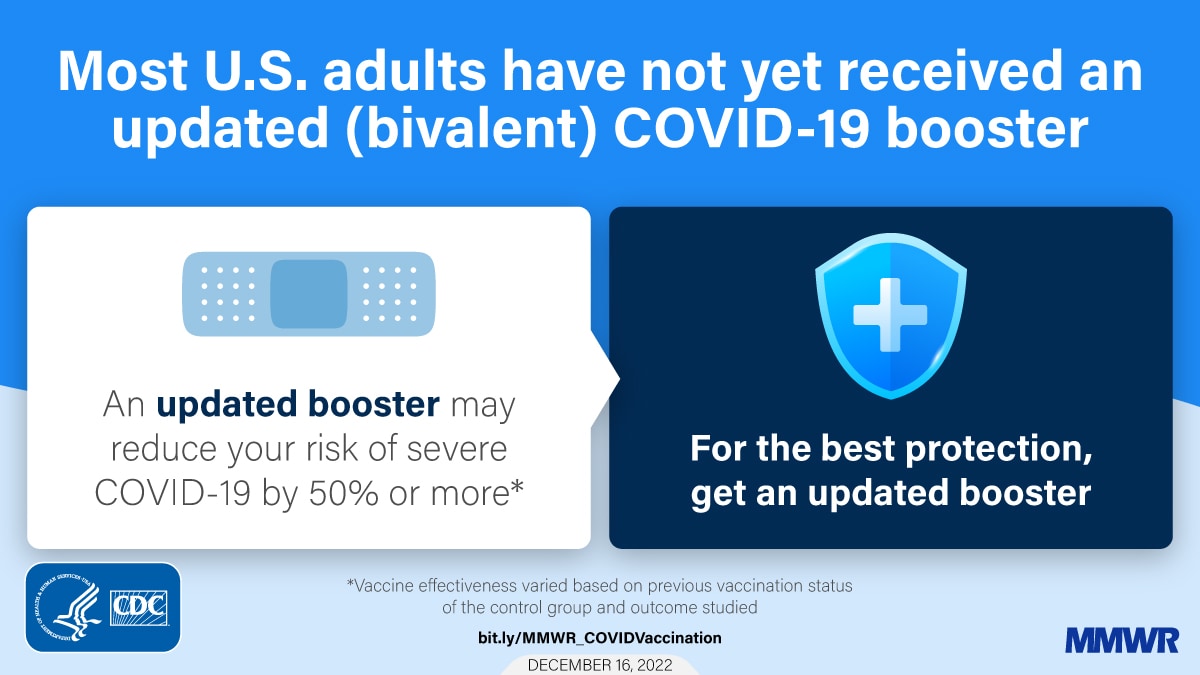
Monovalent COVID-19 mRNA vaccines, designed against the ancestral strain of SARS-CoV-2, successfully reduced COVID-19–related morbidity and mortality in the United States and globally (1,2). However, vaccine effectiveness (VE) against COVID-19–associated hospitalization has declined over time, likely related to a combination of factors, including waning immunity and, with the emergence of the Omicron variant and its sublineages, immune evasion (3). To address these factors, on September 1, 2022, the Advisory Committee on Immunization Practices recommended a bivalent COVID-19 mRNA booster (bivalent booster) dose, developed against the spike protein from ancestral SARS-CoV-2 and Omicron BA.4/BA.5 sublineages, for persons who had completed at least a primary COVID-19 vaccination series (with or without monovalent booster doses) ≥2 months earlier (4). Data on the effectiveness of a bivalent booster dose against COVID-19 hospitalization in the United States are lacking, including among older adults, who are at highest risk for severe COVID-19–associated illness. During September 8–November 30, 2022, the Investigating Respiratory Viruses in the Acutely Ill (IVY) Network§ assessed effectiveness of a bivalent booster dose received after ≥2 doses of monovalent mRNA vaccine against COVID-19–associated hospitalization among immunocompetent adults aged ≥65 years. When compared with unvaccinated persons, VE of a bivalent booster dose received ≥7 days before illness onset (median = 29 days) against COVID-19–associated hospitalization was 84%. Compared with persons who received ≥2 monovalent-only mRNA vaccine doses, relative VE of a bivalent booster dose was 73%. These early findings show that a bivalent booster dose provided strong protection against COVID-19–associated hospitalization in older adults and additional protection among persons with previous monovalent-only mRNA vaccination. All eligible persons, especially adults aged ≥65 years, should receive a bivalent booster dose to maximize protection against COVID-19 hospitalization this winter season. Additional strategies to prevent respiratory illness, such as masking in indoor public spaces, should also be considered, especially in areas where COVID-19 community levels are high (4,5).
During September 8–November 30, 2022, adults aged ≥65 years admitted for COVID-19–like illness¶ to any of 22 hospitals in 18 states participating in the IVY Network were eligible for inclusion in this test-negative design, case-control analysis. Among patients hospitalized with COVID-19–like illness who received testing for SARS-CoV-2 by nucleic acid amplification test or antigen test, those who received a positive test result ≤10 days after illness onset and ≤3 days after hospital admission were classified as case-patients, and those who received a negative test result during the same interval were classified as control patients. Upper respiratory specimens were collected from enrolled patients and retested by reverse transcription–polymerase chain reaction for SARS-CoV-2 and influenza at a central laboratory (Vanderbilt University Medical Center). Patients who were initially enrolled as controls on the basis of negative SARS-CoV-2 test results at their local hospital, but whose test results by central laboratory testing were positive, were reclassified as case-patients in the analysis. Control patients whose influenza test results were positive were excluded from the analysis because of potential correlation between COVID-19 and influenza vaccination behaviors (6).
Demographic and clinical data were obtained through electronic medical record (EMR) review and patient (or proxy) interview. COVID-19 mRNA vaccination status was verified from EMR, state-based registries, vaccination cards, or self-report. Three COVID-19 vaccination groups were defined as: 1) unvaccinated (no COVID-19 vaccine doses received); 2) vaccinated with ≥2 monovalent-only mRNA vaccine doses with last dose ≥2 months before illness onset; and 3) vaccinated with ≥2 monovalent-only mRNA vaccine doses plus a bivalent booster dose ≥2 months after receipt of the last monovalent mRNA vaccine dose. Analyses excluded patients with immunocompromising conditions,** those who received a bivalent booster dose <7 days before illness onset or ≤2 months after their last monovalent vaccine dose, those who received a non-mRNA COVID-19 vaccine, and those with other exclusions.††
Absolute VE against COVID-19–associated hospitalization was estimated by comparing the odds of bivalent booster dose receipt with no COVID-19 vaccination between case-patients and control patients. Relative VE, which is a measure of the additional protection against COVID-19 hospitalization from a bivalent booster dose compared with residual protection from previous monovalent vaccination, was estimated by comparing the odds of bivalent booster vaccination with receipt of ≥2 monovalent-only mRNA vaccine doses between case-patients and control patients. Relative VE was stratified by number of months (i.e., 2–5, 6–11, or ≥12) between the last monovalent vaccine dose and illness onset. Using multivariable logistic regression models, VE was estimated as (1 − adjusted odds ratio [aOR]) x 100). Models were adjusted for U.S. Department of Health and Human Services region, admission date in 2-week intervals, continuous age, sex, race, and Hispanic or Latino (Hispanic) ethnicity. Estimates with nonoverlapping 95% CIs were considered statistically significant. Analyses were conducted using SAS (version 9.4; SAS Institute). This activity was determined to be public health surveillance by each participating site and CDC, and was conducted consistent with all applicable federal laws and CDC policy.§§
During September 8–November 30, 2022, a total of 1,168 immunocompetent adults aged ≥65 years were enrolled in the IVY Network. After exclusion of 370 patients,¶¶ 798 (68%) were included in this analysis (381 case-patients and 417 control patients) (Table 1). The median age of included patients was 76 years (IQR = 70–83 years), 118 (15%) were non-Hispanic Black or African American, 78 (10%) were Hispanic, 588 (74%) had at least two underlying conditions, and 66 (8%) had self-reported or documented SARS-CoV-2 infection before the current illness episode during the Omicron period (December 26, 2021–November 30, 2022). Among the 381 case-patients, 81 (21%) were unvaccinated, 280 (73%) had received ≥2 monovalent-only mRNA vaccine doses, and 20 (5%) had received a bivalent booster dose. Among 417 control patients, 62 (15%) were unvaccinated, 296 (71%) had received ≥2 monovalent-only mRNA vaccine doses, and 59 (14%) had received a bivalent booster dose.
The median interval between receipt of a bivalent booster dose and illness onset was 29 days (IQR = 15–45 days) (Table 2). When compared with unvaccinated patients, VE of a bivalent booster dose in preventing COVID-19–associated hospitalization was 84%. When compared with patients who had received ≥2 monovalent-only mRNA vaccine doses ≥2 months before illness onset, relative VE of a bivalent booster dose was 73%. When compared with patients whose last monovalent dose was 6–11 months and ≥12 months before illness onset, relative VE of a bivalent booster dose was 78% and 83%, respectively. Small sample size precluded estimation of the relative VE of a bivalent booster dose compared with receipt of ≥2 monovalent-only mRNA vaccine doses with last dose 2–5 months before illness onset.***