To study the childhood SES of US faculty, we conducted a large survey of tenure-track faculty at Ph.D.-granting departments in the United States from eight academic disciplines. Responses include information on the education levels of parents and the zip code where faculty grew up. We augmented our survey data with national estimates of educational attainment, income and rural or urban classification by zip code from the US Census, National Science Foundation (NSF) Survey of Earned Doctorates (SED), Internal Review Service (IRS), US News and World Report (USNWR) and the National Research Council (NRC), which allowed us to contrast survey characteristics with patterns in the general US population.
We conducted the online survey between summer 2017 and autumn 2020 on a frame of 46,692 current tenure-track faculty across 1,360 Ph.D.-granting departments in Computer Science, Business, History, Psychology, Physics and Astronomy, Sociology, Anthropology and Biology. These eight academic disciplines were chosen for their diversity of scholarship and represent a broad sample of tenure-track faculty at research intensive institutions in the United States. The sample frame was constructed from the online public directories of institutions, allowing us to explicitly compare respondents with the frame.
In total, 7,204 faculty provided information on a parent’s level of highest education (15.4% of survey frame) and 4,807 provided the US zip code in which they grew up (10.3%).
Parents’ education
Faculty tend to come from highly educated families. Nearly a quarter (22.2%) report at least one of their parents holds a Ph.D., and 3.7% of faculty report both parents hold Ph.D.s. Across all eight disciplines, over half (51.8%) of faculty have at least one parent with a masters degree or Ph.D. (29.6% and 22.2%, respectively; Table 1). In comparison, among adults in the United States aligned to when faculty were born, on average, less than 1% held a Ph.D., and just 7.4% held a graduate degree of any kind.
Table 1 Percentages of faculty by their parents’ highest-held degree Full size table
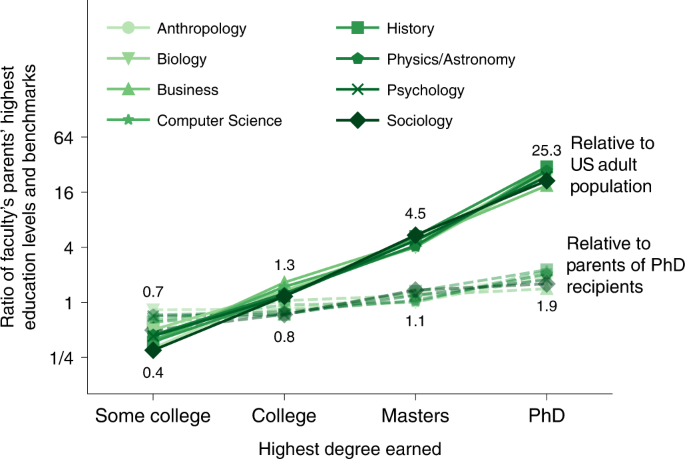
We calculated the relative likelihood that a faculty member has a parent with a Ph.D., compared with either the US adult population or parents of Ph.D. recipients, by estimating upper and lower bounds. These bounds correspond to differences in whether these datasets described individuals (US Census and NSF SED) versus households. Across all eight fields, we estimate that faculty are on average between 12 and 25 times more likely to have a parent with a Ph.D. than the general population, and about twice as likely as other individuals who hold a Ph.D. (Fig. 1 and Supplementary Note C).
Fig. 1: Ratios of faculty parents’ education to broader populations. Percentages of faculty members by their parents’ educational attainment levels (n = 7,204) divided by either percentages of the US adult population in those educational attainment levels (solid) or percentages of Ph.D. recipients with parents’ in those educational attainment levels (dashed)68,69. Disciplines denoted by symbols. Full size image
The distributions of parents’ educational attainment are similar across the disciplines surveyed, suggesting that despite disciplinary differences in scholarship, funding and culture, having a parent with a Ph.D. is universally advantageous for becoming a professor. The rates at which parents of faculty have a college degree or higher have also slightly increased over time, which mirrors broader social trends in the US population (Fig. 2). Women are particularly more likely to have highly educated mothers: 33.3% of women versus 28.3% of men have a mother who holds a graduate degree (two-tailed test, z = 4.5, n = 7,107, 95% CI = 0.028 to 0.073, P < 0.001). Historically, rates of parents’ college completion among women faculty are higher than among men faculty; however, this gap has steadily closed over time fully reaching parity for faculty born in 1985 (Fig. 2).
Fig. 2: Percentages of faculty with college-educated parents by gender and across time. Percentages of faculty reporting their parents’ highest level of education was at least a college degree by faculty year of birth (green), compared with the fraction of US adults earning a college degree or higher in a given year (black). Grey arrows show the difference between men faculty and US adult trends. Full size image
Academic support
We find that faculty with Ph.D. parents are far more likely to receive support and encouragement for their academic careers from their parents (on a scale of 1 to 5: 4.5 versus 3.9 for less than Ph.D., two-tailed test, t = 17.2, n = 5,725, 95% CI = 0.497 to 0.625, P < 0.001), which is consistent with prior work32. This question came from an optional later section of the survey, but responses were representative along faculty rank and departmental prestige of the frame (Supplementary Note A). In fact, the career support that faculty report receiving from their parents increases with greater parental education (Fig. 3) and does not depend on faculty gender (average rating of 4.0, two-tailed test, t = − 0.2, n = 5,695, 95% CI = −0.072 to 0.057, P = 0.827). This strong correlation between parental education and faculty career support suggests that the family resources and experiences of faculty with highly educated parents differ from those without highly educated parents and differ in ways that correlate with improving the odds that a person becomes a professor. For example, the degree of family support is known to correlate with both undergraduate and graduate student retention19,33. Given what is known about educational stratification, we expect that there are other sociocultural mechanisms through which being the child of highly educated parents increases the chances of becoming faculty, such as greater identification with academic ideals, more and earlier experiences in activities valued by academia, or simply closer role models34.
Fig. 3: Parental support by education level. Amount of support parents provided for academic careers on a scale of 1 (None at all) to 5 (A lot), stratified by faculty members’ parents’ highest education levels. Full size image
(Proxied) parents’ income
Faculty also tend to spend their childhoods in wealthier zip codes than do the general public (Fig. 4). The median proxied household income based on zip code data for surveyed faculty when they were children is 23.6% higher than the median across all zip codes (US $73,000 versus US $59,000, Mann–Whitney U, ρ = 0.4, n = 1.2 × 10⁸, P < 0.001). Consistent with the importance of parental education on faculty careers, proxied parental income is correlated with parental education: faculty who reported that at least one of their parents holds a college degree were associated with higher average proxied household incomes (US $78,000) than those who said their parents did not hold a college degree (US $59,000; ρ = 0.3, n = 3,916, P < 0.001). Across disciplines, median proxied parental income remains relatively high, ranging from US $67,000 (Sociology) to US $78,000 (History). Faculty are more likely to have grown up in urban areas compared with the geographic distribution of the US population around the average year faculty were born (89.6% versus 73.6%, point estimates)35. And the majority of faculty reported that their parents owned a home during the first 18 years of their life (75.7% versus 13.4% said primarily rented, and 10.9% rented and owned equally, point estimates), higher than one would expect given rates in the United States at the time (62% of homes owned by their occupants in 196036). Hence, faculty tend to come from families with relatively stable childhood financial circumstances.
Fig. 4: Parental income distribution. Average income distribution estimated using faculty members’ childhood zip codes (green), compared with the income distribution across the 1998 US population (black). Full size image
Impact of parental education on becoming faculty
Because the educational attainment of parents is strongly correlated with becoming faculty, we can use data on how many Ph.D.s are granted in a given year to forecast the changing composition of the professoriate. To better quantify this relationship, we model how the likelihood of having Ph.D. parents depends on a scholar’s characteristics.
Conditioned on having a parent with a Ph.D., the probability of becoming a faculty member is given by:
$$\Pr \left({{{\rm{faculty}}}}| {{{\rm{Ph.D.}}\,{\rm{Parent}}}}\right)=\frac{\Pr \left({{{\rm{Ph.D.}}\,{\rm{Parent}}}}| {{{\rm{faculty}}}}\right)\,\Pr \left({{{\rm{faculty}}}}\right)}{\Pr \left({{{\rm{Ph.D.}}\,{\rm{Parent}}}}\right)}$$
where our estimates of \(\Pr \left({{{\rm{Ph.D.}}\,{\rm{Parent}}}}\,| \,{{{\rm{faculty}}}}\right)\) and \(\Pr \left({{{\rm{Ph.D.}}\,{\rm{Parent}}}}\right)\) are given by the probability of faculty with Ph.D. parents in our survey, and the probability of an adult having a Ph.D. close to the birth year of a professor (22.2% and 0.9%, respectively, Table 1). To estimate the probability of being a tenure-track faculty \(\Pr \left({{{\rm{faculty}}}}\right)\), we assess the proportion of the US adult workforce employed in postsecondary education recorded by the Bureau of Labor Statistics, around the year in which a professor started their job (0.4%)37. Because tenure-track faculty are just one kind of employee in postsecondary education, it is likely that this approach overestimates the percentage of the workforce employed as tenure-track faculty.
Combining these quantities, we estimate that the probability of becoming a faculty member given that one’s parents hold a Ph.D. \(\Pr \left({{{\rm{faculty}}}}\,| \,{{{\rm{Ph.D.}}\,{\rm{Parent}}}}\right)\) is 9.5%, indicating a strong degree of both educational heritability and substantial professional advantage.
Relationships with sociodemographic diversity
To the extent that becoming a professor is strongly influenced by having parents with doctoral degrees, our results paint a disheartening picture for efforts to build a racially diverse pipeline to the professoriate. Broad social and educational inequality within the United States indicates that Black and Hispanic adults are less likely to hold graduate degrees of any kind compared with white adults (Fig. 5). Our race/ethnicity-independent estimate of the probability of becoming faculty may overestimate the production of Black or Hispanic faculty because it fails to account for the lower probability of Ph.D. parents among Black and Hispanic children conditional on SES. Obtaining a precise race/ethnicity-conditioned estimate would require additional conditional estimates that are not currently available (for example, the proportion of Black and Hispanic people who obtain faculty positions).
Fig. 5: Ph.D. attainment by racial or ethnic group. Percentages of white, Black, Hispanic and Asian adults (at least 25 years old) in the US population who hold doctorate degrees84. Trends are smoothed with averages every three years. Full size image
However, we do find evidence of racial differences within our survey results: white professors are more likely to have a parent with a Ph.D. (23.4%, n = 5,905, point estimate) compared with Black or Hispanic faculty (17.2% and 16.9%, respectively, n = 518, point estimates). This distinction is even more pronounced among women surveyed, where 25.5% of white women have a Ph.D. parent versus 14.6% of Black women (point estimates, Supplementary Table 3). To the extent that the probability of becoming faculty depends on parental education, and specifically on having Ph.D. parents, this large racial gap in Ph.D. attainment is an intergenerational impediment to the proportion of Black and Hispanic scholars who become tenure-track faculty.
The relationship between parents’ education and the gender composition of the professoriate is complex. For instance, women in our sample are more likely to have Ph.D. parents than are men (24.8% versus 20.8%, point estimates). Identifying the reasons underlying this pattern is an interesting direction for future work. Of course, SES does not impede gender diversity in academia in the same way or to the extent that it does for racial diversity. Nevertheless, parents may differentially allocate resources to sons and daughters that influence their academic achievement38. Moreover, the intersection between race/ethnicity and gender is not neutral with respect to the likelihood of becoming faculty. For example, Black women faculty are less likely to have Ph.D. parents than are Black men (Supplementary Table 3). Prior evidence suggests that there has been a growing gender gap in college completion, with women outpacing men, among both white and, to a larger extent, Black Americans39. The overrepresentation of Black men from educationally privileged families may imply a differential selection within academia, wherein Black men need more social capital to pursue these careers. Untangling how gender, race/ethnicity and social origins interconnect to shape who pursues academic careers, and specifically why Black women professors were less likely to come from more educationally privileged families, is an important direction for future research.
Trends in socioeconomic origins
Academia has undergone many dramatic shifts over the past 100 years, and our survey reveals several interesting and related trends. For instance, we find that the rate of faculty born from 1940 to 1960 reporting that a parent holds a Ph.D. has increased from 13% at the beginning of the period to 26% by the end (Fig. 6a), but then remains stable at above 20% across the next 50 years. This increase from the 1940s to 1960s mirrors the increasing college and graduate school enrolment rates within the United States over the same period40,41, and hence may simply reflect a general broadening of access to higher education. However, the subsequent stability of the rate at which faculty have a Ph.D. parent, in contrast to the continuing growth in and diversifying demographics of doctoral degree attainment42, suggests that the relationship between the educational attainment of faculty parents and the likelihood of becoming faculty has been consistent and strong for nearly half a century.
Fig. 6: Trends in the percentage of faculty with a Ph.D. parent. a, Percentage of faculty with at least one parent holding a Ph.D., stratified by prestige of the faculty’s current institution. Green upward triangles describe faculty at the top 20% of institutions by USNWR or NRC ranking, and downward triangles the bottom 20% of ranked institutions. Shaded regions denote empirical 95% confidence intervals. The black line describes the average proportion of faculty with Ph.D. parents. b, Current institutional ranking of professors surveyed and the percentage of surveyed faculty at that institution who have a parent with a Ph.D. Dots indicate empirical estimates for 1,360 universities of more to less prestige; lines show a stable negative relationship between increasing institutional ranking and having a Ph.D. parent for faculty born in 1940–1960 (dark green), 1960–1980 (medium green) and 1980–2000 (light green). Full size image
Parental education is so consequential that it also correlates with where in the academic hierarchy a professor lands. Across all years, we find that nearly a third of faculty at top-ranked universities across all eight fields report that one of their parents holds a Ph.D., and faculty at these elite departments are 57.4% more likely to have a parent who holds a Ph.D. than are faculty at the least prestigious departments (29.8% versus 19.0%; two-tailed test, z = 6.5, n = 2,612 95% CI = 0.076 to 0.142, P < 0.001). This concentration among elite departments is consistent with prior research documenting the ways academic hiring tends to devalue faculty of lower socioeconomic standing 26,27, and advantage faculty from more privileged backgrounds.
Modelling faculty placement
Adjusting for faculty discipline, Ph.D. prestige, race/ethnicity and gender within a model, we find that faculty who had parents who attended college tend to be employed at significantly more prestigious universities than faculty without these childhood socioeconomic advantages (Table 2). We recognize that Ph.D. prestige may in fact be endogenous to this model of faculty placement because of Ph.D. placement’s likely relationship with parents education, but regardless include it as a control due to the strong evidence of its importance in predicting faculty placement43. Here, institutional prestige is defined by ordinal ranking, where the most prestigious universities have smaller rank (1), and less prestigious have larger rank (100). On average, faculty with a Ph.D. parent move ‘up’ in the institutional rankings by nearly 7 percentile ranks (two-tailed test, t = −3.4, n = 2,709, 95% CI = −10.536 to −2.850, P = 0.001). Faculty who grew up in wealthy neighbourhoods, who are also less racially diverse than the general population, also tended to place at more prestigious institutions. SES may constrain an individual’s search for a faculty job either by influencing which institutions they apply to, or by shaping their ability to stay on the academic track while searching for employment (Supplementary Note D). These results have direct implications for efforts to increase the socioeconomic and racial diversity of the professoriate, particularly at the most prestigious institutions that train most future professors43. The higher-prestige placement of faculty from advantaged socioeconomic backgrounds also represents a structural barrier to the visibility of the ideas of lower SES faculty because scientific discoveries made at more prestigious universities are more likely to spread throughout academia44.
Table 2 Regression of current institutional prestige based on childhood SES Full size table
Disadvantaged socioeconomic origins
Despite the significant correlation between having a parent who holds a Ph.D. and placement as faculty in the prestige hierarchy, not all faculty at elite universities (here: top 20% by USNWR or NRC) have this advantage. For elite faculty without Ph.D. parents, career support from colleagues both within and beyond their institution, and the wealth and urbanicity of their childhood zip code all become more important factors in explaining their placement at an elite institution. Faculty without Ph.D. parents who are employed at prestigious institutions report slightly higher levels of support from colleagues compared with those at lower-ranked institutions both within their institution (4.0 versus 3.8; two-tailed test, t = 3.6, n = 4,449, 95% CI = 0.078 to 0.261, P < 0.001), and outside their institution (4.0 versus 3.9; two-tailed test, t = 2.6, n = 4,448, 95% CI = 0.028 to 0.204, P = 0.009).
Most faculty earned their Ph.D.s at elite institutions43. Faculty without a Ph.D. parent, currently employed at an elite university, were more likely to come from more elite Ph.D. programmes than were similar faculty at non-elite universities (5.5 versus 14.0 median; Mann–Whitney U, ρ = 0.3, n = 3,813, P < 0.001). Furthermore, without Ph.D. parents, faculty at the top institutions are more likely to come from urban neighbourhoods (92.3% versus 87.3%) that are higher income (US $80,000 versus US $69,000 median; Mann–Whitney U, ρ = 0.4, n= 2,974, P < 0.001).