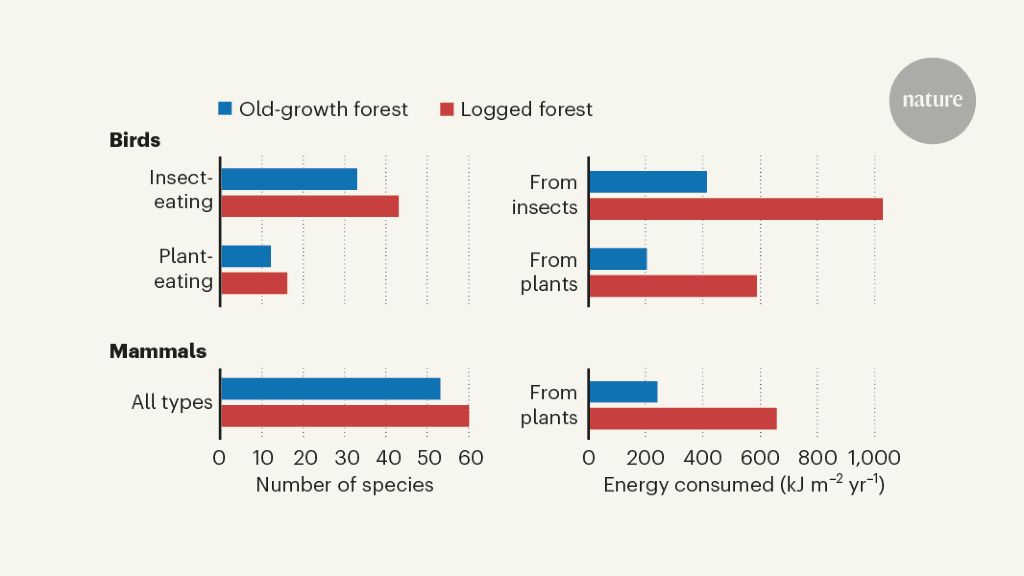
Hearing the terms tropical forest and logging commonly evokes images of deforestation. Yet most tropical timber is produced by felling only a limited number of trees in a piece of forest, leaving the structure of the forest mostly intact. As long as they are managed well, logged tropical forests also retain most of their species of plants and animals1. These forests represent more than one-quarter of all tropical forests worldwide2 — an area twice the size of Mexico — so they can make an important contribution to nature conservation. Despite this, logged tropical forests are often regarded as being degraded and in need of recovery. Writing in Nature, Malhi et al.3 provide a very different view of these ecosystems. Gathering an impressive number of field observations, the authors reveal that the logged forests they studied harboured more animal species and were ecologically more ‘energetic’ than were the unlogged forests.
Nature 612, 636-637 (2022)
doi: https://doi.org/10.1038/d41586-022-04356-2
References Putz, F. E. et al. Conserv. Lett. 5, 296–303 (2012). Blaser, J., Sarre, A., Poore, D. & Johnson, S. Status of Tropical Forest Management 2011. ITTO Tech. Ser. No. 38 (International Tropical Timber Organization, 2011); available at https://go.nature.com/3usq2an Malhi, Y. et al. Nature 612, 707–713 (2022). Zwerts, J. A. et al. Conserv. Sci. Pract. 3, e568 (2021). Wilkie, D. S., Bennett, E. L., Peres, C. A. & Cunningham, A. A. Ann. N. Y. Acad. Sci. 1223, 120–128 (2011). Putz, F. E., Blate, G. M., Redford, K. H., Fimbel, R. & Robinson, J. Conserv. Biol. 15, 7–20 (2001). Download references
Competing Interests The authors declare no competing interests.
Related Articles
Subjects