Subjects
A total of 2,352 adult dogs participated in a smartDOG™ test battery25 between March 2016 and February 2022. Participating dogs were required to be interested in working for food, and to not be overly aggressive to people. We limited the analysis to dogs between the ages of 1 and 8 years, since cognitive traits may not have fully developed in younger dogs26,27, while older dogs may experience cognitive decline28. We included only dog breeds with a minimum of 40 individuals tested per breed. This resulted in a final sample size of 1,002 dogs representing 13 breeds, including one category consisting of mixed breeds. Any individual which had parents belonging to different breeds was classified as mixed breed, except for the Labradoodle. Details of participant dogs’ ages, sexes, and breeds are presented in Table 1.
Table 1 Number of dogs within each breed and their sexes and median ages. Full size table
Participant dogs took part in a test battery involving multiple tests, but not all dogs had results for every test included in this study (see Supplementary Table S1 for number of participant dogs in each test section). Most of the results for each test came from the same dogs, with some results missing, mostly because 17% of the dogs took part in a shortened version of the test battery (see Supplementary Materials S1 for details).
Most participant dogs were privately owned pet dogs. We did not have information on the training history of most dogs, apart from 31 police dogs (see Suppl. Table S2). A large proportion of the pet dogs were actively used in various dog sports (e.g., agility, scent work, obedience, etc.), based on discussions the testers have had with participating owners. Most dogs (including the police dogs) lived inside the house with their owners.
Cognitive test battery
Dogs included in the study were participants in a commercial cognitive test battery (smartDOG™)25, which was developed by one of the authors (KT) based on previous scientific publications. Tests were performed by eight trained female smartDOG licence testers (including KT) at testing sites across Finland. We included 10 tests, seven of which measured cognitive traits and three of which measured behaviour. Descriptions of included tests are outlined in Table 2.
Table 2 Description of each test included in the study, in the order in which they were presented to the dog during the COGNITION test battery. Full size table
All tests involved solving various problems with food rewards. The owners were asked to bring the dog’s favourite treats, which were then used as rewards. In some cases, a toy was also used, if the dog was more motivated by toys than food. The owner was advised not to feed their dog prior to the test to ensure food motivation during the test. Fresh drinking water was available throughout the test. Testing took place indoors, and the minimum size of the testing room was approximately 30 m2. Most often only the tester, owner, and dog were present during testing, but occasionally family members were present as observers. The dog was off the lead throughout the test battery. A short break was included in the COGNITION test battery, during which the owner was asked to walk the dog outside for a maximum of two minutes.
The order of tests was the same for all dogs to ensure consistency across subjects. Each test included several trials. At the beginning of each trial, the tester always drew the dog’s attention, if necessary, by showing them a treat and saying the dog’s name. A (Finnish) word, such as “ok” or similar, was used to indicate to the owner the beginning of each trial. The owner was advised to release the dog upon hearing this word during the test battery. After each trial, the owner called or moved the dog back to the starting position using the collar and held the dog in place before releasing the dog for the next trial. The owner was advised to remain quiet and neutral when the dog was focusing on a task, but they were allowed to praise the dog when the dog ate a treat. Only during the V-detour was the owner allowed to encourage the dog to continue if the dog continuously stared at the owner. Between test sections, the dog was free to walk around for about 1–2 min.
A short description of each test is provided below, and more detailed information can be found in the Supplementary Information S1. An example of each cognitive test can also be found in the supplementary videos S1.
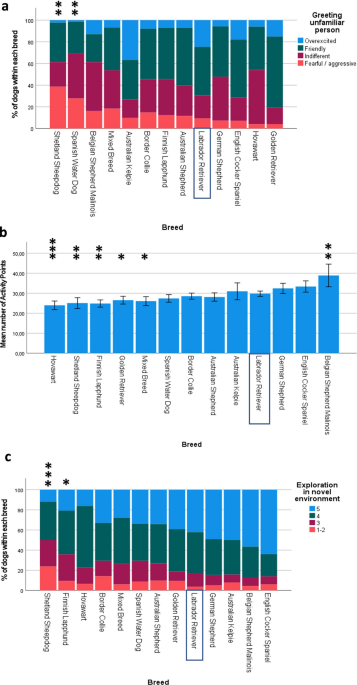
Greeting
When the owner and dog first entered the test room, the dog’s response to the tester (an unknown person) was rated. The tester faced the dog while talking in a friendly voice and allowed the dog to approach herself. If the dog was not fearful or aggressive, the tester bent down and attempted to stroke the dog. The tester then continued stroking the dog as long as the dog was willing. This test lasted between 1–2 min in total.
The tester rated the dog’s response according to a scale ranging from 1 to 7. For analysis purposes, these scores were condensed into four groups: ‘fearful’ (score 1–3), ‘indifferent’ (score 4–5), ‘friendly’ (score 6), and ‘overexcited’ (score 7). The largest category (‘friendly’) was used as the reference category.
Activity level
After the tester had greeted the dog, she attached a FitBark (FitBark Inc., Kansas City, MO, USA) activity monitor to the dog’s collar or harness. FitBark generates ‘BarkPoints’ (from here on referred to as ‘activity points’), which represent a proxy measure for the average activity level of the dog during the test battery. The monitor was kept on throughout testing and taken off when the test battery ended. Only dogs which had taken part in the COGNITION test battery were analysed.
Exploration
After the FitBark had been attached, the dog was released and allowed to freely explore the test room for approximately five minutes. The tester rated the dog’s behaviour on a scale of 1–5. These scores were condensed into four groups: ‘low investigation’ (score 1–2), ‘moderate investigation’ (score 3), active investigation, walking (score 4), and very active investigation, running (score 5). The aim of this test was to measure the extent to which the dogs were willing to investigate a novel environment, which is thought to be an indication of curiosity, boldness, and activity level, whereas remaining by the owner’s side was thought to be a possible indication of fear, anxiety, or neophobia.
The cylinder test
The cylinder test has been used extensively in animal cognition research to study impulsivity and inhibitory control29, more specifically the motor inhibitory response. Inhibitory control is a core executive function, which involves suppression of a prepotent but inefficient behaviour in favour of a more beneficial response. In this test, the dog is required to inhibit reaching directly for a visible food reward and instead detour around the transparent barrier to reach the reward.
The owner and dog were positioned 2–2.5 m away from the cylinder. During the training trials, the cylinder was opaque, and the dog was taught to access a food reward from either of the open sides. The experimenter stood directly behind the cylinder and placed a food reward inside while the dog was watching. The dog was then released and allowed to eat the treat (Supplementary Video S1). After the dog fulfilled the learning criteria (4 out of 5 trials without touching the outside of the cylinder), the test phase began. During the test phase the cylinder was transparent, and the dog was required to inhibit reaching for the now visible food directly, and to instead go around to the side of the cylinder to access the reward (Supplementary Video S2). Each trial during which the dog touched the outside of the cylinder was marked as an incorrect trial. If the dog ate the food without first touching the outside of the cylinder, this was marked as a correct trial. Percentage of correct responses (out of a total of 10 trials) was used as the response variable.
Human gestures
Dogs’ understanding of pointing and other human gestures is often used as a measure of social cognition30,31. The test battery included five different gestures. Before the test phase, the dog was familiarized with the test set-up over four training trials, during which the dog was simply taught that food is available in either of the two bowls. (See Supplementary Video S3 for the training phase procedure.).
During the test phase, dogs took part in six trials for each gesture (30 trials in total). (See Supplementary Video S4 for the test procedure for each of the five gestures.) The percentage of correct responses (out of 30 trials) was calculated from all the gesture tests combined. The order of rewarded bowls was the same for each dog, starting with the left side. Every other trial was rewarded to the right and every other to the left. In order to ensure dogs were not learning this pattern, the percentage of correct responses from the final 6 trials (gaze) were compared to the percentage of correct responses from the first 6 trials (dynamic distal pointing) using a two-tailed paired t-test.
The trial always started with the dog and owner facing the tester, standing 2–2.5 m away. The tester showed a piece of food to the dog and placed it inside one of the bowls which she held in her hands. The bowls were placed on the floor in front of the tester, 95 cm apart from each other. Making sure the dog was watching, the tester provided the gesture (these are described in more detail below). After this, the dog was released and allowed to make a choice.
The procedure for each gesture was the same as described above. Each dog received the gestures in the same order (6 trials each): (1) dynamic distal pointing: the tester pointed at the correct bowl with an extended arm and index finger after which the dog was released, and the tester kept her arm in the same position while the dog made their choice, (2) momentary distal pointing: the tester pointed at the correct bowl with an extended arm and index finger for a duration of 2 s, after which the tester lowered her arm and the dog was released while the tester’s arms were flush at her sides, (3) dynamic proximal foot pointing: the tester placed the tip of her foot on the ground directly behind the correct bowl, and the dog was released while the tester remained in this position, (4) dynamic cross-forward pointing: THE tester used her contralateral arm to point at the correct bowl while rotating her shoulders in the same direction, sustaining this position while the dog made their choice, (5) gaze: the tester alternated her gaze between the dog and the bowl three times, and the dog was released while the tester maintained her gaze on the correct bowl.
V-detour
The V-detour has been used in canine cognitive research to investigate spatial problem-solving ability29. The dog has to detour around a transparent V-shaped fence to access a food reward which is placed on the other side (Supplementary Video S5). Since the dog is required to move away from the visible treat to access it, the task is also often considered to measure inhibitory control.
The V-shaped fence was made out of compost fence panels, which were attached at an angle of approximately 70°. The owner and dog waited about 40 cm away from the intersecting angle of the V-shaped fence. The tester showed the dog several treats (or a toy) and placed them inside the fence while standing outside the fence. The owner released the dog while the dog was looking at the food. The number of seconds taken to solve the task was measured using a stopwatch. If the dog was not able to solve the task within 3 min, the trial was terminated.
Unsolvable task
The unsolvable task has been used in canine cognitive research to assess persistence, problem-solving behaviour, human-directed communication, and social cognition32. In our version of this task, the dog was presented with four solvable trials, after which the task became impossible to solve (Supplementary Video S6).
The test involved a plastic or wooden box with a transparent lid, which had small holes to allow the dog to smell the food inside. During the four training trials, the dog was taught to access a treat placed inside the box by moving the plastic lid off. The difficulty of the trials increased gradually. Once the dog was successful in opening the lid, the test trial was begun. With the dog watching, the tester placed several treats inside the box. She then secured the lid in place so that it could not be opened, after which the owner released the dog. Both owner and experimenter remained quiet and still, looking only at the box during the subsequent 2-min period. The tester measured the time the dog spent on each behaviour: (a) independent problem-solving: attempting to solve the task independently, (b) human-directed behaviour: initiating social contact with either the tester or the owner, or (c) abandoning the task: not directing their behaviour toward the task or a person.
Three variables were used to measure the dogs’ behaviour during the unsolvable task. (1) Complete independence (comparing dogs which did not spend any time on human-directed behaviour to those which spent any amount of time on human-directed behaviour), (2) Percentage of time spent on human-directed behaviour, and (3) Abandoning task (comparing dogs which abandoned the task to those which never abandoned the task).
Logical reasoning
This test aimed to measure the dog’s ability to make inferences based on exclusion33. The dog could see that one of two bowls was empty, and it had to infer that the treat was hidden under the other bowl. The tester sat on a chair or on the floor, about 1 m away from the dog. Two opaque bowls were placed upside down in front of the tester at arm’s length, one on the left and one on the right side. In each trial, a piece of food was placed under one of the bowls. The order of baiting was the same for each dog; first the left-hand bowl was baited, after which every other trial was baited to the right and every other trial to the left. The dog first took part in a training phase consisting of four trials, the aim of which was to familiarize the dog with the set-up and learn that there is always food hidden under one of the bowls. (See Supplementary Video S7 for the procedure of the training phase.).
When the dog correctly performed all four training trials, the test phase was initiated. This consisted of six trials. The tester held a writing pad as a visual barrier in front of the left-hand bowl and placed a treat under the bowl. She then placed the writing pad in front of the right-hand bowl and sham-baited the bowl. The writing pad was then removed, and the tester lifted the empty bowl up about 30 cm above the floor, keeping it there for about 1–2 s while the dog was watching. At the same time, the tester held her other hand on top of the baited bowl. The bowl was then placed back down, the tester placed her hands on her lap, and the dog was released. If the dog approached the correct bowl, they were allowed to eat the treat. The trial was then repeated another five times, every other trial rewarded on the right and every other on the left. (See Supplementary Video S8 for the procedure of the test phase.).
Two variables were used to measure logical reasoning of dogs: (a) percentage of correct responses and (b) understanding of the task. For percentage of correct responses, dogs were divided into three groups: (1) 0–50% of trials correct, (2) 51–82% of trials correct, and (3) 83–100% of trials correct. The tester also evaluated whether the dog had understood the task and was successfully making inferences based on exclusion. The dog was considered to have understood the task if at least 4 out of 6 trials were correct or the final 2–3 trials were correct.
Memory vs gesture
Previous studies have shown that dogs are more likely to choose an empty bowl out of two choices if a human points towards it, even when they have seen that the other bowl has food in it34,35,36,37. Similar to the gesture tests, this test aims to measure social cognition. The procedure for this test was also similar to the gesture test, but instead of gesturing towards the baited bowl, the tester gestured towards the empty bowl. The tester used the gesture which the dog had been most successful with—this was often the dynamic distal point. The bowls remained on the floor throughout the test, and the treat was placed in one of the bowls while the dog was watching. The test consisted of two trials, with the first trial always baited to the left and the second trial baited to the right. (See Supplementary Video S9 for the procedure.) Dogs were divided into two groups: those which chose the baited container on both trials (relied on their memory), and those which chose the empty container on 1–2 trials (relied on the human’s gesture).
Memory
The aim of this test was to measure the duration of the dogs’ short-term memory38. Three identical opaque bowls were placed upside down on the floor in a straight line, about 1 m apart from each other. A piece of food (or a toy) was placed under one of the bowls in each trial. The owner sat on a chair 3 m away from the middle bowl with the dog in front of her. During 7 training trials the dog learned to find a food reward from under one of the three bowls. Only a very short delay between hiding the food and releasing the dog was in place during this phase.
Once the dog had passed the training phase, the four test trials began. The tester placed a treat under one bowl while the dog was watching, after which a visual barrier was placed in front of the dog. The tester waited an increasing duration of time behind the owner and the dog (1st trial: 1 min, 2nd trial: 1.5 min, 3rd trial: 2 min, 4th trial: 2.5 min). After the waiting period, the tester removed the barrier, and the dog was released and allowed to make a choice. The order of baiting the bowls was the same for each dog: trial 1: middle, trial 2: left, trial 3: right, and trial 4: middle. (See Supplementary Video S11 for the procedure of the test phase.) Number of correct trials (out of a total of 4) was calculated for each dog. Since a very small number of dogs had a score of 0, these dogs were combined into a group with dogs that had a score of 1.
Data analysis
All statistical analyses were performed using IBM SPSS Statistics Version 28. An alpha level of 0.05 was used for all statistical tests. Multiple and logistic regression analyses were used with the enter method to analyse differences between breeds for each variable. For ordinal variables, cumulative odds ordinal logistic regression with proportional odds was used. In each model, we included age and sex of the dogs as control variables, since previous research suggests these may affect various measures of cognition and behaviour39,40,41,42. Each model therefore included the predictors breed, age, and sex (apart from success in the V-detour, which only included breed as a predictor). The Labrador Retriever, one of the most popular breeds worldwide, was used as the reference breed, since it had the largest number of individuals tested out of all included pedigree breeds.
For the greeting variable, the data failed the assumption of proportional odds according to the full likelihood ratio test, and therefore a multinomial logistic regression was conducted instead of ordinal logistic regression. For success in the V-detour task, Fisher’s Exact test using the Monte Carlo method was run with 10,000 simulations, since an insufficient number of individuals failed to solve the task for a binary logistic regression to be reliable. For latency (s) to solve the V-detour task, the dependent variable was log-transformed to normalize its distribution. Since the cylinder test variable ‘percentage of correct responses’ was negatively skewed, a reflect and square root transformation was applied (i.e., each data point was subtracted from the maximum value plus 1, and a square root transformation was then applied to these scores). Due to the transformation, the variable was inverted, and therefore named ‘percentage of incorrect responses’ to aid with interpretability. For all transformed variables, the original values are included in the figures, whereas the transformed variables are reported in the tables and text.
Ethical statement
We confirm that the procedures comply with national and EU legislation. Research was performed in accordance with the Declaration of Helsinki. The study was approved by the University of Helsinki Viikki Campus Research Ethics Committee (Statement 12/2021, accepted on 18/05/2021). Before participating in the cognitive test battery, each dog owner gave informed written consent for using their dogs’ test results in research. Reporting of results follows the recommendations of the ARRIVE guidelines. Informed consent was given by each subject for publication of identifying images/videos in an online-access publication.