Participants and study design
We pre-registered all studies on aspredicted.org (Study 1: https://aspredicted.org/46at3.pdf; Study 2: https://aspredicted.org/rn59j.pdf; Study 3: https://aspredicted.org/z3by8.pdf; Study 4: https://aspredicted.org/pg5st.pdf; Study 5: https://aspredicted.org/gt893.pdf; Study 6: https://aspredicted.org/vv9wi.pdf; Study 7: https://aspredicted.org/mq4ut.pdf; Study 8: https://aspredicted.org/m295a.pdf).
In total, N = 4,170 participants took part in our studies (Study 1: n = 142; Study 2: n = 275; Study 3: n = 361; Study 4: n = 416; Study 5: n = 419; Study 6: n = 249; Study 7: n = 193; Study 8: n = 2,115). Three hundred and one additional participants were excluded based on pre-registered criteria (below). The sample sizes of all single studies were determined to be able to detect at least a small effect (f² = 0.05) in a multiple regression analysis with a statistical power of 80% at a significance level of 5%. Demographic data of the participants are presented in the Supplementary Table 1. All studies were conducted online with German adults who were recruited via participant platforms (Clickworker: Studies 1, 2, 3 and 7; Prolific: Studies 5 and 6). Study 8 was run by a recruiting agency (Respondi) to collect a nationally quota-balanced sample (in terms of age, gender, education and state). Payment of participants differed between studies due to different survey lengths but was generally above the statutory minimum wage in the country (except Study 8 for which the recruiting agency determined the payment).
As noted in our pre-registrations, we included participants in our analyses if they fulfilled the following criteria: were at least 18 years old, spoke German fluently (because study materials were largely text based), did not fail the attention check items included in the survey, did not take the survey multiple times, were not psychology students (because they are familiar with psychological study procedures and might be suspicious about our hypotheses) and were not identified as statistical outliers in the main analysis (based on studentized deleted residuals, see pre-registrations). In Study 8, however, we did not apply the language and psychology criteria (as pre-registered) to not compromise the representativeness of the sample. For the same reason, we did not analyse the data of 75 participants in Study 8 who were additionally recruited due to a sampling error of the recruiting agency. On the basis of these criteria N = 301 participants from the original samples were excluded (Study 1: n = 10; Study 2: n = 24; Study 3: n = 36; Study 4: n = 34; Study 5: n = 28; Study 6: n = 22; Study 7: n = 4; Study 8: n = 143). The applied exclusions did not change the results in a way that would lead to different conclusions than the ones we presented in the main text.
Procedure and measures
The experiments were implemented via the Qualtrics survey software. The procedure and measures were nearly identical across all studies. Slight differences across studies were due to the specific research questions addressed in each study. After giving informed consent at the outset of the studies, participants were asked to imagine that there were plans to build five wind turbines close to their communities and that there was a referendum to decide on these plans. Participants were aware that the referendum and the wind farms were fictitious.
Then, participants were randomly assigned to different experimental conditions. Two of these conditions were identical in all studies: the only pro condition and the no communication condition. In the only pro condition, participants were told that the municipality published a leaflet to inform citizens about the planned wind turbines and that the information was based on independent experts’ reviews. The leaflet contained seven arguments in favour of building the wind turbines (Supplementary Methods for details). Participants in the no communication condition did not receive such a leaflet but directly proceeded with the survey. Besides these two basic experimental conditions, several studies contained additional experimental conditions (Supplementary Table 2 for an overview). In Study 2, we added a condition in which the leaflet (containing only pro arguments) ostensibly stemmed from the operating energy company (instead of the municipality) to manipulate vested interests (Supplementary Table 8 for manipulation check results). Studies 4 and 5 contained an additional experimental condition in which participants received an equal number of arguments opposed to building the wind turbines in alternation with the pro arguments. These counterarguments were said to be raised by a local initiative opposing the wind turbines. In Studies 6 and 8, we presented the same balanced arguments, but here they were presented by the same source (that is, the municipality bringing up both sides but eventually refuting the counterarguments). We refer to these latter two conditions as balanced conditions.
Afterwards, participants were asked to indicate their voting intentions as our main dependent variable. The concrete wording of the referendum was ‘Are you in favour of the municipality leasing land for the purpose of constructing and operating five wind turbines?’. Participants’ response options ranged from ‘I would definitely vote no ’ (0%) to ‘I would definitely vote yes ’ (100%). In Study 3, we added two experimental conditions (one presenting only pro and one presenting no communication) in which the framing of the referendum was reversed; that is, asking whether participants were against (instead of in favour of) constructing the wind turbines. In all studies, we included further measures for exploratory reasons (Supplementary Table 3 for a complete list of measures). In Studies 3–8, we measured belief in specific conspiracy theories about the referendum with a six-item scale. Conspiracy mentality was always assessed at the end of the survey with a 12-item scale12. Both measures were not substantially affected by the preceding experimental manipulation (conspiracy mentality: effect size eta-squared (η²) = 0.002; specific conspiracy beliefs: η² = 0.01). Thus, we were successful in our aim to not activate conspiracy theories with our manipulation. Demographic information including age, gender and education was then retrieved before debriefing participants about the purpose of the study.
Analysis strategy
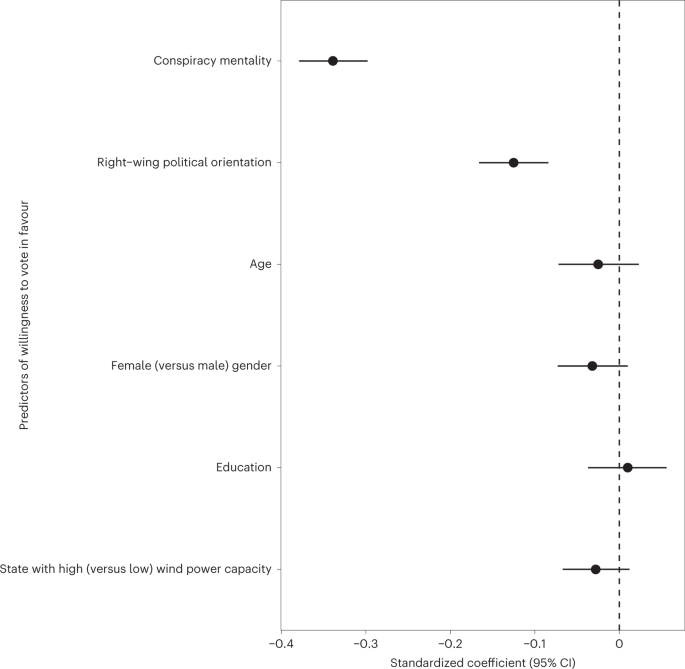
To analyse the relationship between conspiracy mentality (or specific conspiracy beliefs) and the acceptance of wind turbines in the nationally quota-balanced sample (that is, Study 8), we conducted linear multiple regression analysis. Conspiracy mentality was included as predictor and age, gender (+1 female, −1 male), education (1 = low, 2 = medium, 3 = high), political orientation (from 1 ‘left’ to 7 ‘right’) and state. We sorted the 16 German federal states according to their installed onshore wind power capacity divided by the size of the state. Then, we split the states into two groups representing the lower (−1) and the upper half (+1) in terms of installed capacity per km² resulting in comparable numbers of participants (Supplementary Table 4 for the rank order of the states). To be able to include gender as a covariate in these analyses, we removed the two participants who reported their gender as ‘other’.
To examine the impact of the pro arguments versus balanced arguments, we report merged analyses across all studies in the main text (that is, we combined the data of all studies into one large dataset). This was possible because all studies shared the crucial properties of the experimental design and used the same procedure and measures. Such an aggregated way of analysing the data has the advantage of maximizing statistical power to detect the true effect of interest with smaller confidence intervals51. It also allows for presenting all the data we collected in an efficient and transparent manner (that is, we report all studies that we conducted to test the research questions). The reason for conducting several smaller studies partly lies in the fact that the first results were counter to our theory-driven expectations (pre-registrations), which led us to replicate them in subsequent studies and to test several plausible moderators (as outlined in the main text). The final study served to confirm these results with a large and nationally quota-balanced sample.
The merged analyses followed the pre-registration of Study 8 and contained three experimental conditions (communication: only pro versus balanced versus no communication). In a first linear multiple regression analysis, we tested the impact of the only pro (versus no communication) condition on willingness to vote for the construction of the wind turbines. To this end, and following the recommendations of Aiken and West52, we used orthogonal contrasts to code the experimental conditions (focal contrast: +1 only pro, 0 balanced, −1 no communication; residual contrast: −1 only pro, +2 balanced, −1 no communication) and mean-centred the continuous predictor conspiracy mentality. In addition, the interaction terms of both contrasts and mean-centred conspiracy mentality were included as predictors. Following the same principal procedure, we conducted two more linear multiple regression analyses to examine the effectiveness of the balanced communication. These two regression analyses used different contrasts to compare the balanced with the only pro condition (focal contrast: −1 only pro, +1 balanced, 0 no communication; residual contrast: +1 only pro, +1 balanced, −2 no communication) and the balanced with the no communication condition (focal contrast: 0 only pro, +1 balanced, −1 no communication; residual contrast: +2 only pro, −1 balanced, −1 no communication). All statistical tests were two sided. Analyses with specific conspiracy beliefs as predictor were carried out analogously. Complete results of these regression analyses and the pre-registered analyses for all individual studies can be found in the Supplementary Notes. All analyses were carried out with IBM SPSS v25. The research data are publicly available via PsychArchives53.
Ethics
All studies were conducted in line with the ethical guidelines for psychological research of the American Psychological Association and the German Research Foundation and received ethical approval by the institutional ethics board of the Leibniz-Institut für Wissensmedien (Tübingen, Germany; LEK 2019/001).
Reporting summary
Further information on research design is available in the Nature Portfolio Reporting Summary linked to this article.