studies
studies
studies
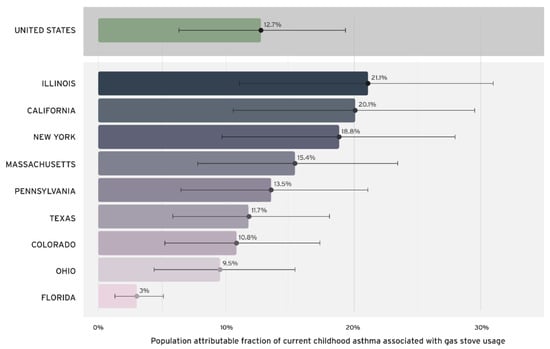
First, we sought to update the effect-size estimates by identifying peer-reviewed manuscripts published subsequent to the most recent meta-analysis [ 1 ]. We searched PubMed using keywords: “gas cooking and children” OR “gas appliance and children” OR “unvented and children” OR “gas heating and children” OR “gas heater and children”. After including only manuscripts of human studies published in English since 4 January 2013, 357 studies remained for possible inclusion. The title review identified 27 manuscripts as potentially pertinent. Full manuscripts (n = 27) were independently reviewed by co-authors; none reported new associations between gas stove use and childhood asthma specifically in North America or Europe. As a result, effect sizes previously reported for current asthma in North America and Europe combined (weighted by inverse variance; N= 10; Odds Ratio (OR) = 1.34, 95% Confidence Interval (CI) = 1.12–1.57) were utilized in the PAF estimations [ 1 ]. The combined effect size was based on a North America-specific effect size (N= 3; OR = 1.36, 95% CI = 0.76–2.43) and Europe-specific effect size (N= 7; OR = 1.34, 95% CI = 1.13–1.60), as reported in a previously published meta-analysis [ 1 ]. We combined effect sizes for North America and Europe given the similarities in housing characteristics and gas-stove usage patterns across these geographies. We estimated the proportion of children (<18 years old) exposed to gas stoves in the US and in certain states using the American Housing Survey (AHS) [ 2 ]. The AHS is a nationally representative survey of households used to characterize the residential housing stock of the US. Each year, a subset of states is oversampled, allowing for precise estimates of housing characteristics for these states. In the most recent iteration of the survey in 2019, nine states were oversampled, allowing us to estimate PAFs at the national level and for these nine states.