Despite rapid advances in the development of evidence for managing COVID-19, further data collection on the effects of COVID-19 during pregnancy is needed. Lower vitamin D concentrations in pregnant women with COVID-19 have been reported [ 51 53 ]. However, the association is still controversial, and the clinical severity of the infection may not associate with vitamin D status in pregnant women [ 54 55 ]. This study aimed to investigate the association between vitamin D deficiency with COVID-19 severity in third-trimester pregnant Mexican women.
Vitamin D deficiency has several effects during pregnancy, such as failure of placental implantation [ 39 ], impaired angiogenesis [ 40 ], disturbances of the immune system [ 41 ], oxidative stress [ 42 ], and high incidence of gestational diabetes, cesarean section, and preterm birth. In infants, the related outcomes are low birth weight [ 43 ], lower bone mass [ 44 ], and, possibly, bronchiolitis, asthma [ 45 ], type 1 diabetes [ 46 ], multiple sclerosis, and autism [ 47 ]. Furthermore, maternal vitamin D deficiency represents a public health issue and is considered the least diagnosed and treated nutrition deficiency worldwide [ 48 49 ]. In a recent cohort study, we showed that the prevalence of vitamin D deficiency (<20 ng/mL) and insufficiency (20 ng/mL–30 ng/mL) was high in Mexican pregnant women [ 50 ].
Given the broad spectrum of activity of vitamin D, its deficiency is involved in many pathologies [ 22 23 ]. Prior to the COVID-19 pandemic, a meta-analysis found a significant association between low serum vitamin D levels and the severity of acute respiratory tract infections [ 24 ]. Currently, a relationship between vitamin D deficiency and the risk of SARS-CoV-2 infection or severe COVID-19 has been established in epidemiological studies [ 25 30 ]. Low vitamin D concentrations might predispose patients with COVID-19 to severe outcomes not only via the associated hyperinflammatory syndrome but also by worsening pre-existing impaired glucose metabolism and cardiovascular diseases [ 31 33 ]. However, some studies have not found these associations [ 34 ]. An observational study of 410 Indian patients hospitalized for COVID-19 showed a high prevalence of vitamin D deficiency but no association between serum vitamin D levels and clinical outcomes of COVID-19 [ 35 ]. In addition, a retrospective study from the UK Biobank showed that both circulating 25-OH vitamin D concentrations and vitamin D deficiency were not associated with the risk of COVID-19 [ 36 37 ]. In a retrospective case-control study, 82.2% of hospitalized patients with COVID-19 had vitamin D deficiency, but no relationship was found between serum 25-OH vitamin D concentrations or vitamin D deficiency and severe outcomes [ 38 ]. Therefore, the role of low vitamin D status in severe COVID-19 is debatable and may vary according to age, region, and ethnicity [ 27 ].
Vitamin D is a liposoluble vitamin and hormone obtained from diet and skin exposure to sunlight [ 12 ]. The classic functions attributed to vitamin D are related to calcium and phosphate homeostasis, acting in the intestine, kidneys, and bone [ 13 ], but research in recent years has revealed a diverse range of biological actions [ 14 ]. Vitamin D is essential for cell differentiation while inhibiting cell growth and modulating inflammatory and immune responses [ 15 ]. Vitamin D deficiency (below 50 nM/L (20 ng/mL)) [ 16 ] is a global public health problem that commonly affects the elderly and those with comorbidities such as obesity, diabetes, hypertension, respiratory disorders, recurrent infections, immune deficiency, and malignancies, as well as ethnic minorities living in temperate countries [ 17 18 ]. Interestingly, the same groups known to be at risk of vitamin D deficiency were amongst the worst affected by COVID-19 [ 19 21 ].
COVID-19 caused by SARS-CoV-2 has affected all population groups, including children, the elderly, and pregnant women [ 1 3 ]. Pregnancy is a particular condition that has significant effects on the biological systems of a woman’s body [ 4 ]. Pregnant women present changes in the immune system; therefore, they are generally considered vulnerable to infectious diseases [ 5 6 ]. Several studies have reported that pregnant women who experienced severe symptoms of COVID-19 were at higher risk for cesarean delivery, postpartum hemorrhage, hypertensive disorders of pregnancy, preterm birth, and maternal death [ 7 11 ].
Similar performance was obtained with a false positive rate (FPR) of 15% ( Table 5 ), and the logistic model performance had an area under curve (AUC) of 0.911 and a detection rate (DR) of 0.70; the lasso model had an AUC of 0.895 and a DR of 0.667. The elastic net via lasso regression and the logistic regression reflects the association of 25-OH vitamin D deficiency with COVID-19 severity in women in the third-trimester of pregnancy ( Table 5 ).
We performed multivariate regression, including maternal age, gestational age, pregestational body mass index (BMI), diabetes, hypertension, gestational diabetes, magnesium, calcium, and vitamin D levels, using a cut-off value < 20 ng/mL considering the presence or absence of 25-OH vitamin D deficiency. The independent predictor of severe COVID-19 was 25-OH vitamin D deficiency showing an odds ratio (OR) of 5.81 (95% CI: 1.108–30.541;= 0.037; Table 3 ). For comparison, we fitted a prediction model via lasso regression. Selected variables obtained were 25-OH vitamin D deficiency, gestational age, cholesterol, and magnesium. Similar performance was obtained ( Table 4 ), and the only statistically significant independent predictor of severe COVID-19 was 25-OH vitamin D deficiency, showing a coefficient of 12.51 (95%CI: 4.097–20.929;= 0.004).
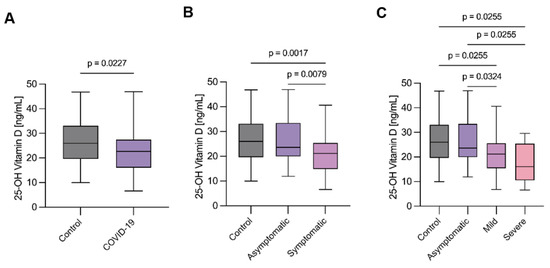
All COVID-19 positive pregnant women (asymptomatic and symptomatic) showed a significantly decreased concentration of serum 25-OH vitamin D compared with controls (= 0.027) ( Figure 1 A). Serum vitamin D concentrations were significantly lower in symptomatic COVID-19 pregnant women compared to the asymptomatic group (= 0.0079) and healthy pregnant controls (= 0.0017) ( Figure 1 B). In contrast, no significant differences were found between asymptomatic COVID-19 pregnant women and healthy pregnant controls. Additionally, we observed that the patients with severe symptoms also showed statistically lower vitamin D concentration compared with the control group (= 0.0255) ( Figure 1 C).
A total of 165 pregnant women in the third trimester were included in the analysis. Eighty-six (52%) tested positive for SARS-CoV-2 by RT-qPCR, and seventy-nine (48%) were negative. Amongst the positive, 32 (19%) were asymptomatic, 44 (27%) had mild symptoms, and 10 (6%) developed severe COVID-19. The demographic characteristics of healthy and infected pregnant women are summarized in Table 1 and fully available in Table S1 . There were significant differences in the gestational age at hospital admission (= 0.0001), serum magnesium (< 0.0001), and serum calcium (= 0.005) between groups.
3. Discussion
28,29,30,31,33,35,36,37,38,57,8,52,53,54, Prior observational studies have either demonstrated an association between vitamin D deficiency and the severity/mortality of COVID-19 [ 25 56 ] or failed to support such an association among hospitalized COVID-19 patients [ 34 58 ]. Thus, low vitamin D status as a risk factor for severe COVID-19 remains controversial. On the other hand, COVID-19 impacts pregnant women and their neonates [ 7 10 ], but vitamin D during pregnancy with SARS-CoV-2 has been investigated in a few cases [ 51 55 ]. Here, we report that women infected with SARS-CoV-2 had lower vitamin D levels than healthy pregnant controls. Additionally, even lower levels were observed in women with severe symptoms, which is consistent with disease progression. Our findings in Mexico are in line with those of Turkish [ 51 ] and French [ 52 ] pregnant groups, using the same definition of vitamin D deficiency [ 16 ]. It is worth considering that vitamin D status varies widely with the country of residence, age, ethnicity, and adequate exposure to the sun.
22, Vitamin D deficiency is common among pregnant women [ 48 49 ]. A meta-analysis of observational studies has shown a positive association between low vitamin D levels and adverse pregnancy outcomes such as preeclampsia, gestational diabetes mellitus, preterm birth, and SGA (small for gestational age) [ 59 ]. In this report, vitamin D deficiency (<20 ng/dL) was frequent (60%) in the severe group of COVID-19 patients. Vitamin D deficiency is associated with increased autoimmunity and an increased susceptibility to infection [ 12 25 ]. It is thought that adequate vitamin D levels (>30 ng/dL) reduce the inflammatory response to SARS-CoV-2 by increasing anti-inflammatory cytokines such as interleukin-4 (IL-4) and IL-10 levels and decreasing the concentrations of pro-inflammatory cytokines such as IL-1β, tumor necrosis factor-α (TNF-α), IL-8, IL-12, and, especially, IL-6 [ 60 61 ]. In particular, vitamin D induces the conversion of monocytes to macrophages and influences the activity of dendritic, T, and B cells [ 62 ].
Although a low serum 25-OH vitamin D concentration has been reported in COVID-19 pregnant women, not all studies consider the form of the disease (asymptomatic, mild, severe) [ 55 ]. Here, using the cut-off value of 25-OH vitamin D deficiency (20 ng/dL), serum biomarkers, and anthropometric and maternal medical history data, we found that vitamin D deficiency was the only variable associated to the severity of COVID-19, even after adjusting for other significant variables such as calcium, magnesium, BMI, hypertension, diabetes, and maternal age. Other studies have shown risk factors that predict severe disease, including age, BMI, and pre-existing comorbidities [ 20 21 ], but these were not significant in our cohort. A second model was created using an elastic net, a regularized regression method that linearly combines the ridge and lasso regressions. Both models reflected the association of 25-OH vitamin D deficiency with COVID-19 severity in pregnant women. Thus, the present work describes that women in the third trimester of pregnancy infected with SARS-CoV-2 have low vitamin D levels and also describes their association with the severity of the disease.
53,63,68, Some randomized controlled trials have shown that vitamin D supplementation is beneficial for reducing infection but not for reducing intensive care unit admission or all-cause mortality in patients with moderate to severe COVID-19 [ 56 63 ]. Current evidence suggests that taking a vitamin D supplement to maintain a serum concentration of 25-OH vitamin D of at least 30 ng/mL (preferred range of 40–60 ng/mL) can help reduce the risk of COVID-19 and its severe outcomes, including mortality [ 64 65 ]. Further, in a meta-analysis of randomized trials with 49,419 participants, a protective effect of daily vitamin D supplementation compared to other regimens in preventing respiratory diseases was found (OR: 0.78; 0.65–0.94) [ 66 ]. Our results suggest that vitamin D supplementation in SARS-CoV-2 infection could have a role in reducing the risk of severe COVID-19 disease in pregnant women [ 51 64 ]. Even though vitamin D supplementation in pregnant women with SARS-CoV-2 infection has not been reported, it is relevant to promote adequate levels (>30 ng/mL) in these women. Moreover, vitamin D supplementation during pregnancy may reduce the risk of gestational diabetes, preeclampsia, preterm birth, and having low birthweight and small for gestational age newborns [ 67 69 ].
The main limitation of the research presented here is the low number of patients who developed the severe form of the disease, which was probably related to the course of COVID-19 being asymptomatic and mild in most pregnant patients. Furthermore, by analyzing pregnant women with COVID-19 infection at the time of delivery, we have not evaluated the possible impact of the infection during pregnancy. Another weakness is the cross-sectional design, which does not allow us to establish a causal relationship between predictors and outcomes. Due to the pandemic situation, no information about diet and exposure to the sun was collected in this study.