The total observation time in the intervention and control groups was 49,147 and 861,141 person-days, respectively. The not-fully vaccinated observation periods comprised 5879 and 240,784 person-days in the intervention and control groups, respectively, whereas fully vaccinated observation periods were 43,268 and 620,357 person-days.
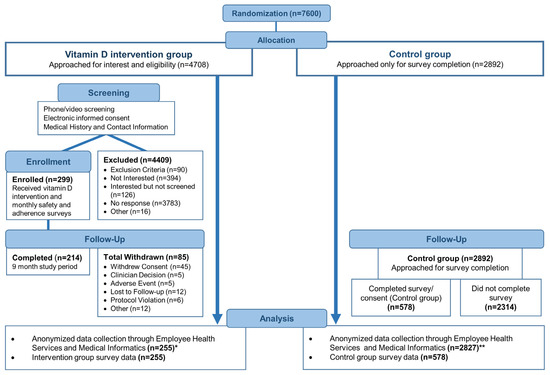
Of our targeted sample size of 859 subjects, 299 healthcare system workers were enrolled between 27 October 2020 and 31 January 2021 to participate in the intervention group. A total of 255 subjects completed vitamin D3 supplementation for at least 2 months and were included in the analyses. The last study participant completed nine months of vitamin D3 supplementation on 23 November 2021. During the same period, 2892 random healthcare system employees were passively enrolled to constitute the control group. Five hundred and seventy-eight control group participants provided demographic and clinical information at the completion of the study period. Detailed trial flow is presented in the CONSORT trial flowchart— Figure 1 . Demographic and clinical characteristics were similar between the vitamin D3 supplementation intervention and control groups— Table 2 . The average age was slightly higher in the control group (50 vs. 47) years. The average adherence rate of vitamin D3 supplementation was 87% with a median rate of 91%.
In the intervention group, three workers had at least 1 episode of ILI, while 197 workers in the control group had at least 1 episode of ILI. Incidence rates of ILI in the vitamin D3 supplementation and control groups are presented in Table 3 and Figure 2 . Comparison of incidence rates revealed that vitamin D3 supplementation was associated with a lower risk of ILI (absolute incidence rate difference −1.7 × 10/person-day, 95%-CI −3.0 × 10to −3.3 × 10/person-day,= 0.0147). Absolute incidence rate differences were −4.653 × 10/person-day, 95%-CI −1.1118 × 10to 1.811 × 10/person-day,= 0.1583 and −2.632 × 10/person-day, 95%-CI −1.0833 × 10to 5.57 × 10/person-day,= 0.5294 when only considering non-fully vaccinated and fully vaccinated observation periods in participants, respectively— Table 4 and Figure 3 and Figure 4
In the intervention group, no workers had a positive COVID-19 PCR test during the observation period, while in the control group 36 workers had at least 1 positive COVID-19 PCR test. Incidence rates in the vitamin D3 supplementation and control groups are presented in Table 3 and Figure 2 . A comparison of incidence rates revealed that vitamin D3 supplementation was associated with a non-statistically significant lower risk of COVID-19 ILI (absolute incidence rate difference—4.181 × 10/person-day, 95%-CI −9.897 × 10to 1.536 × 10/person-day,= 0.1517). The absolute incidence rate difference was −1.495 × 10/person-day, 95%-CI −4.621 × 10to 1.63 × 10/person-day,= 0.3485 when only considering non-fully vaccinated observation periods in participants; no COVID ILI occurred in either group during the fully vaccinated observation period— Table 4 and Figure 3 and Figure 4
In the intervention group, three workers had at least 1 episode of non-COVID-ILI, while 165 workers in the control group had at least 1 episode of non-COVID-ILI. Incidence rates of non-COVID ILI in the vitamin D supplementation and control groups are presented in Table 3 and Figure 2 . A comparison of incidence rates revealed that vitamin D supplementation was associated with a lower risk of non-COVID-ILI (absolute incidence rate difference −1.306 × 10/person-day, 95%-CI −2.541 × 10to −7.1 × 10/person-day,= 0.0382). Absolute incidence rate differences were −3.324 × 10/person-day, 95%-CI −9.078 × 10to 2.43 × 10/person-day,= 0.2575 and −2.632 × 10/person-day, 95%-CI −1.0833 × 10to 5.57 × 10/person-day,= 0.5294 when only considering non-fully vaccinated and fully vaccinated observation periods in participants— Table 4 and Figure 3 and Figure 4
3.5. Treatment-Emergent Adverse Events (TEAEs)
Among the 299 enrolled subjects, 182 workers in the intervention group reported at least 1 TEAE(s). Out of 388 reported TEAEs, 80% were judged to be unrelated, 18% possibly related, and 2.1% probably related. See Table S2 for a comprehensive listing of all TEAEs. There was one unrelated serious adverse event: hospitalization due to ruptured Meckel’s diverticulitis.
The 8 probably related TEAEs occurred in five participants. One participant reported 3 adverse events that began after 7 months on study vitamin D3: burning sensation in arms and legs; oral tenderness; and hypersensitivity to the sun. Interruption of vitamin D3 for 15 days showed a slight improvement in symptoms. Upon resuming vitamin D3 for two weeks, the subject reported worsening symptoms. Abatement of all symptoms was reported approximately one month after the final vitamin D3 discontinuation. The subject was withdrawn from the study. One subject reported two adverse events after 5 weeks of vitamin D3: thirst; and frequent urination. The symptoms abated after discontinuing vitamin D3. Upon resumption, symptoms returned. The subject was withdrawn from the study. One subject reported worsening back and right leg pain. The subject discontinued vitamin D3 after approximately 5 weeks of study due to worsening pain. Within one to two weeks of discontinuation, the subject reported that pain levels returned to baseline. The subject was withdrawn from the study. One subject was on vitamin D3 for approximately two months when she developed mouth lesions. The subject stopped vitamin D3 for 1 week and the lesions resolved. Upon resuming vitamin D3 for a few days, a small lesion appeared. The subject stopped vitamin D3 and discontinued involvement with the study. One subject reported mild abdominal cramping after 10 days on vitamin D3. The subject stated the issue was resolved after changing the time of day (not provided) she took vitamin D3, and the subject completed the study.
Three in-person clinic visits occurred to examine subjects for palpitations, joint pain/depression/nausea and lower back pain/leg pain. Laboratory tests (vitamin D, calcium, phosphorus, magnesium levels) were ordered for a total of 22 subjects. There were no instances of hypercalcemia reported. One subject reported nephrolithiasis on a survey 1 month after the event and was immediately withdrawn. The subject’s calcium level was within normal limits and the nephrolithiasis was considered unrelated to the study vitamin D3. Two subjects were withdrawn due to pregnancy.
Consistent with our protocol’s provision for privacy, adverse events were not collected in the passive control group.