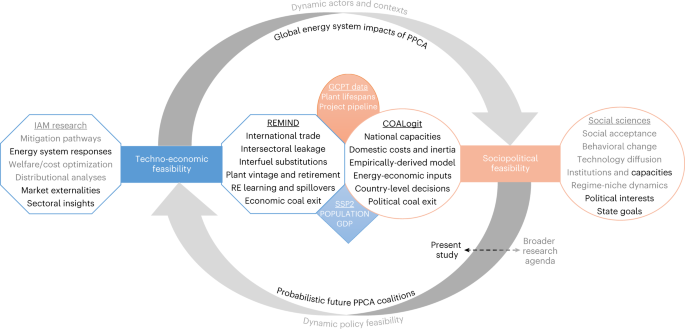
The present study introduces DPE, a conceptual framework for integrating techno-economic and sociopolitical disciplines, a widely recognized gap in the climate mitigation literature4,5,7,56,60. DPE asserts that policy decisions and their feedbacks with global energy system evolution can be prospectively modelled if empirical correlations are established between observed real-world policy and energy-economic variables. The methodology we detail below is specific to the present demonstration of DPE in the context of the PPCA and future studies may explore vastly different implementations depending on the empirical methods used.
REMIND–COALogit model coupling
Building on the logistic regression analysis in ref. 31, we designed a soft-link interface between a country-level, stochastic binary model of coal-exit policy adoption (COALogit; Supplementary Appendix III) and the global, forward-looking, deterministic IAM REMIND (Supplementary Appendix II; ref. 55 gives a full description). The coupling occurs in a sequential loop between them to simulate multistage, bottom-up legislative decisions and translate them to inter- and intra-regionally fragmented policies in long-horizon REMIND scenarios.
First, COALogit defines the current coal-exit ambition of each REMIND region (Supplementary Appendix Fig. 2.1) on the basis of observed PPCA pledges (Supplementary Table 1). Second, a subsequent REMIND run is constrained accordingly, effecting global energy transformations. Third, COALogit inputs data from this REMIND run to the logit model to determine future national PPCA accession probabilities, thereby endogenizing feedback effects of the PPCA on its own prospects. Fourth, COALogit assumes that all countries above an exogenously determined probability cutoff join the PPCA and updates regional coal-exit ambition appropriately. Finally, another REMIND run applies these constraints, which trigger endogenous energy system feedbacks such as international, intersectoral and interfuel leakage effects, as well as technological learning (Fig. 1). The REMIND–COALogit sequence (Extended Data Fig. 4) thereby cohesively depicts the interactions between economic and political coal-exit dynamics.
PPCA declaration
A limiting factor of modelling co-evolutionary transformation pathways is the paucity of historical climate policy observations upon which empirical models can be constructed. The PPCA provides a real-world basis for logit model calibration and precise policy timing in REMIND. The PPCA declaration, although non-binding, defines clear targets for its members: OECD and European Union (OECD henceforth) member nations are expected to observe a 2030 phase-out of unabated coal-fired electricity while all other countries (non-OECD henceforth) are afforded until 2050. For the purposes of this study, we assume that all PPCA signatories will comply with the prescribed deadlines. Countries are defined according to the ISO 3166-1 convention, listing 249 world nations.
Logit model
Supplementary Appendix III details the empirical relationship modelled in COALogit between a nation’s likelihood of PPCA membership and the predictor variables, GDPpc and coal-power share, defined by equations (1) and (2).
$$p\left( {Y = 1} \right) = \frac{{{\mathrm{e}}^{\beta _0 + \beta _1x + \beta _2y}}}{{1 + {\mathrm{e}}^{\beta _0 + \beta _1x + \beta _2y}}}$$ (1)
where p(Y = 1) is the probability of PPCA membership, β i are fitted model parameters (Supplementary Appendix Table 3.1), x is the coal-power share and y is GDP per capita.
$${{{\mathrm{ln}}}}\frac{{p_{\widehat n}\left( t \right)}}{{1 - p_{\widehat n}\left( t \right)}} = \beta _0 + \beta _1x_{C,\widehat n}\left( t \right) + \beta _2y_{\widehat n}\left( t \right)$$ (2)
where: \(\widehat n\) is nation of analysis, \(p_{\widehat n}\) is national probability of coalition accession, t is time (refers to REMIND time-steps in our analyses), \(x_{C,\hat n}\) is national coal-power share and \(y_{\hat n}\) is national GDP per capita.
The parameters are fit against observed PPCA pledges, which delimits the political feasibility space of the PPCA (Supplementary Appendix Table 3.1). COALogit dynamizes this model by assuming that the empirical foundation persists over time, which appears reasonable thus far (Supplementary Appendix III).
Probabilistic coalitions
To operationalize accession probabilities into policy assumptions for deterministic REMIND scenarios, we partition countries into members and freeriders. We define thresholds within the feasibility space (Supplementary Appendix Table 3.3), represented as linear relationships in Fig. 2 between GDPpc and coal-power share, along which the probability of coalition accession is constant. Any country that reaches an accession probability above the threshold value before its PPCA-imposed phase-out deadline is considered an irreversible member of the coalition. The coal-exit policy is then exclusively applied to these nations in the subsequent (downstream) REMIND run.
To simulate coalition accession of OECD countries, we use COALogit to identify which OECD nations lie above each threshold in the 2025 REMIND time step, representing a 5 yr period ending in June 2027. Any prospective member is assumed to have decided by then whether they will observe the 2030 phase-out. Similarly, we define non-OECD coalition members by comparing non-OECD countries to the thresholds in the 2045 model period, July 2042 to June 2047.
Ideally, the coalition would be updated every year, or at least every 5 yr REMIND period, for DPE to depict the most realistic coal phase-out trajectories. However, such a rolling policy enforcement horizon would be highly resource-intensive and impractical for broad sensitivity analyses such as those we report. Future DPE implementations may explore reducing the IAM optimization horizon of each REMIND scenario to reduce the computational burden.
COALogit inputs and outputs
The implementation of REMIND–COALogit requires the downscaling of the relevant variables in equation (2), as derived by REMIND simulations, for all countries in future periods (Supplementary Table 4). For instance, the future development of coal use in REMIND regions must be disaggregated to the country level so that the COALogit model can derive the accession of individual nations to the PPCA coalition. The country-level results are later re-aggregated to the level of REMIND regions to define policy constraints for a downstream REMIND run.
COALogit performs three core functions: (1) reading in and downscaling REMIND results to the country level, (2) logit analysis to define coalition membership and (3) derivation of policy stringency coefficients (PSCs), which account for the distribution of future coal and energy demand between members and freeriders within individual REMIND regions to translate country-level coalitions into region-level policies (Extended Data Fig. 3; equation (6)).
First, COALogit intakes regional variables for total energy demand as well as coal-fired and total electricity generation from the upstream REMIND run, that is a preceding run in which the coalition was not fully defined (Extended Data Fig. 4). COALogit then downscales (equations (4) and (5)) and divides the variables to derive country-level coal-power shares.
Second, the logit model determines national accession probabilities for the specified time step using the national coal-power shares downscaled from the upstream REMIND run and GDPpc from SSP 2 (ref. 88). All countries above the assumed feasibility threshold are considered coalition members. Third, the cumulative coal-power shares of all countries (from the phase-out deadline to 2100) are calculated on the basis of the upstream REMIND run. This is set to zero for coalition members. PSCs are derived by aggregating the cumulative coal-power shares to the REMIND region-level and these are exported REMIND for use in the downstream run.
Power-exit scenario cascade
Each PPCA scenario requires a sequence of four REMIND runs with a COALogit run between each. Extended Data Fig. 4 illustrates this automated cascade and the Roman numerals used below refer to that figure. (I) The starting point of a PPCA scenario cascade is always an NPi reference case, to which historical developments (2005–2015) in all REMIND runs of the cascade are fixed. (II) COALogit regionally downscales the relevant NPi variables (Supplementary Table 3) to derive PSCs for current real-world PPCA members. (III) These PSCs are fed downstream to the ‘Current PPCA’ REMIND run, a conventional SPE of the PPCA (Table 1).
(IV) ‘COALogit-2025’ derives the 95p, 50p and 5p (henceforth, xp) OECD coalition scenarios (Fig. 2b) on the basis of accession probabilities calculated by equation (2) using historical data extrapolation (Supplementary Appendix I) and 2025 variables computed in Current PPCA (Supplementary Table 3). Conceptually, the near-term actions of today’s PPCA may influence the energy landscape in freeriding OECD nations and thus their decision-making. COALogit-2025 returns PSCs for each OECD coalition scenario, which (V) are fed downstream for the ‘OECD-xp’ REMIND runs to enforce the 2030 phase-out policy.
(VI) Each OECD-xp run calls a unique COALogit-2045 instance, which forms the corresponding non-OECD-xp coalition (Fig. 2c,d) using 2045 variables from OECD-xp (Supplementary Table 3) and assigns PSCs accordingly. (VII) Finally, the ‘non-OECD-xp’ REMIND runs encapsulate all the information accrued throughout the cascade. These are fixed to OECD-xp through 2030, preventing non-OECD members from prematurely anticipating the policy while also affording them sufficient lead-time for adherence. Both the OECD and non-OECD phase-outs are enforced during this final run’s 2035–2100 optimization horizon. The non-OECD-xp REMIND runs are the full DPE–PPCA scenarios analysed in Figs. 3 and 4.
Demand-exit cascade
Additionally, we consider an alternate interpretation of PPCA accession: a commitment by national governments to phase all unabated coal consumption out of the economy in accordance with the PPCA’s timeline. This reflects the assumption that PPCA members truly represent a coalition-of-the-willing or are at least predisposed to accept further responsibilities. This demand-exit policy interpretation imposes the PPCA phase-out timeline on all coal-consuming technologies in all economic sectors except the iron and steel industry, which is permitted a 10 yr grace period. This is intended to represent techno-institutional inertia, given that steelmaking is considered a particularly difficult industrial process to decarbonize67 and that high-grade met-coal is a substantially higher-value commodity than is thermal coal.
(I) The same starting point (NPi) and sequence progression applies to demand-exit PPCA scenarios but the coal phase-out constraints and the variables exchanged between REMIND and COALogit (Supplementary Table 3) differ. (II) COALogit-2015 provides (III) Current PPCA with six PSCs—three for the OECD phase-out and three for the non-OECD phase-out. (IV) COALogit-2025 generates three PSCs for each (V) OECD-xp run and (VI) COALogit-2045 xp feeds three more PSCs to its corresponding (VII) non-OECD-xp run. The relevant calculations are detailed below.
Technical implementation
This section details the procedures, calculations and assumptions involved in the REMIND–COALogit interface. Each subsection presents the general logic and formulae that pertain to the indicated steps of Extended Data Fig. 4. Supplementary Table 3 details the sources and flow of variables exchanged along the cascade.
OECD national coal-power shares derivation (IV)
In the 2025 COALogit instance, country-level coal-fired power generation is calculated on the basis of the coal-power capacities extrapolated from Global Coal Plant Tracker (GCPT) data65 (Supplementary Appendix I). These are multiplied by the national 2025 utilization rates, which are in turn extrapolated from 2015 data. Countries with zero coal capacity in 2015 are assigned their REMIND region mean utilization rate. Per the default exogenous assumption used in REMIND, equation (3) describes how all countries linearly converge to a utilization rate of 50% by the 2035 period, persisting until 2100.
$$\begin{array}{l}\mu _{\widehat n}\left( t \right) = \mu _{\widehat n}\left( {t_0} \right) + \frac{{0.5 - \mu _{\widehat n}\left( {t_0} \right)}}{{t_{\mathrm{c}} - t_o}}\left( {t - t_0} \right)\\ \mathrm{for}\,t_0 < t < t_{\mathrm{c}}\end{array}$$ (3)
where: \(\mu _{\widehat n}\) is the national utilization rate, t 0 is 2015 and t c is 2035 (time step when μ becomes constant).
Some regions in REMIND are individual countries (India, Japan and the United States). For these countries, total electricity generation in all periods is taken directly from the upstream run. Other REMIND regions are aggregates of three to 54 nations, hence projected electricity generation must be downscaled. Disaggregation weights for total power generation are assigned to each region by assuming that base-period per capita electricity demand remains constant in each of its nations (Supplementary Table 4). To prevent negative weights, countries with low base-year electrification and a declining population are instead assumed to keep their total electricity generation constant at base-year levels. National coal-power shares in 2025 are thus calculated as the ratio of extrapolated bottom-up coal-power generation values and disaggregated top-down total electricity production figures.
Non-OECD national coal-power shares derivation (VI)
To extrapolate national coal-power shares from multinational REMIND regions in the 2045 instance of COALogit, we use a different downscaling routine, grounded in the assumption that the relative difference between the coal-power share of a region and those of its member nations remains constant. First, national coal-power shares in 2030 are downscaled from the upstream REMIND run (OECD-xp, Extended Data Fig. 4) by assuming its percentage above or below its region’s coal-power share remains unchanged from 2025. This is represented by equation (4).
$$\begin{array}{l}x_{\widehat n}\left( t \right) = \left\{ {\begin{array}{*{20}{c}} {x_{\widehat n}\left( {t - {\Delta}t} \right) + \frac{{x_{\widehat n}\left( {t - {\Delta}t} \right) - x_R\left( {t - {\Delta}t} \right)}}{{1 - x_R\left( {t - {\Delta}t} \right)}} \times \left( {1 - x_R\left( t \right)} \right),\quad \mathrm{if}\,x_R\left( t \right) \ge x_R\left( {t - {\Delta}t} \right)} \\ {x_{\widehat n}\left( {t - {\Delta}t} \right) - \frac{{x_R\left( {t - {\Delta}t} \right) - x_{\widehat n}\left( {t - {\Delta}t} \right)}}{{x_R\left( {t - {\Delta}t} \right)}} \times x_R\left( t \right),\quad \mathrm{if}\,x_R\left( t \right) < x_R\left( {t - {\Delta}t} \right)} \end{array}} \right.\\ \mathrm{for}\,t \ge 2030\end{array}$$ (4)
where:
t − Δt is the previous period analysed (Δt varies between 5 and 15 yr) and R is the REMIND region containing nation \(\widehat n\).
Country-level coal-power generation in 2030 is then calculated by multiplying total national electricity generation by coal-power share. However, OECD coalition members, as defined in the 2025 COALogit instance, must have zero coal electricity generation. Their newly derived coal electricity values are thus counterfactual and must be redistributed to other nations in the region. Equation (5) describes this.
$$\begin{array}{l}\widetilde {\mathrm{seel}}_{C,\widehat n}\left( t \right) = \left\{ {\begin{array}{*{20}{c}} {0,\quad \quad \quad \quad \quad \quad \quad \quad \quad \quad \quad \quad \quad \quad \quad \quad \quad \quad \mathrm{if}\,\widehat n \in M_R} \\ {\widehat {\mathrm{seel}}_{C,\widehat n}\left( t \right) + \frac{{\widehat {\mathrm{seel}}_{G,\widehat n}\left( t \right)}}{{\mathop {\sum}
olimits_{n \in F_R} {\widehat {\mathrm{seel}}_{G,n}\left( t \right)} }} \times \mathop {\sum}\limits_{n \in M_R} {\widehat {\mathrm{seel}}_{C,n}\left( t \right),\mathrm{if}\,\widehat n \in F_R} } \end{array}} \right.\\ \mathrm{for}\,t \ge 2030\end{array}$$ (5)
where: \(\widetilde {\mathrm{seel}}_{C,\widehat n}\) is the national coal electricity after accounting for OECD phase-out, \(\widehat {\mathrm{seel}}_{C,\widehat n}\) is the counterfactual national coal electricity downscaled from upstream REMIND run, \(\widehat {\mathrm{seel}}_{G,\widehat n}\) is the total national electricity generation downscaled from upstream REMIND run and n is each nation within region R, M R is the OECD coalition members in region R and F R is the freeriding nations in region R.
Finally, with the OECD phase-out reflected in the national coal-power generation values, coal-power shares are recalculated for 2030. National coal-power shares in 2045 can then be derived through equation (4) using 2030 as the previous period and these values are used in equation (2) to derive non-OECD coalition accession probabilities. Nations above the xp threshold of the scenario must enact the power-exit in the downstream REMIND run.
Power-exit policy stringency coefficients (IV and VI)
Because several REMIND regions contain both coalition members and freeriders, COALogit translates its national output into regional policy constraints via PSCs. Member-rich regions are assigned highly stringent PSCs, while freerider-dominant regions adopt less stringent policies. Member-only regions must fully exit coal-fired electricity (PSC = 0) and regions containing only freeriders are unconstrained (PSC = 1, that is 100% of electricity can be coal-fired). COALogit-2025 defines PSCs for the OECD phase-out from 2030 to 2100 and COALogit-2045 for the non-OECD phase-out from 2050 to 2100. These two coefficients can vary greatly in a region containing both OECD and non-OECD states.
PSCs in power-exit scenarios denote the maximum cumulative share of coal permitted in the electricity generation of each region. This is defined in equation (6) as the freeriders’ coal-power generation of a region divided by the region’s total electricity generation in the upstream run. As this would constrict those freeriders to their reference coal-power demand, thereby preventing leakage, we include a term permitting them to increase coal-fired electricity a maximum of 50% in response to PPCA phase-outs.
$$\mathrm{PSC}_{R,\alpha } = \frac{{\mathop {\sum}
olimits_{t = t_\alpha }^{2100} {\mathop {\sum}
olimits_{n \in F_R} {\widehat {\mathrm{seel}}_{C,n}\left( t \right)} } }}{{\mathop {\sum}
olimits_{t = t_\alpha }^{2100} {\mathop {\sum}
olimits_{n \in R} {\widehat {\mathrm{seel}}_{G,n}\left( t \right)} } }} \times L$$ (6)
$$\mathrm{for}\,t_\alpha = \left\{ {\begin{array}{*{20}{c}} {2030,\quad \mathrm{if}\,\alpha = \mathrm{OECD}} \\ {2050,\quad \mathrm{if}\,\alpha = \mathrm{non-OECD}} \end{array}} \right.$$
where PSC R,α is the policy stringency coefficient for region R in the current accession stage α and L, the intraregional coal leakage allowance, is 1.5.
Criteria for policy enforcement
Similarly, if the coalition members of a region are greatly outweighed by its freeriders, COALogit sets PSC to 0. Coalition members must fulfil three criteria for their region to enforce a power-exit. They must: (1) constitute at least 20% of the upstream coal-power generation of their region and (2) total PE demand and (3) not be the sole coalition member in a multinational region. These conditions ensure that the emerging economies of a region are not artificially prevented from capitalizing on PPCA-induced coal price depression simply because the wealthy few accede (for example, South Korea in ‘Other Asia’).
Power-exit implementation in REMIND (V and VII)
We model the power-exit in REMIND by restricting the share of total electricity production from coal-fired power plants without CCS. The sum of electricity generated by REMIND unabated coal plants (Supplementary Appendix II gives technology types) from the policy start year until 2100 in each region is constrained to a PSC-defined fraction of the total regional electricity generated in that timespan. Equation (7) describes this constraint, unique to power-exit scenarios.
$$\mathop {\sum}\limits_{t = t_\alpha }^{2100} {\mathop {{\mathrm{seel}}}\limits^ \vee _{R,U}\left( t \right) \le \mathrm{PSC}_{R,\alpha }} \left( {\mathop {\sum}\limits_{t = t_\alpha }^{2100} {\mathop {{\mathrm{seel}}}\limits^ \vee _{R,G}\left( t \right)} } \right)$$ (7)
where: \(\mathop {{\mathrm{seel}}}\limits^ \vee _{R,U}\) is the unabated coal-fired electricity generation in downstream run and \(\mathop {{\mathrm{seel}}}\limits^ \vee _{R,G}\) is the electricity generation in downstream (relative to PSC derivation) run.
Note that non-OECD-xp REMIND runs include both the OECD and non-OECD constraints. Coal-power generation from 2050 to 2100 is ultimately bounded by the more stringent of the two but a region is theoretically free to consume its entire 2030–2100 allowance within the 2030–2050 timespan.
Demand-exit policy stringency coefficients (IV and VI)
Demand-exit policies are implemented through a three-step process. First, a PSC is derived to limit the share of total regional CO 2 emissions that can come from non-solid coal consumption from 2030 (2050) until 2100 in the OECD (non-OECD). Second, a separate PSC constrains the CO 2 from coal solids used for non-metallurgical purposes, for example cement production, as a share of overall regional CO 2 over the same horizons. Third, another PSC limits CO 2 emissions from coal-based metallurgy, applied from 2040 (2060) to 2100. Equations (8)–(10) describe this procedure. Demand-exit PSCs are derived on the basis of the emissions from each coal demand vector rather than consumption because REMIND v.2.1 directly calculates the emissions from each fuel type in each industrial subsector (cement, steel, chemicals and process heat) using baseline energy demands and marginal abatement cost curves. Relative emissions are equivalent to relative consumption because REMIND assumes identical emissions factors for all coal uses.
$$\mathrm{PSC}_{R,\alpha _c} = \frac{{\mathop {\sum}
olimits_{t = t_{\alpha _c}}^{2100} {\mathop {\sum}
olimits_{n \in F_R} {\left( {\widehat {\mathrm{emi}}_{n,\overline c }\left( t \right) - \widehat {\mathrm{emi}}_{n,\overline s }\left( t \right)} \right)} } }}{{\mathop {\sum}
olimits_{t = t_{\alpha _c}}^{2100} {\widehat {\mathrm{emi}}_{R,E}(t)} }} \times L$$ (8)
$$\mathrm{PSC}_{R,\alpha _s} = \frac{{\mathop {\sum}\limits_{t = t_{\alpha _s}}^{2100} {\mathop {\sum}
olimits_{n \in F_R} {\left( {\widehat {\mathrm{emi}}_{n,\overline s }\left( t \right) - \widehat {\mathrm{emi}}_{n,m}\left( t \right)} \right)} } }}{{\mathop {\sum}
olimits_{t = t_{\alpha _s}}^{2100} {\widehat {\mathrm{emi}}_{R,E}\left( t \right)} }} \times L$$ (9)
$$\mathrm{PSC}_{R,\alpha _m} = \frac{{\mathop {\sum}
olimits_{t = t_{\alpha _m}}^{2100} {\mathop {\sum}
olimits_{n \in F_R} {\widehat {\mathrm{emi}}_{n,m}\left( t \right)} } }}{{\mathop {\sum}
olimits_{t = t_{\alpha _m}}^{2100} {\widehat {\mathrm{emi}}_{R,E}(t)} }} \times L$$ (10)
$$\mathrm{if}\quad \alpha = \left\{ {\begin{array}{*{20}{c}} {\mathrm{OECD},\,\mathrm{then}\,t_{\alpha _c},\quad t_{\alpha _s} = 2030,\,t_{\alpha _m} = 2040} \\ {\mathrm{non-OECD},\,\mathrm{then}\,t_{\alpha _c},\quad t_{\alpha _s} = 2050,\,t_{\alpha _m} = 2060} \end{array}} \right.$$
where: \(\widehat {\mathrm{emi}}_n\) is the CO 2 emissions of each nation in R, downscaled from the upstream run, E is all energy end-use activities, c is non-solids coal end-uses, \(\bar c\) is all coal end-uses, s is non-metallurgical coal solids end-uses, \(\overline s\) is coal solids end-uses and m is met-coal end-uses (that is, iron and steel manufacturing).
Analogous policy enforcement criteria as defined for the power-exit apply to each of the demand-exit PSCs individually, for example PSC m = 1 unless the region’s coalition members account for 20% of its total emissions from met-coal. If they do, the met-coal emissions of that region are constrained but its non-solids coal emissions may not be if coalition members emitted <20% of total regional coal-based CO 2 .
Demand-exit policy implementation (V and VII)
The three PSCs enter REMIND in a series of corresponding equations that enforce the demand-exit policy. Equation (11) illustrates how the non-solids coal and non-metallurgical coal solids elements of the policy are implemented by controlling different sets of technologies, just like the power-exit. Equation (12) shows the additional assumption used to isolate the emissions from met-coal, namely that the share of coal in a region’s solid energy consumption is uniform across all sectors.
$$\mathop {\sum}\limits_{t = t_{\alpha _j}}^{2100} {\mathop {{\mathrm{emi}}}\limits^ \vee _{R,j}\left( t \right) \le \mathrm{PSC}_{R,\alpha _j}} \left( {\mathop {\sum}\limits_{t = t_{\alpha _j}}^{2100} {\mathop {{\mathrm{emi}}}\limits^ \vee _{R,E}\left( t \right)} } \right)$$ (11)
$$\mathop {\sum}\limits_{t = t_{\alpha _m}}^{2100} {\left( {\mathop {{\mathrm{emi}}}\limits^ \vee _{R,m}\left( t \right) \times \frac{{\mathop {{\mathrm{FE}}}\limits^ \vee _{R,\overline s }\left( t \right)}}{{\mathop {{\mathrm{FE}}}\limits^ \vee _{R,S}\left( t \right)}}} \right) \le \mathrm{PSC}_{R,\alpha _m}} \left( {\mathop {\sum}\limits_{t = t_{\alpha _m}}^{2100} {\mathop {{\mathrm{emi}}}\limits^ \vee _{R,E}\left( t \right)} } \right)$$ (12)
where: j = {c, s}, \(\mathop {{\mathrm{emi}}}\limits^ \vee _R\) is the regional CO 2 emissions variable in downstream run, \(\mathop {{\mathrm{FE}}}\limits^ \vee _R\) is the regional final energy production variable in downstream run and S is all solid final energy production.
COVID-19 recovery programs
The third dimension of our analysis (Table 2) considers the near-term uncertainties associated with the COVID-19 shock89. We assess the path-dependencies90,91,92,93,94 of PPCA dynamics and outcomes to different near-term trajectories of coal-power capacity. These are derived by first calculating detailed national-level historical statistics using plant-level data and then applying stylized global assumptions (Supplementary Appendix Table 1.3) to extrapolate potential future trends (Extended Data Fig. 1).
We name these outlooks green, neutral and brown COVID recoveries, in ascending order of the global coal-power generation in 2025. The neutral recovery assumes that the COVID crisis has no effect on the average lifespans of coal plants nor the historical completion rates of projects in each phase of the development pipeline. The green and brown recoveries, meanwhile, are designed to capture the ‘reasonable’ range of COVID-induced changes to those statistics (Supplementary Appendix I).
Despite their fast-approaching PPCA deadline, our neutral and brown extrapolations expect several OECD states to continue increasing coal capacity (Korea and Japan even in the green recovery). Under default REMIND assumptions, early coal plant retirement is generally limited to 9% of a total fleet of a region each year (45% per 5 yr time step). A power-exit by 2030 was thus mathematically infeasible in several regions, leading us to relax this constraint to 20% (that is, a 100% power-exit is possible within 5 yr even if all plants are under 40 years old).
Unlike the other two dimensions, these exogenous constraints are independent of the PPCA and also apply to the NPi and NDC scenarios. Hence, each of the three NPi-COVID baselines (NPi-green, NPi-neutral and NPi-brown) initiates its own two scenario cascades, one for each policy interpretation (Extended Data Fig. 4) and all runs within these two cascades are fixed to the same 2025 coal-power generation level. Importantly, the COVID-19 dimension can have direct impacts on the energy system as well as feed-forward effects on the growth of the coalition, indirectly affecting scenario outcomes.
Reporting summary
Further information on research design is available in the Nature Portfolio Reporting Summary linked to this article.