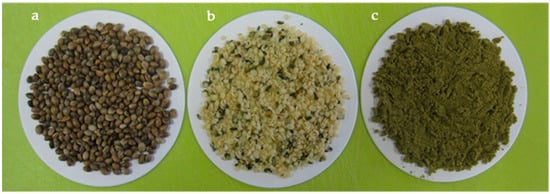
Hemp cake, a residual material of oil expression from the hemp seed, has long been utilized for livestock feeds [ 100 101 ]. It is a highly nutritive as well as sustainable feed stuff for cows [ 102 ], quails [ 103 ], cockerels [ 104 ], pigs [ 105 ], and broilers [ 106 ]. Now, research is in progress to utilize hemp protein “directly” as a material for plant meat.
The commercially available vegan meat products, represented by high moisture meat analogues (HMMAs), are made mostly from soy. In the production of HMMA, protein-rich materials, such as soy protein isolate, are subjected to a twin screw co-rotating extruder. Thermomechanical stresses are applied to the material at a high-water content (>40%) followed by forcing through a cooling die [ 107 ]. Soy-based HMMAs have a desirable chewy meat-lite texture. However, cultivating soy in colder climates such as in northern Europe is challenging. Thus, Zahari et al. [ 108 ] sought to investigate whether and to what extent soy protein isolate could be replaced by hemp protein concentrate in the production of HMMAs. A rapid visco analyzer (RVA) and differential scanning calorimeter (DSC) were used to investigate pasting features and melting temperature of the raw materials. They found that hemp protein absorbed less water and requested higher temperature for denaturation compared to soy protein. However, replacement of soy protein with hemp protein was possible up to 60% to yield layered and fibrous meat-like extruded products. Based on the DSC and RVA results, a higher cooking temperature and longer retention time are recommended for the extrusion of hemp/soy meat, as hemp protein needs a higher temperature for denaturation. Furthermore, to develop a more laminar fiber structure, the interior structure of the extruder should be equipped with more complicated kneading elements such as screws to hold the material longer in the extruder. Zahari et al. [ 108 ] concluded that while future studies are needed to optimize the condition of the extrusion process and the formulation matrix, it is possible to substitute soy protein with hemp protein without sacrificing the quality in meat analogue formulation.
5.4.3. “Meaty” Hemp Meat: Anisotropy and Fibrousness
To develop plant-based meat with a realistic “meaty” texture, anisotropy and fibrousness are among the most critical factors [ 109 110 ]. Anisotropy is the property of a material expressing different behaviors depending on the directions from which the external pressure is applied [ 111 ]. Meat structure is highly directional. On the molecular scale, actin and myosin form well-ordered and parallel arrays of filaments. On the macroscale, those filaments form into the muscle fiber bundles [ 112 ].
During a high-moisture extrusion of plant protein-based materials, the dynamics of protein aggregation and phase separation are the keys for the formation of meaty fibrous structures. The fibrousness is expressed during migration from the die to the cooling zone through a “sub-layer transformation” cross-linking [ 113 ]. The desired anisotropic structure of plant-based meat analogues has been accomplished by extrusion at high water content (>40%) and at elevated temperatures (>100 °C) followed by passing through a cooling die which prevents expansion of the matrix at the ejection from the extruder [ 114 ]. Interestingly, there are two distinct hypothetical mechanisms to explain how the anisotropic structure is made in the extruded plant meat. One is the “cross-linking” mechanism in which the anisotropic structure is explained as being formed by the alignment of protein and the subsequent stabilization at the molecular level. Protein molecules are unfolded and align along the direction of flow, followed by stabilization of the aligned proteins by way of interactions between/among proteins newly developed by disulfide or hydrophobic interactions.
The other is the “multiphase” mechanism in which formation of the anisotropic structure is explained due to the existence of multiphase systems [ 114 ]. Thermodynamic immiscibility of the biopolymers involved triggers the occurrence of phase separation in the extrusion process. The dispersed phase is deformed in the extruder die, then directed along the flow. The subsequent cooling process solidifies the material resulting in the anisotropic structures of the plant-meat products. In the case of extrudates using soy protein isolate solely as a protein source, the formation of anisotropic structures are derived from a multiphase system. Cryo-imaging and X-ray analysis of the extrudates revealed a water-rich dispersed phase surrounded by a continuous protein-rich phase with less moisture. Meanwhile, significant changes of protein–protein interactions were not observed [ 114 ]. Thus, in this model system, multiphase systems rather than cross-linking of proteins seemed to be the primary factor of the anisotropic structure.
On the other hand, during high-moisture extrusion processing of meat analogues made of pea protein and fatty acids, protein–protein interactions played key roles in the product structure [ 115 ]. Micromorphology analysis demonstrated that formation of anisotropic fibrous structures in the cooling die was disturbed by the coalescence of fatty acids of an unsaturated type, such as oleic and linoleic acids. Meanwhile, saturated stearic acid dispersed uniformly in the protein matrix, facilitating formation of disulfide bonds and promoting the generation of anisotropic fibrous structures along the extrusion direction [ 115 ]. Moreover, in the case of plant meat made by high-moisture extrusion processing of pea protein, amylopectin, and stearic acid, its anisotropic fibrous structures have been explained by the “anchor orientation and flexible cross-linking” mechanism [ 116 ]. In the cooling zone, stearic acid played the role of anchors, preventing the unfolded protein structure from refolding. In contrast, amylopectin facilitated the rearrangement, disulfide formation, and polymerization of the protein molecules. Thus, amylopectin and stearic acid synergistically mitigated the interaction between proteins. These aggregates with loose and flexible structures aligned along the extrusion direction and successfully formed anisotropic and fibrous structures in the extruded products.
Nasrollahzadeh et al. [ 67 ] compared the structure of plant meat made of hemp protein with the counterpart made of pea proteins. The proteins were respectively mixed with maize starch and were subjected to high moisture extrusion. The extruded pea meat was soft and isotropic while hemp meat was hard and anisotropic. The protein structure was investigated using SDS-PAGE in the presence or absence of a reductant, dithiothreitol (DTT). In the case of the hemp meat sample, some protein bands derived from edestin appeared only in the presence of DTT. In contrast, less-intense protein bands of pea meat appeared regardless of the presence or absence of the reductant. The results demonstrate a higher contribution of disulfide cross-linking in the polymerization of hemp protein during the extrusion process than in the case of pea protein. As mentioned above, hemp protein contains more cysteine (1.6–1.4 g cysteine/100 g protein) than pea protein (1.0 g of cysteine/100 g protein). Thus, in the case of hemp meat, protein–protein interactions played critical roles in the formation of anisotropy and fibrous-like mesoscale structures. More recent studies support the view by demonstrating that addition of cysteine controls the texture of plant meat. Addition of cysteine changed both the physical and chemical properties of extrudates made from soy protein isolate and wheat gluten [ 117 ]. The SH-containing amino acid promoted the fiber structure formation and affected the degree of texturization and rheological properties, as well as microstructures of the extrudates by rearranging the disulfide-mediated cross-linking among protein molecules [ 117 ]. Meanwhile, addition of L-cysteine or L-ascorbic acid on the material of the pea protein/wheat gluten blend altered the fibrousness and the mechanical properties of the meat analogue obtained by the high-temperature shear cell [ 118 ]. Cysteine accelerated protein polymerization through the disulfide–sulfhydryl exchange reactions in the heating process, yielding a continuous protein network upon cooling.
Conclusively, the alternative mechanism of the generation of fibrousness and anisotropy in the plant meat, whether cross-linking or multiphase, depends on the protein species, extraction process of the protein, and the subsidiary materials such as starches and fatty acids. In the case of hemp protein, its high content of free sulfhydryl groups is expected to produce the unique “meaty” texture of the products.