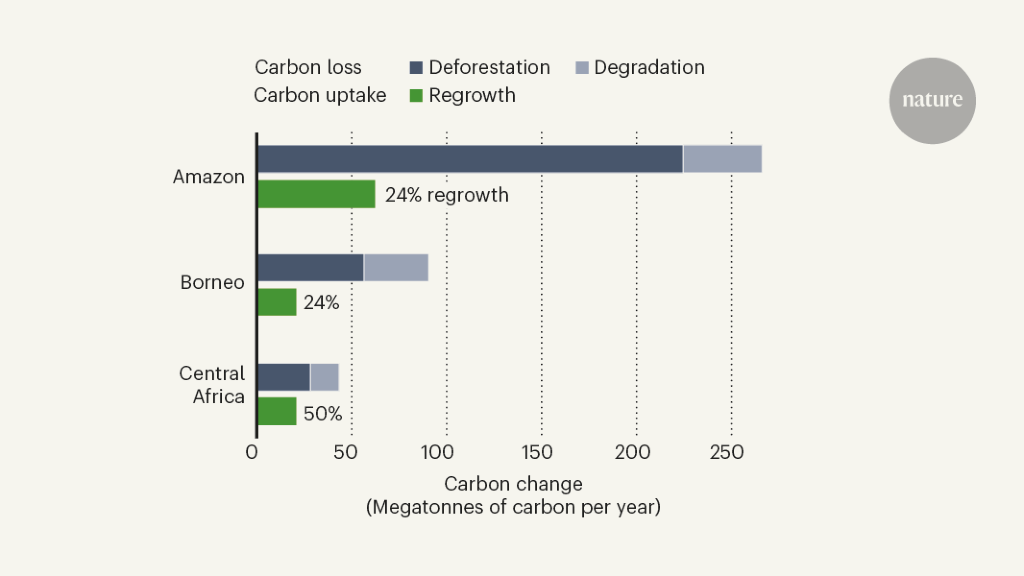
An enormous amount of carbon dioxide is likely to be sequestered in humid tropical forests that are recovering from human-induced disturbances, but an estimate that encompasses all of the planet’s tropical zones has been missing. In a paper in Nature, Heinrich et al.1 fill this gap using a new approach that analyses satellite data. For the three major regions of humid tropical forest on Earth — the Amazon Basin in South America, Central Africa’s Congo Basin and Borneo — the authors estimate rates of recovery after deforestation, and quantify the associated uptake of carbon between 1984 and 2018. They find that regrowing forests sequester large amounts of carbon, and that this process might have mitigated about one-quarter of the emissions that originally occurred as a result of forest loss and degradation.
Nature 615, 398-399 (2023)
doi: https://doi.org/10.1038/d41586-023-00706-w
References Heinrich, V. H. A. et al. Nature 615, 436–442 (2023). Baccini, A. et al. Nature Clim. Change 2, 182–185 (2012). Friedlingstein, P. et al. Earth Syst. Sci. Data 14, 4811–4900 (2022). Poorter, L. et al. Science 374, 1370–1376 (2021). Piponiot, C. et al. eLife 5, e21394 (2016). Sullivan, M. J. P. et al. Science 368, 869–874 (2020). Heinrich, V. H. A. et al. Nature Commun. 12, 1785 (2021). Griscom, B., Ellis, P. & Putz, F. E. Glob. Change Biol. 20, 923–937 (2014). Piponiot, C. et al. Environ. Res. Lett. 14, 124090 (2019). Putz, F. E. et al. Conserv. Lett. 5, 296–302 (2012). Vancutsem, C. et al. Sci. Adv. 7, eabe1603 (2021). Schwartz, N. B., Aide, T. M., Graesser, J., Grau, H. R. & Uriarte, M. Front. For. Glob. Change 3, 85 (2020). Lapola, D. M. et al. Science 379, eabp8622 (2023). Download references
Competing Interests The authors declare no competing interests.
Related Articles
Subjects