An interdisciplinary approach to modelling urban water flows
To quantify the unequal urban water interplay and its long-term impacts on urban water systems, this system-dynamics model brings together concepts from physical and engineering sciences and critical social sciences. While physical and engineering sciences have advanced understanding on the way in which human activities play a role in exacerbating urban droughts and water crises10,42,43,44, critical social sciences further the analysis by moving beyond interpretation of society as homogeneous or water and drought management as apolitical. By combining critical social studies with physical and engineering sciences, the model quantifies the role of different social groups in altering urban water balances. The contribution of both disciplines is crucial in the development of our new system-dynamic model. On the one hand, critical social sciences enable more complex understandings of urban water dynamics by examining the prevailing power structures that constitute and reshape cities16,45. Specifically, critical theories elucidate the role that elites play in reshaping the water demand and supply of a city relative to other social groups15,16,46. On the other hand, engineering and physical studies provide the tools to quantify human–water interplays and retrace their long-term implications within cities43,44.
This paper employs a state-of-the-art methodology developed by engineering and physical scientists over the past decades to quantify human influences on water systems alongside retracing the interplay of water and society47,48. We used system-dynamic modelling as it is particularly suitable for reproducing the behaviour of complex human–water systems and their responses to certain interventions over time49,50. By integrating critical social sciences into a system-dynamic model, this paper examines the inequalities of human–water interplays within a city. Relative to previous accounts of water inequalities across urban spaces, this interdisciplinary model simulates and quantifies the long-term trends of these unequal water consumption patterns along with their impacts on the city’s water balance.
To account for urban inequalities, the model is discretized into households, which are further reaggregated into distinctive social groups, each of which expresses different levels of power and distinctive patterns of water consumption. Our hypothesis is that the power relations between different social groups influence different levels of consumption and, in turn, shape water availability and future water shortages in cities. The model simulates diverse water consumption patterns employing specific coefficients and parameters that express distinctive characteristics of the social groups and ultimately households. To determine the urban water balance, the model considers both the public and private water sources that supply the households. Each household, depending on its socioeconomic features, can access or not private water sources in addition to public water. In this model, private water sources are boreholes drilled within the household’s premises. While not directly depleting the public water supply, the use of private boreholes has a long-term effect on the availability of groundwater sources within the study area. Besides their socioeconomic status, households also change their consumption patterns in response to droughts and municipal water restrictions. Thus, depending on the amount of water available in the city’s reservoir, the municipal water policies change and enforce different levels of water restriction. Restrictions may include water tariff increases and, in turn, limit the ability of some households to afford water. Moreover, municipal water restrictions also influence the awareness of the household51. In this model, awareness represents a crucial variable as it directly influences the amount of water consumed within each household. As a result, for a certain period, the household would limit its use of public water and, if possible, access private sources.
Supplementary Fig. 1 illustrates the model structure and the causal links that relate all the variables. At an urban scale, the main variables are the reservoir storage, municipal water polices, public water demand, private water demand and private water sources. Together, these variables determine the water balance of the city. The remaining variables characterize the human–water interplay within one household and determine the total amount and type of water consumed by the household. The model structure (Supplementary Fig. 1) shows how the water consumption of every household is aggregated into five different social groups, which differently affect the urban water balance either by reducing the water available in the municipal reservoir or by reducing the availability of private water sources. To account for emerging dynamics during drought events, the model retraces domestic water consumption over time for each social group using a monthly time step52. While this model has been built on Cape Town’s socioeconomic and hydrological features, its structure constitutes a useful representation of urban water dynamics adaptable to other cities characterized by socioeconomic inequalities and where households have access to both public and private water sources.
Case study
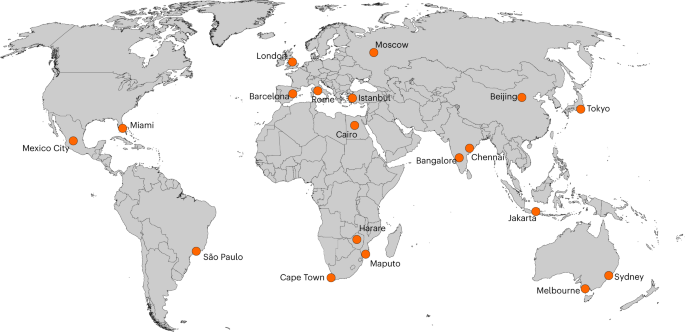
The model is applied and tested on the Cape Town urban area as it recently faced a severe drought, which unfolded into an unprecedented water crisis. Thus, the city represents a case in point of the threat that water crises pose to urban environments. Specifically, Cape Town is an example of a Mediterranean climate, and the catchments that supply water to the metropolitan area have mean annual precipitation that varies between 334 and 694 mm. The city is an ideal case study because it is characterized by stark socioeconomic inequalities and spatial segregation53, making it relevant to analyses of the impacts of uneven and unjust water consumption patterns. These distinctive features originate from the colonial era and are further exacerbated by apartheid and post-apartheid regimes. Since the seventeenth century, colonial policies have excluded the native population from the city’s land, resources and political spaces to serve the interests of white European settlers. Over time, and especially throughout the apartheid regime, the development of urban infrastructure and the exploitation of natural resources enabled the expansion of a rich urban centre with a relatively high level of public services enjoyed exclusively by the white elite54. After the end of apartheid (1994), the city underwent substantial reforms marked by a strong neoliberal ideology, which further exacerbated basic services inequalities in the city. Despite some attempts to redress social inequalities, these reforms did not succeed in completely overhauling apartheid policies and ended up perpetuating deeply rooted injustices. These political–economic conditions enabled unsustainable water consumption by elites through the establishment of world-class services in privileged urban areas and the creation of unsafe spaces with substandard services on the outskirts of the city53,54,55.
According to the 2020 census, Cape Town includes over one million households, of which 1.4% belong to the elite, 12.3% to upper-middle income, 24,8% to lower-middle income, 40.5% to lower income and, ultimately, 21% to informal areas21. The classification into five distinctive social groups is based on an index developed by the Western Cape Government for the City of Cape Town and other municipalities in the Western Cape20. The Socio-Economic Index provides a qualitative assessment of Cape Town’s urban areas on the basis of their income levels, education, type of housing and access to basic services. In turn, each such group is also characterized by a different level of water access and different consumption patterns. These specific socioeconomic features that characterize Cape Town’s social groups are used only to define the model structure and, for the simulation, characterize the input data such as parameters and coefficients.
Most of the model’s values are based on a fieldwork undertaken in Cape Town between May 2019 and March 2020 (Supplementary Tables 2–4). Primary qualitative data were collected through 65 interviews and 5 focus groups with households and governmental and non-governmental organizations. The interviews with non-governmental organizations and water-sector organizations focused mostly on the technical specification, operation and maintenance of Cape Town Water Supply System along with the governmental response to droughts and water shortages. The semi-structured interviews and focus groups with households focused on the household water consumption patterns and their experience of the drought, including changes in everyday water practices and coping strategies. The interview participants were selected across diverse socioeconomic groups and urban areas to capture different experiences of the drought. Qualitative primary data were triangulated with media outlets and reports and further combined with data collected through a documentary analysis. Quantitative data, including time series of rainfall, temperature, monthly inflow, reservoir storage, population and daily water consumption, have been retrieved, respectively, from the city of Cape Town data portal, the Hydrological Service of the South African Department of Water and Sanitation and the South African Weather Service56,57,58.
Since this model aims to simulate the interplay between human and water systems rather than the complexity of specific social or hydrological processes, it unavoidably makes a number of simplifying assumptions. First, the model focuses on socioeconomic inequalities, which are often easier to quantify. Thus, it does not explicitly capture the city’s racial polarization. Indeed, the legacy of apartheid remains vivid in Cape Town, where economic inequalities and geographical segregation are deeply entangled with racial categorization54. The model thus simplifies critical intersectional dimensions of water insecurity that still differentiate conditions of water access and insecurity. Second, run-off generation does not account for the hydrological processes of percolation, infiltration and groundwater changes. This assumption does not produce any instability in the model as private water sources do not directly affect reservoir storage values (Supplementary Fig. 1). Third, the model could not be validated against observed values of water consumption by the different social groups due to the lack of data. Last, the model focuses on intra-urban inequalities and consumption dynamics. As such, it does not simulate the increasing competitions and conflicts between the cities and their surrounding areas4. Yet it does offer an analytical framework that can be further extended for future studies integrating domestic and rural consumptions with the goal of broadening the scope of the analysis beyond the city.
A system-dynamic model for unequal cities
The model simulates the unequal interplay between water availability (from public and private water sources) and water consumption (from basic needs and amenities) of different income groups. Each social group can reshape its drought response depending on its socioeconomic conditions along with the restriction levels imposed by the municipality and the ultimate water costs. In turn, every household can respond to drought restrictions by either reducing their use of public water or by increasing their use of private water sources (for example, constructing boreholes for groundwater abstraction). The model reproduces the household’s decision-making process, its water consumption patterns and behavioural response to drought restrictions via the establishment of causal links between physical and socioeconomic variables (Supplementary Fig. 1). For example, lower levels of reservoir storage lead to higher water restrictions by the municipality, and in turn to higher levels of drought awareness across the different social groups, which will be compelled to reduce their public water consumption. This reduction of public water use leads to a higher consumption of private water sources depending on the socioeconomic conditions of each income group.
The model assumes that the main public water supply consists of a system of surface water reservoirs, as is the case for the metropolitan area of Cape Town. Indeed, Cape Town relies on the Western Cape Water Supply System, consisting of six main reservoirs, as its main source of water59. The model uses external observed data as monthly input of the public water sources. Change in time of the reservoir storage V (in m3) is calculated as:
$$\frac{{{\mathrm{d}}V}}{{{\mathrm{d}}t}} = Q_t^{\mathrm{I}} - W_t - Q_t^{\mathrm{A}} - Q_t^{\mathrm{S}} - Q_t^{\mathrm{E}} - {\mathrm{ET}}$$ (1)
where QI is the observed monthly reservoir inflow, W (m3 month–1) represents water withdrawals for water supply, QA (m3 month–1) is the observed water consumption for agricultural purposes, QS (m3 month–1) is the spillway release, QE (m3 month–1) is the environmental flow and ET [m3 month–1] is evapotranspiration. To define and assess the amount of water outflowing from the reservoir, the model employs Draper and Lund’s60 standard operational rules, which calculate the total withdrawal from the reservoir, as:
$$W_t = \left\{ {\begin{array}{*{20}{l}} {\frac{{V_t + Q_t^{\mathrm{I}}{{\Delta }}t - Q_t^{\mathrm{E}}{{\Delta }}t}}{{K_{\mathrm{P}}{{\Delta }}t}}{{{\mathrm{if}}}}\,V_t + Q_t^{\mathrm{I}}{{\Delta }}t - Q_t^{\mathrm{E}}{{\Delta }}t < K_{\mathrm{P}}\mathop {\sum}\limits_{S = 1}^5 {{\mathrm{Pu}}_t^S} {\mathrm{HH}}^S} \hfill \\ {\mathop {\sum}\limits_{S = 1}^5 {{\mathrm{Pu}}_t^S} {\mathrm{HH}}^S\,{\mathrm{Otherwise}}} \hfill \end{array}} \right.$$ (2)
where V (in m3) is the reservoir storage, Pu (m3 month–1 HH–1) is the total public water demand required by all the income groups in Cape Town, HH is the number of households, S is the five different social groups and K p is the hedging release slope.
Once the maximum storage capacity of the reservoir V MAX (in m3) is reached, the spillway releases an amount of water equal to:
$$Q_t^S = \left\{ {\begin{array}{*{20}{l}} {V_t + Q_t^{\mathrm{I}}\Delta t - Q_t^{\mathrm{E}}\Delta t - V_{{\mathrm{MAX}}}\,if\,V_t + Q_t^{\mathrm{I}}\Delta t - Q_t^{\mathrm{E}}\Delta t \ge \mathop {\sum}\limits_{S = 1}^5 {{\mathrm{Pu}}_t^S} {\mathrm{HH}}^S + V_{{\mathrm{MAX}}}} \hfill \\ {0\,{\mathrm{else}}} \hfill \end{array}} \right.$$ (3)
The environmental flow released by the reservoir, required to sustain downstream natural ecosystems, is calculated considering a presumptive standard of 20% the monthly reservoir inflow, according to ref. 61.
Finally, the losses from evapotranspiration are calculated using the method proposed by ref. 62:
$${\mathrm{ET}}_t = 0.00409 \times 6.11 \times {\mathrm{exp}}\left( {\frac{{17.3T_t}}{{237.3 + T_t}}} \right)$$ (4)
Where T (°C) is the average monthly temperature.
The volume of water consumed by each household is divided into water used for basic needs and water used for water-dependent amenities. In this model, basic water is supplied by public water sources (from the reservoirs system), and its amount depends mostly on income, societal awareness about water shortage and water tariff of each social group. In particular, the change in per capita water use for basic needs B (m3 HH–1 month–1) is estimated as:
$$\frac{{{\mathrm{d}}B^S}}{{{\mathrm{d}}t}} = \left\{ {\begin{array}{*{20}{l}} { - B_t^S\left[ {A_t^S\alpha _{\mathrm{D}}\left( {1 - \frac{{B_{{\mathrm{min}}}^S}}{{B_t^S}}} \right)} \right]\,{{{\mathrm{if}}}}\,\frac{{A_t^S}}{{{\mathrm{d}}t}} > 0} \hfill \\ { + B_t^S\left[ {A_t^S\alpha _{\mathrm{D}}\left( {1 - \frac{{B_t^S}}{{B_{{\mathrm{MAX}}}^S}}} \right)} \right]\,{{{\mathrm{if}}}}\,\frac{{A_t^S}}{{{\mathrm{d}}t}} < 0} \hfill \end{array}} \right.$$ (5)
where B min and B MAX are model parameters representing the minimum and maximum per capita water use for basic needs (Supplementary Table 4), A is the drought awareness and α D is a parameter representing the decay rate of changes in consumption for basic needs. In this study, drought awareness is considered as a function of municipal water restriction, household income and total cost of water. In particular, we assumed that an abrupt change of awareness occurs after the adoption of water restrictions by the municipality due to a water shortage (first component of equation (6)). In addition, we assume that the sense of awareness decays over time63 when no restrictions are in place (second component of equation (6)):
$$\frac{{A_t^S}}{{{\mathrm{d}}t}} = \frac{{R_t}}{{R_{{\mathrm{MAX}}}}}\left( {1 - A_t^S} \right) - \mu _{\mathrm{D}}\frac{{C_t^S - I^S}}{{I^S}}A_t^S$$ (6)
where μ D (1 month–1) represents the decay rate of drought awareness over time and I is the mean income (rand month–1). Here we used existing sociohydrological studies51 to define the decay rate of awareness and assumed that the value will decay in the same way for the five social classes. To test the impact of this assumption on the model’s results, we run additional simulations that consider different values for each social group. The results of this sensitivity analysis confirm the validity of our choice and the robustness of the model (Supplementary Fig. 2). R is the restriction levels identified by the local water authorities during drought periods, R MAX is the maximum restriction level that can be implemented and T (rand month–1 m–3) is the water tariff. Municipal restrictions entail a price increase of the water tariff and an increase in the awareness of the different social groups.
Different restriction levels are triggered when the reservoir level reaches certain thresholds (Supplementary Table 5). Such restrictions have an influence on both water tariff and in the drought awareness of the different social groups, resulting in different allocation of water to the metropolitan area.
The water cost C (rand month–1) is calculated as the product of the water tariff T (rand month–1 m–3) (Supplementary Table 6) and the total water use (the sum of water demand from basic water needs and amenities M (m3 HH–1 month–1); see the following). Water tariff varies by the monthly volume consumed per household and is assessed on the basis of the public water use Pu of each social group and the ongoing restriction level (Supplementary Tables 5 and 6).
Once the water fee is known, the total water cost C (rand month–1) is calculated as:
$$C_t^S = T_t^S\left( {B_t^S + M_t^S} \right)$$ (7)
where M (m3 HH–1 month–1) is the water demand from water-dependent amenities, highly dependent on the social group. As mentioned, high-income social groups will consume more water for amenities relative to lower-income groups as these privileged groups often use water for filling swimming pools, washing cars and gardening22. In particular, the initial value of water amenities is assessed as:
$$M_{t = 1}^S = \varepsilon _{\mathrm{W}}\delta ^S + \varepsilon _{\mathrm{G}}^SB_{t = 1}^S + \varepsilon _{\mathrm{C}}^S\chi ^S\eta ^S$$ (8)
where ε W is the average water demand for a swimming pool per month, δ is the percentage of households with a swimming pool in a given social group, ε G is the percentage of water use for gardening, ε C is the average water demand for car cleaning per month, χ is the average number of cars in the household of a given social group and η is the number of car cleanings per month. The variation of water amenities over time is calculated as:
$$\frac{{{\mathrm{d}}M^S}}{{{\mathrm{d}}t}} = \left\{ {\begin{array}{ll} {M_t^SA_t^S\alpha _{\mathrm{M}}\frac{{I^S}}{{I_{{\mathrm{MAX}}}}}}&{if\,R < 2} \hfill \\ {0}&{if\,R = 2} \hfill \\ { - M_t^SA_t^S\frac{{I^S}}{{I_{{\mathrm{MAX}}}}}\left( {1 - \frac{{M_{{\mathrm{min}}}}}{{M_t^S}}} \right)}&{if\,R > 2} \hfill \end{array}} \right.$$ (9)
where α M is a parameter representing the increasing rate of changes in water amenities, M min is the minimum value of amenities, I is the mean income of a given social group and I MAX is the maximum income among the groups.
The total water use TW (m3 month–1 HH–1) consumed by each social group is the sum of basic (B) and amenities (M) water uses. Total water use can be supplied either by public water sources (reservoirs) or by private sources (groundwater). We first calculated the private water demand Pr (m3 month–1 HH–1), and we assessed the public water demand Pu (m3 month–1 HH–1) as the difference between total water use and private water. We assumed that each social group can increase its private water on the basis of drought awareness, convenience and distance to the private water source. Specifically, we calculate Pr and Pu as follows:
$${\mathrm{Pr}}_{t + 1}^S = \left( {1 - d^S} \right)A_{t + 1}^Sc^S{\mathrm{TW}}_{t + 1}^S$$ (10)
$${\mathrm{Pu}}_{t + 1}^S = {\mathrm{TW}}_{t + 1}^S - {\mathrm{Pr}}_{t + 1}^S$$ (11)
where d is the normalized average distance of the social group to the private water sources, assumed 0 for high-income groups and 1 for lower-income groups, TW (m3 month–1 HH–1) is the total water use, while c is the model parameter representing the convenience of private water use (Supplementary Table 6). In this model, we assumed that informal dwellers do not have access to private water sources as described in ref. 22. Model parameters and model initial conditions are based on values retrieved from the interviews and focus groups with households and governmental and non-governmental organizations undertaken in Cape Town between May 2019 and March 2020. These values were further triangulated with an in-depth literature review on water consumption in Cape Town21,22,64. Observed values of reservoir storage, monthly reservoir inflow and average monthly temperature are retrieved from South African Weather and Hydrological Data Services56,57.
Scenarios description
To understand the manner and extent to which the unsustainable water consumption of privileged groups influences the water balance of a city, this work simulates and compares the occurrence of five different scenarios of water consumption. The aim of those scenarios is to consider the differential effect of the unsustainable water consumption of privileged groups relative to other drivers of water depletion. The first two scenarios focus, respectively, on population growth and climate changes because these drivers are considered as the major forces that threaten the availability of freshwater resources by altering the spatiotemporal characteristics of temperature and precipitation along with increasing the level of water consumption2,9. The population growth scenario does not use different population growth rates across social groups as this detailed information is not available or is too uncertain. It should be noted, however, that if the model had incorporated these differentiated trends, the relative impact of population growth on the urban water balance would probably have been even smaller as projections suggest that informal settlements will grow more than the rest of the population38. In this scenario-based analysis, the population growth and climate change scenarios are compared with three other scenarios characterized by different levels of social inequalities and, in turn, diverse amounts of unsustainable water consumption by privileged social groups. These are, respectively, a baseline scenario with existing inequalities, a scenario with more-extreme inequalities with increased water consumption by privileged groups and a scenario that foresees a more-egalitarian society with sustainable and equal consumption of water across the city. Supplementary Table 7 summarizes the values and coefficients attributed to each scenario.
Model evaluation
To assess the model’s ability to quantify observed hydrological and socioeconomic variables, we carried out a model evaluation by means of structural and behaviour validity tests65,66. The structural test aims to assess whether the designed model structure can effectively represent the problem under investigation, whether it has a logical structure and whether the links between the model’s variables have been properly conceptualized. In our study, we used three different types of structural test, as proposed by ref. 67. First, we performed a structure examination test to check whether the model structure is consistent with the descriptive knowledge of the real system under study. In addition, the empirical research carried out in Cape Town served to define the model structure, the relationships between social groups and urban water systems, the socioeconomic characteristics and decision-making process of each such group and their influence on the urban water balance. Governmental documents and official reports served instead to examine the robustness of the model and, in particular, its causal links and polarities (the positive or negative signs in Supplementary Fig. 1), its equations and general assumptions. These reports provided specific information regarding municipal water policies, drought-related restriction, households’ consumption patterns and awareness68,69. Second, we performed a dimensional consistency test. This test verifies the dimensionality of each mathematical equation by checking the measurement units on both sides of a given equation. Third, we ran the extreme condition test on the model using extreme values for each parameter to assess whether the model exhibits a logical behaviour and whether it remains numerically stable (Supplementary Fig. 3). We multiplied the model parameter values by three and found a higher water consumption leading to lower reservoir values and higher dependency on additional water sources as water fees increased. Eventually, this test did not detect any numerical instability under extreme parameter values. It is worth noting that we did not multiply the parameters linked to the initial values of water amenities (equation (8))—that is, number of households HH and mean income I—as this would have led to unrealistic values of water consumption, consequent drastic reduction of the reservoir volume and constant dependency on public water sources. Ultimately, the model did not show any numerical instability also in the case of unlimited use of private water sources. In the behaviour validity test (Supplementary Fig. 4), we evaluated the model results with observations of the real system. First, we compared observed and simulated values of the reservoir volumes and obtained a Nash–Sutcliffe efficiency of 0.84 (with 1.00 representing a perfect model). Second, we compared the observed values of annual average water consumption (Ml d–1) with the model simulation between 2011 and 2019. This test returned a satisfying root mean square error of 133 Ml d–1.
Ethical approval
The research protocol for this study was approved by the Municipality of Cape Town (PSRR-0259). The research team followed established guidelines and protocols for ethical research, including those provided by the Italian Research Ethics and Bioethics Committee (protocol 0043071/2019), the Swedish Ethical Review Authority (Dnr 2019-03242) and the European Union under Horizon 2020 (FAIR Data Management and EU General Data Protection Regulation).
We obtained oral informed consent from all participants, which included clear and detailed information about the context and purpose of the interview, the expected duration of participation, the funders and lead researchers of the project, data protection, confidentiality, privacy and the storage duration of personal data. We also made it clear to participants that they were not obligated to answer any questions and that they could withdraw from the interview at any time.
Our team took great care to ensure that the ethical principles of the research were followed throughout the study and that the rights and well-being of participants were protected at all times.
Reporting summary
Further information on research design is available in the Nature Portfolio Reporting Summary linked to this article.