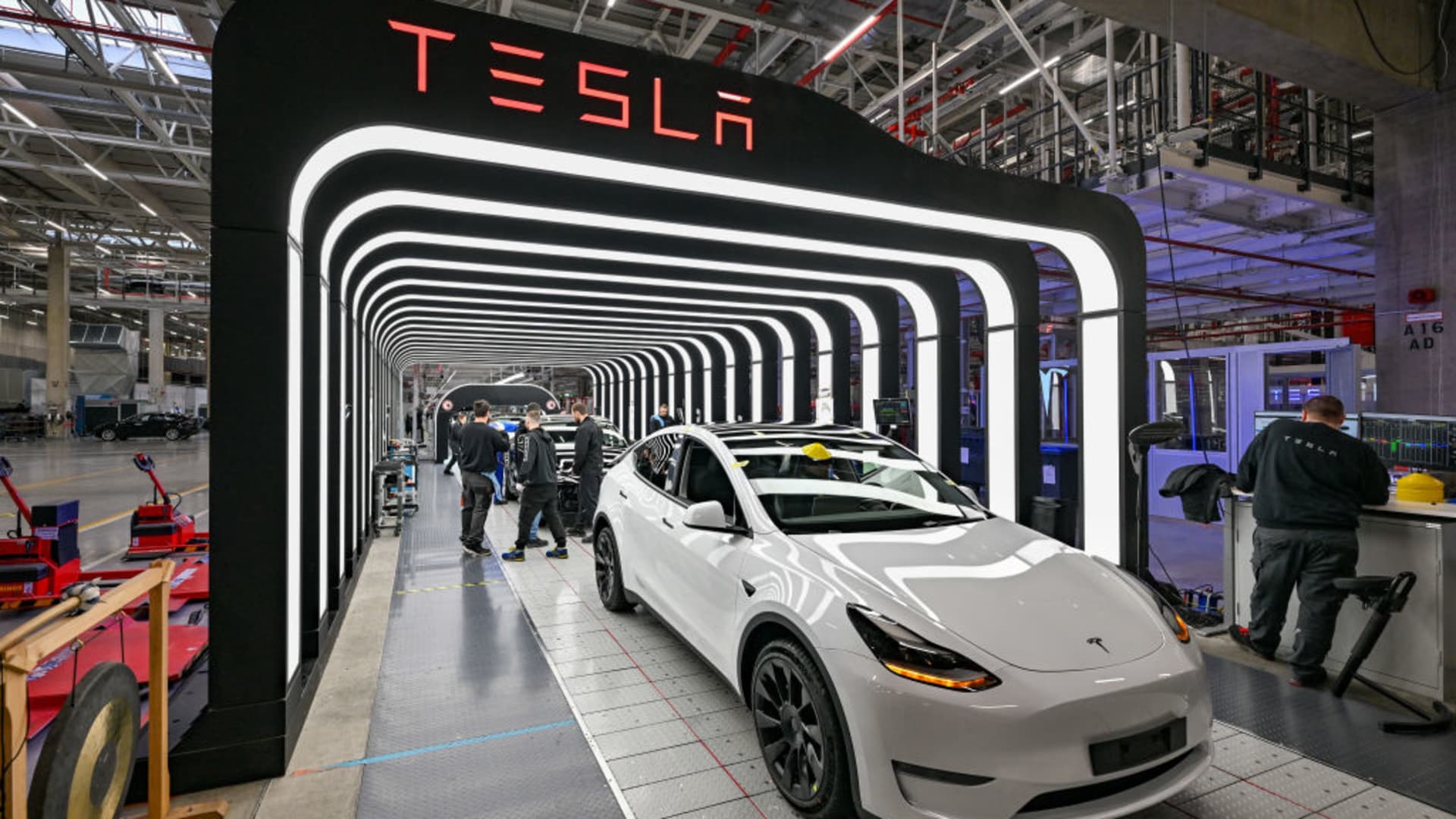
Employees of the Tesla Gigafactory Berlin Brandenburg work on the final inspection of the finished Model Y electric vehicles. The Tesla plant was opened and put into operation on March 22, 2022.
Shares in electric vehicle maker Tesla dropped more than 4% after the company reported first-quarter earnings after the bell Wednesday. Here are the results.
Earnings per share: 85 cents adjusted vs 85 cents expected, according to the average analyst estimate compiled by Refinitiv
85 cents adjusted vs 85 cents expected, according to the average analyst estimate compiled by Refinitiv Revenue: $23.33 billion vs $23.21 billion expected, according to Refinitiv estimates
Net income came in at $2.51 billion, down 24% from last year, while GAAP earnings per share came in at 73 cents, down 23% from the year-ago quarter.
Tesla specified in a shareholder deck that "underutilization of new factories" stressed margins, along with higher raw material, commodity, logistics and warranty costs, and lower revenue from environmental credits, all contributing to the drop in earnings from last year.
Automotive revenue, Tesla's core segment, reached $19.96 billion in the quarter, up 18% from last year. Total revenue rose 24%. Revenue from automotive regulatory credits during the first three months of 2023 amounted to $521 million, down from $679 million in the first quarter of last year.
On an earnings call, CEO Elon Musk emphasized an "uncertain" macroeconomic environment that could impact people's car-shopping plans. During a question-and-answer session with analysts, Musk said he expected 12 months of "stormy weather" in the economy. He cautioned that, "Every time that the Fed raises interest rates, that's the equivalent to an increase in the price of a car." He also said, whenever there's uncertainty in the economy, people will generally postpone "big new capital purchases like a new car."
He said, "We've taken a view that pushing for higher volumes and a larger fleet is the right choice here, versus a lower volume and higher margin," but noted he expects Tesla vehicles "over time will be able to generate significant profit through autonomy."
When Tesla began to discuss its ambitions in self-driving technology in 2016, Musk said the company would conduct a hands-free trip across the U.S. by late 2017. It has yet to complete that mission.
Tesla Energy revenue soared to $1.53 billion, up 148% compared with the same period last year. Tesla's energy storage systems deployment increased to 3.9 GWh, or by 360%, the company said. These lithium-ion battery-based energy storage systems, made by Tesla, include the home backup battery, called the Powerwall, and the utility-scale Megapack system which enables utilities to store and use more energy generated from renewable, but intermittent, sources like solar and wind.