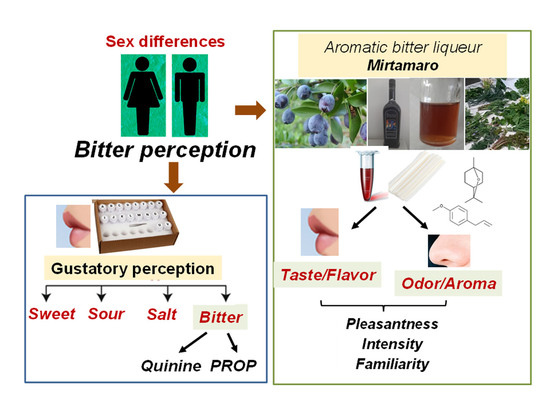
Then, in the second part of the study, we evaluated in healthy subjects the sensory perception (odor and taste) and acceptance of a commercial Italian “Amaro”, a bitter aromatic herbal liqueur, to evidence the influence of sex on the bitterness intensity rating and to evaluate whether the presence of volatiles (aroma) from aromatic herbs/plants could influence bitter taste perception/acceptance. The odor and taste perception of the aromatic myrtle bitter liqueur (Mirtamaro) was assessed in a group (subpopulation) of non-trained subjects (= 40). Differences in sensory perception between men and women were evaluated considering the rate of the gustatory and olfactory dimensions of pleasantness, intensity, and familiarity using a hedonic scale method (Likert scale), as previously used for the determination of the sensory properties of food products [ 21 27 ]. Bitter liqueur was obtained by the maceration of myrtle () leaves and berries together with a complex mixture of Mediterranean herbs and plants as flavoring/bittering ingredients. Myrtle is an after-meal liqueur typical of Sardinia (Italy), greatly appreciated for its bitter flavor and special aroma, and its tonic, digestive, antioxidant, and anti-inflammatory properties [ 11 29 ]. Quantitative analyses by gas chromatography–flame ionization detection–mass spectrometry (GC-FID/MS) of the main volatile compounds extracted from Mirtamaro were performed and their potential contribution to bitter perception was evaluated. Moreover, the influence of sex on the intensity rating of the 6-n-propylthiouracil (PROP) was also evaluated in this selected group of subjects.
We initially evaluated the role of sex in the bitter intensity rating of quinine, a common bitter substance [ 7 24 ] in a healthy population (= 231 Caucasian European participants). Bitterness perception was determined by the “Taste Strips” test [ 21 26 ]. The correlation between bitter perception with demographic features, other basic tastes (sweet, salty, and sour), and olfactory function was also determined.
Therefore, starting from all these considerations, the objectives of the present research were to explore the occurrence of sex differences in the perception of bitter compounds and an aromatic bitter herbal liqueur, and to evaluate the modulatory effect of aromatic substances on sex-specific bitterness perception/acceptance. To the best of our knowledge, no previous work has been reported on sex differences in sensory perception of a complex aromatic herbal bitter liqueur.
Gustatory perception of the bitter taste is a promising area of study because of its role in food choices, feeding behavior, and food’s perceived healthiness [ 4 19 ]. Many studies are focused on the investigation of the genetic [ 1 17 ] and age [ 17 19 ] differences regarding bitterness perception; however, there is still limited and heterogeneous information on the influence of sex on bitter taste perception [ 7 19 ]. The knowledge of sex differences in bitter taste acuity has potential applications in precision nutrition/medicine [ 18 20 ]. Moreover, strategies are currently required to successfully reduce/mask bitterness in food/pharmaceutical products and increase their acceptance [ 4 7 ]. There is a great interest in the dietary use of aromatic herbs and spices for their ability to impart distinctive flavorings to food products, contemporaneously increasing their nutritional value and positively affecting human health [ 21 ]. Volatile constituents (terpenes and terpenoids) contribute to the flavor and aroma of aromatic herbs and spices [ 10 13 ]. It has been reported that the rich aromatic substances in alcoholic beverages may influence bitterness perception [ 2 ]. Volatile organic flavor compounds are responsible for food/liqueur aroma and are perceived through retro-nasal olfaction [ 11 12 ]. It has been evidenced that odor–taste interactions can result in cross-modal summation [ 22 ] and that bitterness is cognitively related to aromas [ 2 ]. Individual differences largely influence aroma perception [ 22 ] and previous studies reported that women exhibit better olfactory ability compared to men [ 23 ].
The bitter taste is also constantly dropping its popularity among consumers [ 2 13 ]. The consumption of bitter herbal liqueurs has greatly increased in the last years due to their digestive and tonic-restorative properties [ 10 16 ]. Italy possesses a great tradition in the preparation of “Amari” [ 11 12 ], alcoholic (above 15°) aromatic preparations with a distinctly bitter taste, used as an aperitif to stimulate the appetite or consumed after a meal to aid food digestion (eupeptic properties) [ 10 16 ]. Moreover, bitter herbal liqueurs generally possess considerable antioxidant properties due to their high polyphenol content [ 10 15 ]. Traditional Italian bitters are made by the infusion/maceration of a mix of different parts (barks, rhizomes, roots, berries, flowers, and peels) of selected aromatic and bitter herbs/spices/plants in a hydroethanolic base [ 11 12 ]. Herbal bitter liqueurs’ formulation requires the blending of bitter-tasting herbs/plants (generally, andspp.) with aromatic ones, with one being the main contributor to the final sensory properties of the product, whereas others are used for flavor or color corrections [ 10 11 ].
The consumer’s perception of bitter taste is a key factor in the acceptability and success of foods and drugs; therefore, food/pharmaceutical industries aim to mask or minimize bitterness to increase the acceptance of food products and avoid treatment refusal [ 2 7 ]. However, bitter substances can be well tolerated, and certain bitter foods (chocolate, broccoli, and whole wheat bread) and beverages (coffee and tea) are known to be safe for consumption [ 1 4 ]. It has been demonstrated that a moderate amount of bitterness may enrich flavor and confer physiological functions on alcoholic beverages [ 2 12 ]. Indeed, bitterness is a basic flavor in beer, wine, herbal liquors, and rice wine [ 2 12 ]. Bitter compounds such as caffeine, polyphenols, glucosinolates, and humulones have health benefits in the concentrations at which they are typically consumed [ 1 4 ]. Therefore, removing or breaking down healthy bitter phytonutrients may reduce the food’s beneficial effects [ 2 4 ].
The bitter taste is one of the basic taste modalities and bitterness perceptions, often associated with food aversions and rejection behavior, and is considered a defense mechanism against harmful compounds (toxicants) [ 1 4 ]. Plants produce bitter toxic substances as a defense strategy against herbivores [ 3 4 ]. However, numerous natural bitter compounds have negligible toxicity and exert important health benefits (antioxidant and anti-inflammatory properties) [ 1 5 ]. Indeed, several herbs rich in bitter chemicals are often used in traditional Chinese and Ayurveda medicines for their beneficial properties [ 1 6 ]. The receptors for bitter taste are called taste 2 receptors (TAS2Rs or T2Rs) and are a subfamily of G protein-coupled Receptors (GPCRs) on the taste bud cells of the tongue and oral cavity [ 1 8 ]. Bitter taste receptors, TAS2Rs, expressed in extraoral tissues may also be responsible for some physiological effects exerted by bitter compounds and are thus considered potential drug targets for the treatment of several diseases and disorders [ 5 9 ].
Data were expressed as a mean ± standard deviation (SD). The evaluation of the statistically significant differences was performed using Graph Pad INSTAT 3.0 software (GraphPad Software, San Diego, CA, USA) and with the software package IBM SPSS Statistics 25 for Windows (IBM, Armonk, NY, USA). The normal distribution of data was calculated using the Shapiro–Wilk test. Statistically significant differences between men and women were performed using Student’s unpaired t -test with Welch’s correction, which does not assume those two populations have the same standard deviation. Bivariate correlations using Pearson’s coefficient (r) were calculated between different factors in total subjects, men, and women to identify the more promising factors for the multivariate linear regression analyses. Moreover, the multivariate linear regression analysis with a stepwise selection was performed to assess: the potential contribution of sex, age, weight, and sweet taste perception (independent variables) to the bitter (quinine) taste intensity score (dependent variable) in all subjects, men, and women; the potential contribution of Mirtamaro odor pleasantness, odor intensity, odor familiarity, taste intensity, and taste familiarity dimensions (independent variables) to bitter liqueur taste pleasantness (dependent variable) in men and women. The significance level was set at p < 0.05.
Quantitative analyses were performed on a gas chromatograph Agilent 7890A GC (Agilent Technologies, Palo Alto, CA, USA) equipped with a flame ionization detector (FID) and a 30 m × 0.25 mm i.d. with a 0.25 μm stationary film thickness HP-5ms capillary column (Agilent J&W, Palo Alto, CA, USA), coupled with a mass selective detector with an electron ionization device (EI) and a quadrupole analyzer (Agilent 5973) as previously reported [ 21 34 ]. The following temperature program was used: from 60 °C to 246 °C at a rate of 3 °C/min and then held at 246 °C for 20 min (total analysis time 82 min). Other operating conditions were the following: carrier gas helium (purity ≥ 99.9999%—Air Liquide Italy); flow rate, 1.0 mL/min; injector temperature, 250 °C; detector temperature, 300 °C. Injection of 1 μL of diluted sample was performed with 1:20 split ratio, using an autosampler (Agilent, Model 7683B). The MS conditions were as follows: MS transfer line temperature 240 °C; EI ion source temperature, 200 °C with ionization energy of 70 eV; quadrupole temperature 150 °C; scan rate, 3.2 scan/s atscan range, (30 to 480). To handle and process chromatograms and mass spectra, the software Agilent MSD ChemStation E.01.00.237 (Agilent Technologies) was used. Compounds were identified by comparison of their mass spectra with those of NIST02 library data of the GC/MS system [ 35 ] and Adams libraries spectra [ 36 ]. The results were further confirmed by comparison with the compounds’ elution order with their retention indices on semi-polar phases reported in the literature [ 35 ]. Retention indices of the components were determined relative to the retention times of a series of n-alkanes (two standard mix: C–Cand C–C) with linear interpolation [ 37 ]. Quantification of constituents was made by integration of GC-FID peak areas without using the response correction factors. The individual volatile compound concentration was expressed as the percentage of the total amount of volatile compounds (%). Three replicates were performed for each sample.
Liquid/liquid extraction, using n-hexane as the solvent, was used to extract volatile compounds from Mirtamaro. This non-polar organic solvent is well recognized as suitable for the extraction of a wide class of flavor compounds [ 21 33 ]. Briefly, aliquots (3 mL) of the bitter liqueur were treated with 1 mL of n-hexane in a glass screw-cap vial. After 72 h at 25 °C in the dark, the n-hexane supernatant was filtered through a 0.45 μm syringe filter into a vial. Aliquots (1 μL) of n-hexane extracts were directly injected (to avoid volatile compound losses) into the GC/MS system for the determination of the quali-quantitative composition of the main volatile components.
Filter paper strips impregnated with the myrtle bitter liqueur for taste assessment were prepared by immersing the strip in an aliquot (2 mL) of Mirtamaro and removing the alcohol by strip shaking. Before the taste experiment, participants rinsed their mouths with drinking water. Participants evaluated the taste pleasantness, intensity, and familiarity of Mirtamaro and generated subjective sensory attributes, such as the presence of a particular flavor note or aftertaste. The odor and taste pleasantness, intensity, and familiarity of Mirtamaro were evaluated using a 7-point Likert-type scale, which ranged from 0—not at all to 6 (such as 0 = very unpleasant and 6 = very pleasant; 0 = not intense at all and 6 = very intense; 0 = not familiar at all and 6 = very familiar). A value of 3 was considered a neutral point [ 21 27 ].
Among all participants, a group of subjects (14 men and 26 women) were randomly enrolled to assess the sensory properties of the aromatic myrtle herbal liqueur (Mirtamaro). Non-trained subjects were asked to evaluate the odor and taste dimensions (pleasantness, intensity, and familiarity) of the bitter liqueur by using a hedonic scale method (self-reported Likert scale) [ 21 27 ]. Before the sensory assessment, myrtle bitter liqueur was aliquoted, at room temperature (23 °C), in 2 mL disposable plastic test tubes. Initially, the sample was smelled by the subjects, and they were asked to indicate the subjective aroma attributes/descriptors that they perceived with more intensity. Then, participants evaluated the odor pleasantness, intensity, and familiarity of Mirtamaro.
As indicated on the commercial label, the bitter liqueur is obtained by extensive infusion in a hydroethanolic base of myrtle ( Myrtus communis ) together with a complex mixture of aromatic and medicinal Mediterranean herbs and plants as flavoring/bittering ingredients. More than twenty aromatic herbs/plants (gentian root, Citrus fruits, licorice, helichrysum, and fennel among others) are mixed with myrtle leaves and berries according to a secret recipe to obtain the right balance of bitter, balsamic, spicy, and citrus flavors of this digestive liqueur. Both wild and cultivated (from organic production on a local farm) herbs/spices and plants are used for bitter liqueur preparation. Herbs and plant parts are used both fresh and after drying. The final alcohol concentration is 30% ( v / v ). Another ingredient reported on the label is sugar, added to balance the taste and make it more palatable.
Among all participants. a group of subjects (= 40, 14 men and 26 women) were enrolled to assess the sensory properties of n-6 propylthiouracil (PROP). The PROP bitter taste intensity was performed using three different solutions (0.032. 0.32, and 3.2 mM) according to the literature [ 32 ]. Drinking water was used as the solvent and to rinse the mouth. Filter paper strips (4 cm) were soaked in PROP solutions and presented to participants at room temperature. Subjects placed filter paper strips on their tongue and were asked to describe the taste on their tongue. If they reported that perceived bitter taste, the first stimulus was the lowest concentration. If the participant’s first response was tasteless, subsequent stimuli increased in concentration. The PROP bitter intensity score is calculated as the sum of correct answers and may range from 0 to 3.
The olfactory function was assessed using the Sniffin’ Sticks test (Burghart Messtechnik, Wedel, Germany), which consists of three different tasks, odor threshold (OThr), odor discrimination (ODi), and odor identification (OId) [ 25 31 ]. All subjects were allowed to drink only water 1 h before the test and had to avoid smoking and scented products on the testing day. Sniffin’ Sticks consists of pen-like odor-dispensing devices. All participants were blindfolded for the OThr and ODi tasks. Primarily, OThr task was evaluated using 16 stepwise dilutions of n-butanol [ 25 31 ]. OThr task was assessed employing a three-alternative forced-choice task (3AFC) and single-staircase technique [ 31 ]. OThr scores may vary from 16 (subject who could perceive the lowest concentration) to 1 (subject who could not perceive the highest concentration). Secondly, ODi test was assessed over 16 pen-like odor-dispensing devices. In the ODi task, three different pens were used, two containing the same odor and the third containing the target one with the 3AFC task. The ODi total score is calculated as the sum of correct answers and may range from 0 to 16 [ 25 31 ]. Finally, OId test was evaluated by 16 common odors with four verbal descriptors and a multiple forced choice format (three distractors and one target) [ 25 ]. The total olfactory function (TDI score = values of OThr + OId + ODi) was calculated and values over 30.5 indicated normosmia [ 25 31 ].
The gustatory perception was assessed in all subjects using the “Taste Strips” test (Taste Strips 50 LA-13-00314 test, Burghart Messtechnik, Wedel, Germany). The test consists of filter paper strips (with a length of 8 cm and a tip area of 2 cm) impregnated with four concentrations of each basic taste quality: sweet, bitter, sour, and salty [ 21 26 ]. Concentrations were: 0.4, 0.2, 0.1, 0.05 g/mL of sucrose for sweet taste; 0.006, 0.0024, 0.0009, 0.0004 g/mL of quinine hydrochloride for bitter taste; 0.3, 0.165, 0.09, 0.05 g/mL of citric acid for sour; 0.25, 0.1, 0.04, 0.016 g/mL of sodium chloride for salty taste [ 21 26 ]. Drinking water was used as the solvent in each taste modality. Before the test, participants rinsed their mouths with drinking water. The global taste score may range from 0 to 16 and a score ≥ 9 is considered normogeusia [ 21 26 ].
Two hundred and thirty-one subjects were enrolled with an age range of 19–85 years (mean age ± SD, 35.8 ± 15.9), 153 women and 89 men. All subjects received an explanatory statement and gave their written informed consent to participate in the research study. Exclusion criteria were cognitive impairment, head or neck trauma, stroke, chronic/acute rhinosinusitis, neurodegenerative disorders, psychiatric conditions, and any disorder that may interfere with the olfactory and gustatory evaluations, as previously reported [ 21 27 ]. None of the participants had taken medications (for allergies or other diseases) for 5 days before the test. Age (years), weight (kg), height (m), and body mass index (BMI) were collected for all participants. This study was approved by the “Azienda Ospedaliera Universitaria di Cagliari” Ethical Committee (protocol number: PG/2018/10157) and was performed according to the Declaration of Helsinki.
Chemical analysis revealed that Mirtamaro was characterized by high amounts of oxygenated monoterpenes (fenchone, linalool, terpinen-4-ol, alpha-terpineol, and gamma-terpineol) and phenylpropanoids (methyl chavicol and (E)-anethole). However, the aromatic liqueur contained lower amounts of monoterpene hydrocarbons (alpha-thujene, orto -cymene, limonene) and other compound classes (octanoic acid). The main constituents of the extract were: 1,8-cineole (35.11%), methyl chavicol (estragole) (13.73%), octanoic acid (9.72%), alpha-terpineol (5.65%), fenchone (5.30%), and carvone (5.16%). Other minor compounds were: terpinen-4-ol (3.26%), limonene (3.10%), linalool (2.81%), gamma-terpineol (1.77%), (E)-anethole (0.87%), and alpha-thujene (0.26%).
Mirtamaro odor intensity and taste intensity were strictly related both in men (r = 0.687, p < 0.05) and women (r = 0.508, p < 0.01), indicating that a high odor intensity rating corresponded to a high taste intensity rating. Moreover, strong correlations were found between odor pleasantness/familiarity and taste pleasantness/familiarity in both groups, indicating that familiarity with the bitter liqueur aroma and taste influenced their likability. Interestingly only women showed a strong correlation between odor pleasantness/taste pleasantness (r = 0.564, p < 0.01), indicating the contribution of Mirtamaro aroma in taste acceptance, and therefore a positive modulation of bitterness perception.
Interestingly, strong correlations were found between the different Mirtamaro odor (OP, OI, OF) and taste dimensions (TP, TI, TF). Our data showed that women exhibited more correlations than men between different Mirtamaro odor and taste dimensions. Significant positive correlations were determined for OP/OF, OP/TI, OI/TI, OF/TI, and TP/TF in men, and OP/OF, OP/TP, OP/TF, OI/TI, OF/TP, OF/TF, and TP/TF in women ( Table 5 ).
Taking into consideration the perceived attributes, for all subjects, the taste intensity of Mirtamaro corresponded to the intensity of its bitterness. Therefore, in this subpopulation, women showed a higher Mirtamaro bitter taste intensity rating than men, confirming the results obtained for the classical bitter stimuli quinine and PROP. In general, most women perceived the odor/aroma of the bitter liqueur as very pleasant, while they indicated the high bitterness as unpleasant, whereas men perceived the Mirtamaro aroma as less pleasant than women and did not indicate the high bitterness as unpleasant.
In general, both men and women showed lower ratings of taste pleasantness and familiarity than the same odor dimensions. As observed for odor, no significant sex differences were observed in the perception of Mirtamaro taste familiarity. Regarding pleasantness, women perceived the bitter liqueur taste as less pleasant (2.15 ± 1.87) than men (2.75 ± 1.76). Moreover, a significantly ( p < 0.01) higher rating in taste intensity was observed in women (5.19 ± 0.94) (46.1% of whom indicated a perception score of 6) than in men (4.08 ± 1.16; 8.3% indicated a perception score of 6).
Regarding the taste subjective sensory properties (flavor) of Mirtamaro ( Table 4 ), both men and women indicated bitterness as the main taste perception (the attributes were very bitter or bitter). In general, the time necessary for bitterness perception in the mouth was greater compared with the other taste modalities (sweet, sour), and in many cases, participants indicated an initial sweet taste perception followed by a bitter taste. The occurrence of alcohol and myrtle extract was recognized by both groups. As observed for odor, in the description of Mirtamaro taste perceived attributes, women gave more sensory descriptors than men, in terms of the presence of another specific flavor such as anote, woody note, mint aftertaste, or caramel aftertaste.
In general, high mean scores (>4) were measured both in men and women for all odor dimensions. No significant marked sex differences were observed in the perception of Mirtamaro odor pleasantness and familiarity dimension; however, women perceived Mirtamaro odor as more pleasant than men. Interestingly, a significantly ( p < 0.01) higher rating in odor intensity was observed in women than men, with 73.1% of women showing perception scores of 5 and 6.
Regarding Mirtamaro’s odor (aroma), both men and women individuated the presence of alcohol, myrtle extract, and bitter compounds. In addition to myrtle, the main contributor to the sensory properties of the product, participants (untrained panelists) generally had difficulties individuating specific components (herbs/spices) of the flavoring mixture. However, women gave more sensory descriptors than men, in terms of the presence of specific aromas (such as licorice, juniper, berries, orange, woody, etc.).
Then, non-trained subjects were asked to evaluate the odor and taste dimensions (pleasantness, intensity, and familiarity) of Mirtamaro by using a hedonic Likert-type scale [ 21 27 ] to evidence the potential role of sex in the perception of bitterness and the possible modulatory effect of aromatic compounds in bitter taste perception.
This trend was also confirmed using PROP as the bitter stimuli, with a significantly ( p < 0.01) higher intensity perception of bitter taste in women (2.69 ± 0.62) than in men (1.83 ± 1.19). Among women, 76.9% of them perceived all PROP-tested concentrations, while a lower value (33.3%) was observed in men.
In this subpopulation, the intensity rating of the bitter compounds PROP was also determined and compared with the intensity scores obtained for quinine. Figure 3 A shows mean values ± SD of the intensity rating of the bitter compounds quinine and PROP measured for total subjects, men, and women. The % values of each quinine taste score (0, 1, 2, 3, and 4) determined for men and women are reported in Figure 3 B and Figure 3 C, respectively, while Figure 3 D and Figure 3 E show the % values of each PROP taste score (0, 1, 2, and 3) measured in men and women, respectively.
Demographic and clinical features of the total subjects, men, and women are reported in Supporting Information (Table S1) . Mean values ± SD of sweet, salty, and sour taste scores measured for total subjects, men, and women are reported in Figure S3 Supporting Information . No significant differences were observed between men versus women for all analyzed parameters, except for weight.
Then, in the second part of the study, we evaluated in healthy subjects the influence of sex on the bitterness perception of the bitter aromatic herbal liqueur Mirtamaro and explored the effect of volatile compounds (aroma) from aromatic herbs/plants on bitter taste perception/acceptance.
Furthermore, the multivariate linear regression analysis using a stepwise selection was performed to assess the potential contribution of sex, age, weight, and sweet taste perception on the bitter (quinine) taste intensity in all subjects. In the multivariate linear regression analysis, the bitter taste intensity was considered the dependent variable, while age, sex, weight, and sweet taste perception were independent variables based on bivariate correlation results. The model was corrected for age unless not significantly correlated with bitter taste intensity since the gustatory function usually decreases with age.
Considering all subjects, low significant correlations emerged between bitter taste intensity versus sex, weight, BMI, and sweet taste intensity, while no significant correlations were found versus other parameters. Low significant correlations were found between bitter (quinine) taste intensity versus sweet taste intensity in men, and versus weight and BMI in women ( Table 2 ). The bitter intensity was significantly correlated with total taste perception in all three groups.
Significant differences were observed for sweet (< 0.01) and salty (< 0.05) scores between men versus women, which showed the highest intensity rating, while similar values were observed for the sour taste in the two groups. Interestingly, women showed significantly (< 0.01) higher mean values (3.08 ± 0.90) of bitter (quinine) taste intensity ratings than men (2.64 ± 1.31). The patterns of subjects’ bitterness perception, expressed as percentual values (%) of each bitter (quinine) taste score, revealed a preponderance of 3 (37.9%) and 4 (39.2%) score values in women, with low percentages of 0 (2.6%) and 1 (3.3%) scores, whereas men showed lower percentages of 3 (30.8%) and 4 (32.0%) scores and higher percentages of 0 (10.3%) and 1 (10.3%) values than women. Significant differences (< 0.05) in bitter (quinine) perception were also observed between men and women separated into three different age groups [ 18 ]: 18–36 years (= 50 for men and= 91 for women), 37–50 years (= 10 for men and= 24 for women), and 51–85 years (= 18 for men and= 38 for women), with women showing the highest intensity rating ( Figure S1, Supporting Information ).
The mean overall age was 35.8 years, without statistically significant differences between men and women. The age range was from 18 to 85 years old. Significant differences were observed between men and women for the mean weight ( p < 0.001) and BMI ( p < 0.001), while similar values were measured for OThr, ODi, OId, and TDI.
4. Discussion
2 , =N–, –SH, –S–, –SO 3 H, –S–S, =C, =S) are often associated with bitter taste [ Bitterness is usually considered the most unpleasant taste by humans since it is associated with the bitter taste of poisonous compounds and our instinct is to reject them [ 1 2 ]. However, most of the natural bitter compounds found in herbs/plants have bioactive properties in the human organism [ 1 2 ]. Several herbs rich in bitter chemicals are often used in traditional Chinese and Ayurveda medicines, which are based on the cross-cultural belief that the bitterness of medicine is correlated with the desired medicinal activity [ 3 ]. A phytochemical bitter taste has been proposed as a better predictor of anti-inflammatory activity than the chemical class [ 5 ]. Several chemical functional groups (–NO, =N–, –SH, –S–, –SOH, –S–S, =C, =S) are often associated with bitter taste [ 1 2 ]. The Bitter Database (BitterDB) has gathered information on more than 1000 bitter compounds [ 1 40 ]. Several compounds can be perceived as bitter, such as ions, peptides, humulones, polyphenols (flavonoids, tannins), alkaloids, terpenes, iso-α-acids, higher alcohols, and glucosinolates [ 1 2 ]. Polyphenols are mainly responsible for the bitterness in fruits and vegetables [ 1 2 ].
2,7,9,18,17,18, Studies on bitterness perception have nutritional, nutraceutical, pharmaceutical, and health implications. Gustatory perception of the bitter taste seems to be related to an enhanced intake of dietary fat and to a tendency to develop obesity [ 17 ]. Bitter-taste sensitivity greatly changes among individuals due to the genetic variability of bitter-taste receptor TAS2Rs (polymorphisms) [ 1 17 ]. Moreover, a significant decrease in bitter perception with increasing age has been reported [ 17 19 ]. Studies devoted to investigating the influence of sex on bitter taste acuity demonstrated that women have better bitterness perception than men; however, data are very contrasting [ 7 19 ]. The influence of sex in bitter taste perception should be taken into account for potential applications within the new precision nutrition/precision medicine framework [ 18 20 ].
In the first part of this study, we analyzed the influence of sex on the intensity rating of the four basic tastes: sweet, salty, bitter, and sour (separately and jointly in a “total taste score”) in a healthy population. Our results showed that women perceived bitter taste (by challenging subjects with different quinine concentrations), as well as sweet, salt, and total taste, significantly more intensely than men.
18,18, According to our results, a greater taste perception in women has been reported for several taste qualities [ 17 41 ], although the results are not always consistent. Several studies have demonstrated that women perceive taste significantly more intensely than men and score better in taste identification tests [ 17 41 ]; however many other studies found no relationship between sex and gustatory function [ 41 ]. A large epidemiological study reported statistically significant differences between women and men for bitter (quinine), sweet, salty, and sour tastes, and women perceived each taste significantly more intensely than men [ 41 ]. Barragan et al. [ 18 ] found that women consistently have a greater perception of bitter (PROP), sweet, salty, and sour than men, except for umami. Previous studies evidenced that bitter taste perception can be different between men and women, though both have the same gene expression about bitterness, and women have a better perception of bitterness than men and a strong tendency to be supertasters [ 17 ]. However, no statistically significant differences were observed between males and females related to the perception of the bitter taste of the steroid prednisolone [ 7 ]. Moreover, a study conducted to determine the influence of age and sex on the taste functions of healthy Taiwanese subjects showed that all individual tastes were rated as similarly intense regardless of sex [ 19 ]. The mechanism through which sex/gender affects the sense of taste is not exactly known, but it may be related to hormonal influences on taste, and a complex association between hormones and chemoreceptor functions has been suggested to exist in women [ 17 ].
2) versus those with a body weight ≤ 60 kg (BMI < 28 kg/m2). Previous studies suggested that the sensitivity to bitterness is related to body weight and reported an inverse correlation between the perception of PROP bitterness and BMI [ Regarding bitterness perception in women, our data showed a significant negative association between bitter taste intensity versus weight, indicating a decrease in bitter perception with a weight increase. Significant lower bitter taste scores were measured in women with a body weight > 65 kg (BMI mean value > 28 kg/m) versus those with a body weight ≤ 60 kg (BMI < 28 kg/m). Previous studies suggested that the sensitivity to bitterness is related to body weight and reported an inverse correlation between the perception of PROP bitterness and BMI [ 17 ].
25,10,11,12, Gentiana , Artemisia , and Achillea spp. are largely used for conferring bitterness to aromatic bitter liqueurs [ Gentiana lutea ) (mainly roots), a plant with important healthy properties (digestive, stimulating the appetite, curing indigestion, and easing constipation) [ Strategies employed to reduce/mask bitterness include the use of other taste stimuli (such as sucrose and sodium chloride) or bitter modifiers/blockers, compounds that affect bitter perception by the modulation of the human bitter taste receptors, complexation/encapsulation of bitterants, or the formation of a physical barrier between bitterant and taste receptors [ 42 43 ]. In the last years, a remarkable increase has been observed in the dietary use of aromatic herbs and spices for their ability to provide complex flavor to food products and positively affect human health [ 21 44 ]. Aromatic plants, used as flavor enhancers, provide phytochemicals, essential oils, proteins, vitamins, minerals, and fiber, greatly contributing to the promotion of health due to their antioxidant and anticancer activity and capacity to prevent cardiovascular/neurodegenerative diseases [ 21 44 ]. The use of aromatic plants, spices, and essential oils to prepare beverages dates back to ancient Mediterranean history [ 11 ]. Herbal liqueurs are descendants of former cordials, medicinal plants, alcoholic extracts, or elixirs that were believed to manifest curative properties [ 10 ]. The bitter taste is also constantly dropping its popularity among consumers [ 4 ] and traditional bitter liqueurs are also consumed for their supposed pharmacological activity (digestive, anti-inflammatory, and antioxidant properties) [ 5 14 ]. Italy seems to produce the largest number and widest variety of bitter, herbal liqueurs traditionally consumed as aperitifs or digestives, usually called “Amari”, or, literally, “bitters” [ 11 ]. Plants belonging to, andspp. are largely used for conferring bitterness to aromatic bitter liqueurs [ 11 ]. The most popular bitter botanical used in alcoholic beverages is gentian () (mainly roots), a plant with important healthy properties (digestive, stimulating the appetite, curing indigestion, and easing constipation) [ 45 46 ].
M. communis L.) is an aromatic plant endemic in the Mediterranean area and has long been used by locals in traditional medicine (for treating several common diseases, including gastrointestinal, urinary, and skin disorders) and for its culinary properties. Myrtle berries, leaves, seeds, and essential oils are currently widely employed in the food, cosmetic, and pharmaceutical industries for their antioxidant and anti-inflammatory properties [28, Myrtle (L.) is an aromatic plant endemic in the Mediterranean area and has long been used by locals in traditional medicine (for treating several common diseases, including gastrointestinal, urinary, and skin disorders) and for its culinary properties. Myrtle berries, leaves, seeds, and essential oils are currently widely employed in the food, cosmetic, and pharmaceutical industries for their antioxidant and anti-inflammatory properties [ 11 29 ]. Myrtle berries and leaves are amply used for food aromatization, and to prepare, by hydro-alcoholic maceration, a typical liqueur (“Mirto”) that is very popular, especially on Sardinia Island [ 11 28 ]. Mirtamaro is a recent after-meal liqueur, characterized by a bitter flavor, obtained by the maceration of myrtle leaves and berries together with a complex (secret) mixture of aromatic Mediterranean herbs and plants as flavoring/bittering ingredients. In the second part of this study, we evaluated, in a group of 40 healthy subjects, sex differences in the sensory perception (odor and taste) of this aromatic myrtle bitter liqueur and explored the role of volatiles (aroma) from aromatic herbs/plants in the bitter taste perception/acceptance.
All participants perceived the odor of the aromatic bitter liqueur as very pleasant and familiar; however, women perceived Mirtamaro odor more intensely than men and were able to discriminate some aroma components. Many studies report superior female performance on tests of odor identification [ 47 ]. All subjects perceived the Mirtamaro taste as less pleasant and familiar than the odor. Moreover, both men and women indicated bitterness as the main taste modality of the aromatic liqueur. In many cases, participants indicated an initial sweet taste perception followed by a strong bitter taste. It is well known that the time necessary for bitterness perception in the mouth is greater than for other tastes [ 2 ]. Women perceived the Mirtamaro bitter taste more intensely than men, confirming the influence of sex on the bitterness perception. The higher perception of bitterness in women made the bitter liqueur taste more unpleasant than for men. In this group of participants, women also perceived the bitter taste of PROP, as well as quinine, significantly more intensely than men.
Significant positive correlations emerged between bitter liqueur odor pleasantness/odor familiarity and taste pleasantness/taste familiarity both in men and women. Many studies demonstrated a positive correlation between odor familiarity and pleasantness, which represents a consistent result in olfactory research [ 48 ]. Moreover, it is well demonstrated that the habitual consumption (familiarity) of a food/liqueur raises its acceptability [ 27 49 ]. Interestingly, a positive correlation was found between Mirtamaro odor intensity/taste intensity in both groups. The perception of food flavor affecting food choice derives from the integration of olfactory/gustatory information [ 27 49 ]. Additional significant positive correlations emerged between bitter liqueur odor pleasantness/taste pleasantness, odor pleasantness/taste familiarity, odor familiarity/taste pleasantness, and odor familiarity/taste familiarity in women, indicating a complex integration between olfactory and gustatory functions. Interestingly, the strong positive correlation between odor pleasantness and taste pleasantness measured only in women possibly indicated the contribution of Mirtamaro aroma in taste acceptance, and therefore a positive modulation of bitterness acceptance due to pleasant volatile aromatic compounds.
22, Volatile organic flavor compounds are responsible for food/liqueur aroma/odor and are perceived through the smell sensory organs of the nasal cavity (ortho-nasal smell) [ 27 50 ]. Flavor involves the combination of gustative perception of soluble and non-volatile compounds (basic tastes), volatile compounds perceived through retro-nasal olfaction (aroma), and chemical sensations through the trigeminal nerve [ 21 50 ]. A complex relationship exists between the presence of specific configurations of volatile organic compounds in food and drink products and multisensory flavor perception [ 51 ]. The bitterness properties of alcoholic beverages primarily result from the various raw materials, unique techniques, and interactions of various flavor compounds [ 2 ]. Aroma and taste activate the central cognitive pathway to generate flavor perception [ 2 50 ]. Previous studies evidenced that odor–taste interactions can result in cross-modal summation [ 2 22 ] and that bitterness is cognitively related to aromas [ 2 ]. It has been reported that the rich aromatic substances in alcoholic beverages may influence bitterness perception [ 2 ].
Citrus fruits, licorice, helichrysum, and fennel) are mixed (according to a secret recipe and the formula was not publicized) to myrtle leaves/berries to obtain the right balance of bitter, balsamic, spicy, and citrus flavors of Mirtamaro. The root of gentian is used for conferring bitterness. The main volatile compounds of Mirtamaro liqueur were isolated by liquid–liquid extraction with n -hexane and analyzed by GC-FID/MS. n -Hexane has previously been reported as a proper solvent for the extraction of volatile compounds in honey and flavored sea salts without the extraction of polar components (such as sugars, salt, and water) [ orto -cymene, and alpha-thujene represented minor components. Compounds such as 1,8-cineole, alpha-thujene, linalool, orto -cymene, limonene, terpinen-4-ol, and alpha-terpineol are typical components of myrtle berries and leaves and are also responsible for their characteristic aroma and taste [39,39, More than twenty aromatic herbs/plants (among others gentian,fruits, licorice, helichrysum, and fennel) are mixed (according to a secret recipe and the formula was not publicized) to myrtle leaves/berries to obtain the right balance of bitter, balsamic, spicy, and citrus flavors of Mirtamaro. The root of gentian is used for conferring bitterness. The main volatile compounds of Mirtamaro liqueur were isolated by liquid–liquid extraction with-hexane and analyzed by GC-FID/MS.-Hexane has previously been reported as a proper solvent for the extraction of volatile compounds in honey and flavored sea salts without the extraction of polar components (such as sugars, salt, and water) [ 21 33 ]. 1,8-Cineole, methyl chavicol (estragole), octanoic acid, alpha-terpineol, fenchone, and carvone emerged as the main Mirtamaro aroma components, while terpinen-4-ol, limonene, linalool, gamma-terpineol, (E)-anethole,-cymene, and alpha-thujene represented minor components. Compounds such as 1,8-cineole, alpha-thujene, linalool,-cymene, limonene, terpinen-4-ol, and alpha-terpineol are typical components of myrtle berries and leaves and are also responsible for their characteristic aroma and taste [ 21 29 ]. Fenchone, estragole, and (E)-anethole are the compounds that characterize the aroma of wild fennel [ 52 ]. The aromatic terpene oxide eucalyptol (1,8-cineole) and the phenylpropene methyl chavicol (estragole) represented the most abundant volatile compounds in Mirtamaro, accounting for approximately 49% of volatile compounds. Both compounds possibly contributed to the odor pleasantness of the bitter liqueur, being characterized by a pleasant odor (descriptors: camphor-like, citrus, herbaceous, and fruity for 1,8-cineole [ 38 53 ]; sweet, phenolic, fennel, anise, spicy, green, and herbal for estragole [ 38 53 ]).
O -glucoside, petunidin-3- O -glucoside, and delphinidin-3- O -glucoside as the most representative ones [14, Phenolic compounds, anthocyanins, and essential oil are the most important phytochemicals in myrtle berries and leaves [ 11 28 ]. Previous studies showed that myrtle liqueur is composed of arabinoside derivatives, flavonols, flavanols, hydroxybenzoic acids, and anthocyanins with malvidin-3--glucoside, petunidin-3--glucoside, and delphinidin-3--glucoside as the most representative ones [ 11 28 ]. Phenolic compounds have a great influence on the final bitter taste due to their bitterness and astringency notes [ 2 54 ]. Gentian roots are a high source of bitter molecules such as the secoiridoid glycosides amarogentin and gentiopicroside [ 45 46 ]. Previous studies indicated the non-volatile metabolites gentisin, isogentisin, swertiamarin, sweroside, gentiopicroside, loganic acid, and amarogentin as the most abundant compounds in gentian liqueurs produced by simple maceration of the dried or fresh gentian roots in spirits [ 45 ]. Therefore, Mirtamaro flavor perception is the result of a multisensory interaction due to the presence of multitudinous flavors and bitter compounds.
n -hexane extracts and other non-volatile polar components present in a hydro-alcoholic solution could contribute to the taste/flavor of Mirtamaro and bitterness perception. Non-volatile polar compounds of Mirtamaro may modulate the taste perception on taste buds in the tongue, whereas aromatic compounds present in bitter liqueur, liberated in the mouth, may be responsible for the flavor attributes indicated by the untrained panelists through retro-nasal olfaction. However, the exact sensory impact of analyzed volatile compounds was difficult to predict due to the wide range of aroma qualities associated with all identified terpenes [ Therefore, volatile compounds measured in-hexane extracts and other non-volatile polar components present in a hydro-alcoholic solution could contribute to the taste/flavor of Mirtamaro and bitterness perception. Non-volatile polar compounds of Mirtamaro may modulate the taste perception on taste buds in the tongue, whereas aromatic compounds present in bitter liqueur, liberated in the mouth, may be responsible for the flavor attributes indicated by the untrained panelists through retro-nasal olfaction. However, the exact sensory impact of analyzed volatile compounds was difficult to predict due to the wide range of aroma qualities associated with all identified terpenes [ 13 53 ].