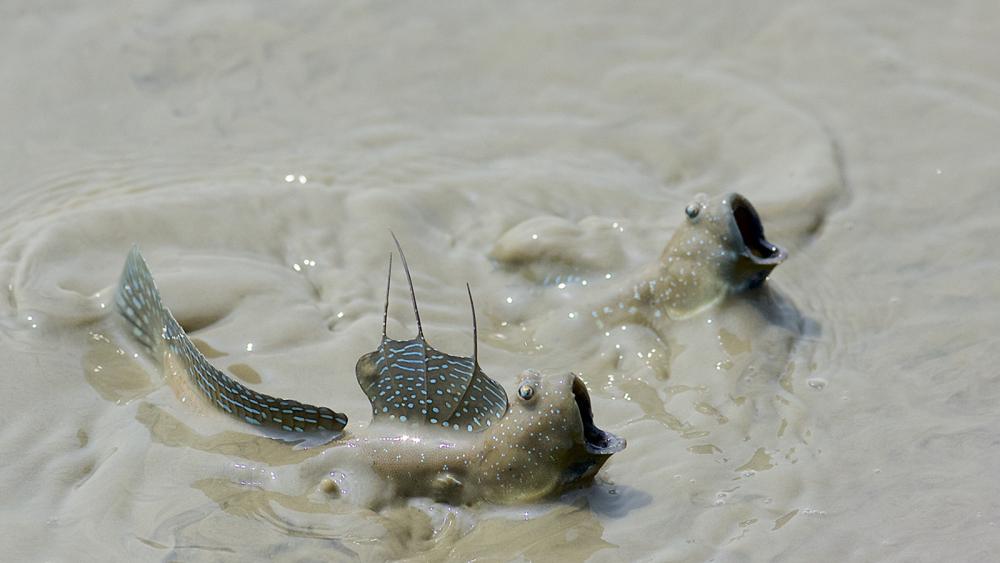
“Blinking in mudskippers appears to have evolved through a rearrangement of existing muscles that changed their line of action and also by the evolution of a novel tissue, the dermal cup,” said Aiello. “This is a very interesting result because it shows that a very rudimentary, or basic, system can be used to conduct a complex behavior. You don’t need to evolve a lot of new stuff to evolve this new behavior — mudskippers just started using what they already had in a different way.”
To uncover why mudskippers blink on land, the team considered the roles that blinking plays in humans and other tetrapods. In humans, tears are critical to keep cells in the eye healthy and oxygenated, so the researchers analyzed whether mudskippers also blink to keep their eyes wet.
“We found that, just like humans, mudskippers blink more frequently when confronted with dry eyes,” said Aiello. “What’s incredible is that they can use their blinks to wet the eyes, even though these fish haven’t evolved any tear glands or ducts. Whereas our tears are made by glands around our eyes and on our eyelids, mudskippers seem to be mixing mucus from the skin with water from their environment to produce a tear film.”
The research team also tested whether blinking in mudskippers could be triggered to protect the eye from possible injury and if blinking cleaned the fish’s eyes of dust or debris. In both cases the answer was “yes.” Therefore, blinking in the mudskippers seems to fulfill three of the main functions of blinking — protecting, cleaning, and maintaining moisture — in humans and other tetrapods.
“Our study, which considered the behavior and anatomy of a living fish that underwent a transition to life on land, similar to the earliest tetrapods, helps us to reimagine how and why these early tetrapods might have been blinking,” said Aiello. “Having the opportunity to study how and why this behavior first evolved provides an amazing opportunity to learn more about the way humans came to be as they are and gives us insight into changes associated with major transitions in the history of animals — like inhabiting land.”
Blinking is something that humans and other tetrapods are constantly doing throughout the day, often without even noticing it happens, Aiello explained. Despite being a subtle action, blinking is actually quite complex and fascinating, because it is a single behavior that can perform multiple functions, which are all critical to the health and safety of the vertebrate eye, he said.
“The transition to life on land required many anatomical changes, including changes for feeding, locomotion and breathing air,” said Stewart. “Based on the fact that mudskipper blinking, which evolved completely independently from our own fishy ancestors, serves many of the same functions as blinking in our own lineage, we think that it was likely part of the suite of traits that evolved when tetrapods were adapting to live on land.”