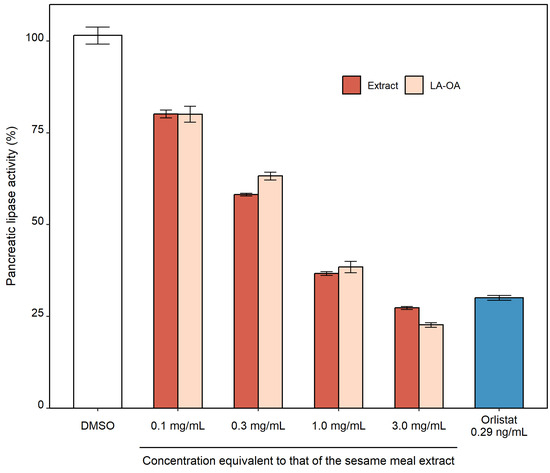
PL inhibition has been established as a safe and effective strategy to treat obesity. To date, a tremendous number of chemically diverse PL inhibitors of varying degrees of activity have been identified from a wide range of natural sources such as plant extracts and microbial products. Despite maintained interest in the modulation of intestinal lipid handling by targeting PL, very few of the PL inhibitors have found their way into clinical research [ 5 9 ]. One of the few is apple polyphenol extract, the PL inhibitory activity of which is attributable to the presence of oligomeric procyanidins. The oral administration of 600 mg of the extract was shown to significantly inhibit the postprandial elevation of TGs in serum in 6 non-hypertriglyceridemic subjects. One obvious limitation of this study was the small sample size, and neither the AUCs nor iAUCs of postprandial TGs were evaluated [ 10 ].L. leaf extract has been reported to be a PL inhibitor in vitro and effective in lowering lipid absorption in mice. In a trial in patients with hyperlipidemia,L. leaf extract was found to reduce the values of fasting TGs and several other lipidemic parameters; however, since neither the postprandial lipemic, particularly TG, responses, nor fecal fat excretion were monitored, whether the antihyperlipidemic action of the extract was attributable to its PL inhibitory activity remains unclear [ 11 ]. Tea polyphenols have been shown to reduce postprandial hypertriglyceridemia in non-hypertriglyceridemic and mildly hypertriglyceridemic individuals through PL inhibition [ 12 13 ]. In addition, 3-month treatment with a green tea extract was reported to be effective in reducing body weight and waist circumference in moderately obese patients, but the parameters related to lipid metabolism were not measured [ 14 ]. Taken together, it is evident that there is a scarcity of clinical studies of natural product-derived PL inhibitors. We had previously reported that the ethanolic extract of sesame meal was a potent PL inhibitor in vitro with its activity hinging exclusively on two non-esterified FFAs—LA and OA, and that the administration of a mixture of these FFAs markedly reduced the elevation of serum TGs after a high oral fat load in rats [ 8 ]. To investigate if the outcome obtained in rodent models could be translated to humans, in the present study, we further assessed the effects of the sesame meal extract as a carrier of free LA and OA on postprandial lipemic responses in human subjects. The results of the study demonstrated that a single oral administration of 90 mg of the free LA and OA-enriched sesame meal extract was effective in reducing the absorption of dietary fat after ingestion of a standardized high-fat meal, as measured by attenuated postprandial TG excursions, in non-hypertriglyceridemic, nonobese individuals. Treatment with the extract was also shown to impede the postprandial rise of serum RLP cholesterol, phospholipids, and βLPs, and to enhance the HDL cholesterol response. The present study is appropriately powered and the first trial that demonstrated the efficacy of free LA and OA-enriched natural products in modulating dietary fat absorption and the consequent postprandial lipemic responses by inhibiting PL in healthy individuals. Furthermore, the free LA and OA-enriched sesame meal extract was effective at a lower dose (90 mg per meal) compared to those of the aforementioned extracts or compounds (>200 mg per meal for solid or 500 mL per meal for liquid), indicating the possibly greater PL-inhibitory potency of the sesame meal extract conferred by free LA and OA, although explicit comparisons were difficult.
Humans spend most of diurnal time in a postprandial state, and it is increasingly acknowledged that disease development is essentially associated with the dysregulation of substrate fluxes in the immediate postprandial period [ 15 ]. Epidemiological studies have revealed that elevated postprandial TG levels pose increased risks for a myriad of chronic conditions, particularly atherosclerotic cardiovascular diseases [ 2 19 ], and the associated mortality [ 19 21 ] in men and women. The postprandial period, especially after a fatty meal, is characterized by a rise in circulating TGs, which results in an increase in TG-rich chylomicrons and TG-rich very-low-density lipoprotein (VLDL), which are collectively known as TG-rich lipoproteins (TRLs) [ 22 23 ]. It is established that the effects of elevated postprandial TGs on the pathophysiology of atherosclerotic cardiovascular diseases are substantially mediated by RLPs, the lipolytic products derived from TRLs, rather than TGs or TRL themselves [ 17 21 ]. RLPs, carrying 5 to 20 times more cholesterol per particle than LDL particles, can penetrate the endothelial barrier and be readily taken up in an unregulated fashion by scavenger receptors expressed by resident macrophages in the subendothelial space, facilitating cholesterol deposition and the development of atherosclerosis [ 24 ]. Herein, we reported that oral intake of the free LA and OA-enriched sesame meal extract led to reduced mean incremental RLP cholesterol level at all postprandial time points and a statistically significant difference was observed at 6 h, although statistical significance was not achieved for the iAUC of RLP cholesterol. Meanwhile, intake of the extract also contributed to significant decreases, at all postprandial time points, in the concentration of circulating βLP or LDL particles, which are more atherogenic than the LDL particles in the fasting state [ 25 ] and regarded as a stronger predictor of the incidence of cardiovascular events than either LDL cholesterol or non-HDL cholesterol [ 26 ]. As both RLPs and LDL are derived from TRLs, the suppressed postprandial rise in RLP cholesterol and LDL particles observed after intake of the extract points to a postprandial state of attenuated TRL responses due to ameliorated triglyceridemia. Moreover, we observed a significantly higher HDL cholesterol level at 6 h after consumption of the high-fat meal along with the free LA and OA-enriched extract. It is known that elevated postprandial TGs and TRLs favor the exchange of cholesteryl esters and TGs between HDL and TRLs, resulting in TG enrichment of HDL, reducing HDL cholesterol and exacerbating HDL dysfunction [ 18 29 ]. Therefore, we speculate that the higher postprandial HDL cholesterol level associated with the extract intake is likely a result of the attenuated postprandial triglyceridemia and TRL elevation and the thereby reduced transfer of cholesteryl esters from HDL to TRL. In case of high TG availability, similar to HDL, LDL particles are also modified by TG transfer, resulting in the formation of small dense LDL and a slight decrease in the cholesterol components of LDL [ 29 ], which is consistent with our observation in this study. However, it seemed that a single dietary intervention with the sesame meal extract did not alter the trajectory of postprandial LDL cholesterol in a significant manner comparing to the placebo. In addition, the postprandial rise in phospholipids was observed for both arms as a result of the digestion and absorption of phospholipids present in the standardized high-fat meal. Lower levels of postprandial phospholipids were observed in association with the intake of the extract. The cause of this alteration remains to be further clarified as postprandial phospholipid responses relate to various factors, for instance, the phospholipase-mediated digestion of dietary phospholipids and the transport and subsequent remodeling of the digestive products of phospholipids [ 30 31 ]. Finally, it should be noted that despite the promising results about the attenuating effects of dietary intervention with the free LA and OA-enriched sesame meal extract on postprandial lipemia, these results do not permit us to draw conclusions regarding its effects on the lipoprotein subclass pattern in real-life scenarios, wherein the meals are sequential.