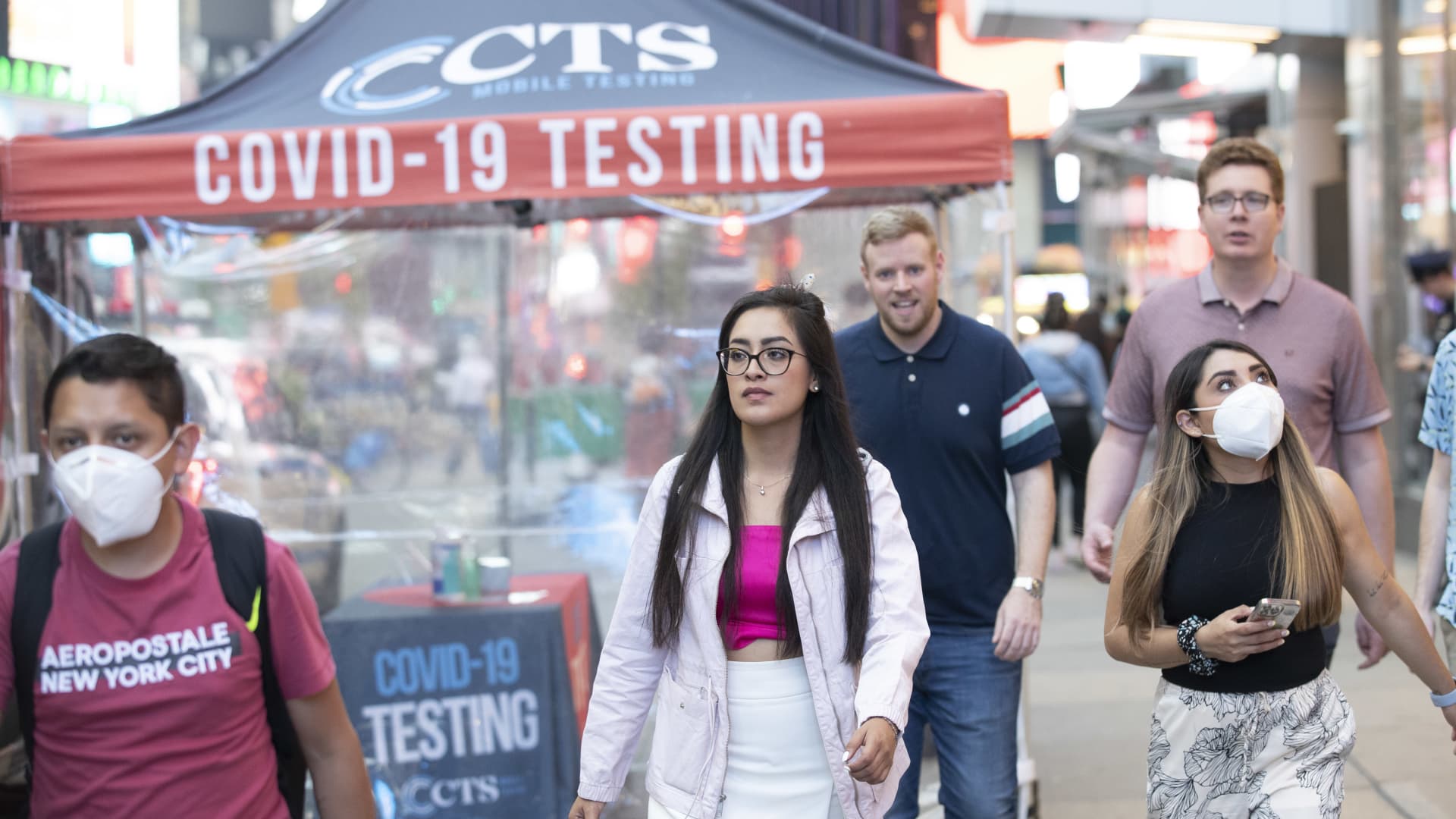
People walk by a Covid-19 testing site at Times Square on May 12, 2022 in New York City. Liao Pan | China News Service | Getty Images
The Centers for Disease Control and Prevention will have less data to track the spread of Covid-19 and new variants in the U.S. after the public health emergency ends on Thursday. "The end of the public health emergency means CDC will have less authority to collect certain types of public health data — that means less data will be available to us," Dr. Nirav Shah, the CDC's principal deputy director, told reporters during a call Thursday. Shah acknowledged that disease surveillance in the U.S. was inadequate during the pandemic and needs to be improved. "Our ability to detect and monitor disease threats should be better in the future than it has been in the past," he said. "And that ability to detect and monitor should be built into our baseline and not contingent upon emergency declarations," Shah said. The U.S., unlike other wealthy nations, has a fragmented health-care system in which the authority to decide what disease data gets reported largely rests with corporations, the 50 states, tribes and territories — not the CDC. Dr. James Lawler, an infectious disease expert at the University of Nebraska Medical Center, said this fragmented system is a consequence of a lack of willpower to reform — not a technical challenge. "How ludicrous is it that in 2023, I can tell you where my UPS packages are at any given point in time and I don't have visibility into health-care data," said Lawler, who advised the Bush and Obama administrations on biodefense and pandemic preparedness. "Health care is the third rail in politics and nobody wants to touch it," he said.
A more fractured system
Labs certified by the Centers for Medicare & Medicaid Services will no longer have to report Covid test results to the CDC. Congress required these labs in March 2020 to send results to the federal government, but that mandate was tied to the public health emergency. Some states will also stop reporting cases to the CDC altogether, said Dr. Brendan Jackson, who heads the agency's Covid response team. Covid has been classified as a national notifiable disease since April 2020. This means new cases should be reported to the CDC, but notification by the states to the federal government is a recommendation — not a mandate. "Each individual state or other jurisdiction has its own rules or regulations that determines what is reportable," Jackson said. "In some of the jurisdictions or some of the states those authorities will go away with the end of public health emergency," he said. The CDC will shift its collection of positive Covid tests to a voluntary network of more than 450 labs, Jackson said. Covid case data in the U.S. became unreliable many months ago because so many people are testing at home — if at all. These test results are not picked up in CDC data because there's no reporting requirement. The World Health Organization has repeatedly warned that the dramatic decline in testing around the globe is making it difficult to to track new Covid variants. Though the CDC will continue to track Covid variants domestically and among international travelers entering the U.S., the agency will have to scale back how often it reports this data. "There's certainly been a decline in the amount of testing that's going on and specimens that are able to be submitted for genomic sequence, so we may need to scale back on the frequency of how often we're reporting on those," Jackson said. Variant data will be reported twice a month rather than weekly moving forward, according to the CDC. The spotty reporting of case data also means the CDC will no longer report virus transmission at the county level after the public health emergency ends. Health-care facilities used this data to know when to mask and nursing homes relied on it for testing admissions. Jackson said the CDC will update its recommendations for these facilities so they know how to prevent infections moving forward. The agency will also phase out its Covid community levels, which provide local recommendations to the general public on when to mask and take other precautions based on how many cases and hospitalizations the virus is causing in individual counties. The community levels will be replaced with a new system that relies solely on hospitalizations, Jackson said.
Other ways to monitor
Public health authorities are focused on tracking severe disease through hospitalizations and deaths rather than cases, because infections have become less of a threat due to the availability of vaccines and so many people have some degree of immunity from catching Covid. Shah said the CDC will still have ways to monitor Covid after the public health emergency ends. Hospitals are required to report Covid admissions through 2024. The CDC will rely primarily on this information as well as sewage surveillance that covers nearly 140 million Americans, Jackson said. The hospital data will be reported weekly rather than daily moving forward. The CDC will continue to report Covid deaths, though the system will shift to the National Vital Statistics System. Jackson said this should improve death data reporting. "We will still be able to tell that it is snowing even though we're not counting every snowflake," Shah said.