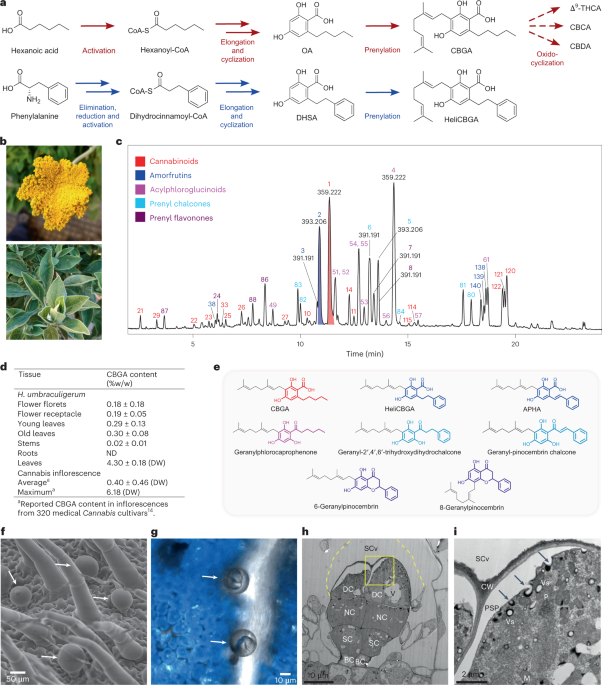
a., b. Representative cryo-SEM micrographs of the lateral view of flowers showing stalked glandular trichomes (marked by arrows). Micrographs are representative of multiple (n > 3) flower areas sampled on the same day. c. Light micrograph showing the biseriate structure of stalked glandular trichomes of leaves (n > 3). d.-f. Selected TEM micrographs of leaves’ trichomes at different stages of secretion. Micrographs are representative of distinct trichomes (n = 2–5 for each developmental stage) from sections of young and old leaves. High magnification images show the ultrastructure of disk cells (DCs). CW, cell wall; M, mitochondria; N, nucleus; P, plastid; PSP, periplasmic space; SCv, secretory cavity; V, vacuole; Vs, vesicle. d. In the presecretory stage, DCs contained a very dense cytoplasm covered by ER and multiple ribosomes. There was no SCv or PSP and plastids were large and resembled pro-plastids. e. In the secretory stage, delamination of the apical DC wall led to the formation of the SCv. Electron transparent secretions were exuded out of plastids in vesicles delimited by an electron-dense layer. The vesicles released their contents to the PSP by exocytosis where the secretory product accumulated prior to secretion into the SCv (marked by arrow). f. DCs of mature trichomes post-secretion were largely vacuolated with a cytoplasm restricted to the small remaining area. Plastids at this stage had degenerated and no vesicles were observed. The cell wall had a largely cutinized layer with a large SCv. MALDI-MSI of m/z 361.23 ± 0.01 Da signals of the g. abaxial and h. adaxial leaf domains (n = 1), following partial removal of trichomes by duct tape (the peeled area is outlined by green line). The areas with partially/fully removed trichomes show less or no signals compared to the untouched parts. i. Optical image and j. MALDI-MSI of m/z 361.23 ± 0.01 Da of a cross-sectioned flower receptacle (n = 2). Glandular trichomes in i are marked to improve interpretation. The signals in g., h. and j. correspond with the protonated m/z of CBGA 1 and geranylphlorocaprophenone 4. The white broken lines in g.-j. mark the regions analyzed.
Parallel evolution of cannabinoid biosynthesis