In this cross-sectional study, we compared the community composition and structure of the colonic adherent microbiota based on caffeine intake using 16S rRNA gene sequencing among 34 individuals with endoscopically normal colons. We hypothesized that individuals with higher caffeine intake could have different microbial community composition and structure compared to those with lower caffeine intake. Because coffee is the major source of caffeine [ 12 ], we also evaluated the association between coffee consumption and gut microbiota in the present study. Better knowledge of the association between caffeine and coffee intake and the gut microbiota may help refine dietary guidance.
Previous studies have suggested that coffee modulates gut microbiota. One study showed that coffee intake decreased the relative abundance ofin fecal samples in a mouse model [ 9 ]. In contrast, another study in humans showed that heavy coffee consumers (45–500 mL/daily) had higher fecalabundance [ 10 ].has a complex association with inflammation and obesity. Another study showed that 16 adults who consumed three cups of coffee daily for three weeks had an increased abundance of anti-inflammatoryin their feces [ 11 ]. However, the association between the intake of phytochemicals in coffee, such as caffeine, and gut microbiota has not been well established in either experimental models or humans.
Caffeine is known to antagonize the adenosine Aand Areceptors, mobilize intracellular calcium in muscle tissue, and inhibit phosphodiesterases and gamma-aminobutyric acid receptors, leading to increased catecholamine synthesis and turnover in the body and enhanced secretion of dopamine, serotonin, and acetylcholine in the central nervous system [ 8 ]. While these effects could explain caffeine’s neuropsychiatric effects, they do not readily explain caffeine’s effects on cancer, cardiovascular disease, liver disease, and diabetes.
Caffeine has been widely consumed in food and drink for centuries. Caffeine is well known for stimulating wakefulness, alertness, and energy. Caffeine has been associated with decreased risk of cardiovascular disease, Parkinson’s disease, and type 2 diabetes mellitus [ 1 2 ]. Some gastrointestinal health benefits from caffeine include decreased odds of ulcerative colitis and acute colitis development with in vitro and in vivo studies [ 3 4 ], reduced hepatic fibrosis in patients with mild to advanced hepatic fibrosis [ 5 6 ], and lower risk of developing colorectal cancer [ 7 ].
The study participants’ sociodemographic and clinical characteristics and nutrient intake were compared based on caffeine and coffee intake using Fisher’s exact test, Student’stest, or ANOVA. The bacterial alpha diversity (the number of observed OTUs and Shannon Index) and the relative abundance of taxa were compared based on the intake of caffeine and coffee using a Wilcoxon test or Kruskal–Wallis test when appropriate. PERMANOVA with weighted UniFrac dissimilarity and principal-coordinate analysis were carried out for microbial beta diversity analyses [ 23 ]. The Monte Carlo permutation test was performed to estimatevalues. For bacteria with a relative abundance >1% that differed significantly (< 0.05) by both caffeine and coffee intake, we used multivariable negative binomial regression models for panel data to examine the incidence rate ratio (IRR) and its 95% confidence interval (CI) of having non-zero bacterial count in those with higher intake of caffeine or coffee compared with those with a lower intake, adjusting for age (continuous), ethnicity (non-Hispanic white, non-Hispanic African American, and Hispanic), body mass index (BMI) (continuous), smoking (never, former, and current), alcohol use (never, former, and current), HEI score (continuous), and colon segments. Intakes of other nutrients, including total fat, total carbohydrate, total protein, and vitamin B family (vitamin B2, B6, and B12), were also evaluated as potential confounding factors. Vitamin B2 intake was adjusted in the multivariate model in addition to HEI because it differed significantly by caffeine intake and was associated with the relative abundance and count of gut bacteria [ 24 ]. Coffee intake was modeled as a continuous variable in the multivariable model. We treated each participant as a panel because some participants contributed multiple biopsies to the analysis.
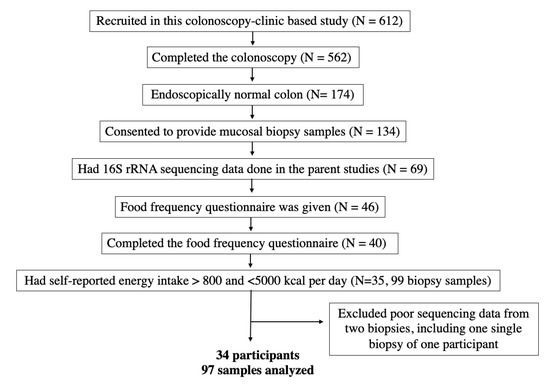
We used the in-house bioinformatics pipeline for data analysis. Reads were merged using USEARCH v7.0.1090 [ 19 ]. A quality filter was applied to the merged reads, and those containing more than 0.5% expected errors were discarded. We used the Divisive Amplicon Denoising Algorithm 2 (DADA2) v1.10.1 package in R v3.3.3 to classify the bacteria using the amplicon sequence variants (ASVs). The ASVs were mapped to the SILVA v128 to determine taxonomies [ 20 21 ]. A rarefaction curve, using a factor of 4356, was constructed using the sequence data for each sample to ensure that we sampled most of its microbial diversity. Following rarefaction, two mucosal samples with poor sequence reads were lost, including one sample from a participant who contributed one piece of biopsy. Therefore, we included 97 mucosal samples of 34 participants in the final analysis ( Figure 1 ).
We enrolled 612 eligible participants in the study. Of 174 participants who were confirmed polyp-free, 134 consented to provide colonic mucosal biopsies. Samples from 69 polyp-free participants were sent for microbiota profiling. Among those, 40 returned the Block FFQ. Five study participants who had self-reported energy intake <800 or >5000 kcal per day were excluded from the analysis. As a result, the sequencing data of 99 mucosal samples from 35 participants were available for analysis. A flow chart of participant selection and final sample size is shown in Figure 1
Participants were advised to stop taking aspirin, anti-inflammatory drugs, blood thinners, iron, or vitamins with iron seven days before the procedure and to stop diabetic medication one day before the procedure [ 13 ]. Participants took 3.78 L of polyethylene glycol (Golytely) the night before the colonoscopy. During the procedure, endoscopists obtained biopsies from each colonic segment (cecum, ascending, transverse, descending, sigmoid colon, or rectum) when possible.
After obtaining informed consent, the research coordinator administered a questionnaire collecting information on lifestyle, social history, and medical history. We assessed caffeine intake and the number of cups of coffee consumed in the past 12 months using the validated self-administered Block Food Frequency Questionnaire (FFQ) 2005 [ 14 ]. Participants answered questions on daily liquid intake, including “how often did you drink coffee, regular or decaf in the past year” and “how many cups did you drink per day in the past year?”. All categories were combined to arrive at aggregate caffeine intake by Nutritionquest. Caffeine intake (mg/day) was derived from coffee, hot tea, iced tea, and 40 other food items. All diet and nutrient variables were energy-adjusted using the density method. The healthy eating index (HEI) 2015 was used to score dietary quality [ 15 ].
The study protocol was approved by the Institutional Review Board of Baylor College of Medicine (BCM) and MEDVAMC. All procedures performed in studies involving human participants were in accordance with the ethical standards of the institutional and/or national research committee and with the 1964 Helsinki Declaration and its later amendments or comparable ethical standards. The research coordinator obtained informed consent from participants during their attendance at an educational session 1–2 weeks before the colonoscopy.
Participants were recruited at the endoscopy suite of the Michael E. DeBakey VA Medical Center (MEDVAMC) in Houston, Texas, between July 2013 and April 2017. The study cohort, study design, and exclusion criteria were described in detail previously [ 13 ]. Individuals were eligible to be enrolled in the study if they were between 50 and 75 years of age. Individuals were ineligible if they had the following: (1) hereditary polyposis syndromes such as familial adenomatous polyposis and hereditary non-polyposis colon cancer; (2) inflammatory bowel disease; (3) invasive cancer except for non-melanoma skin cancer; (4) colorectal polyps in the past three years; (5) end-stage renal disease requiring dialysis; (6) severe mental disabilities; (7) hospitalization within the past year; (8) oral or systemic use of antibiotics in the past three months; (9) hepatitis B or C infections; (10) HIV or methicillin-resistant Staphylococcus aureus-positive infection; or (11) contraindications to obtaining mucosal biopsies.
In the multivariable negative binomial regression models, the incidence rate of having a non-zero count of(IRR: 3.05, 95% CI: 1.10–8.48) and(IRR: 5.28; 95% CI: 2.68–10.4) was higher and the incidence rate of having a non-zero count of(IRR: 0.07; 95% CI: 0.02–0.25) was lower in those who had higher caffeine intake compared to those who had lower caffeine intake. Higher coffee intake was associated with higher(IRR: 2.84; 95% CI: 1.38–5.84) and(IRR: 2.35; 95% CI: 1.50–3.68) and lower(IRR: 0.24; 95% CI: 0.07–0.84). Adjusting for total energy intake, BMI, and macronutrients in the analyses did not change the rate ratio estimate. However, the associations betweenand caffeine and coffee intake were attenuated after adjustment of vitamin B2. There were also no significant associations between bacterial count and coffee intake. There was a statistically significant inverse association betweencount and caffeine intake (IRR: 0.02; 95% CI: 0.003–0.17,value < 0.05) ( Table 3 ). In addition, adjusting for vitamin B6 in the model slightly attenuated the association betweencount and caffeine intake, and adjusting for vitamin B12 in the model slightly attenuated the association betweencount and caffeine intake.
We did not observe a significant difference in the relative abundance of bacterial phyla based on caffeine intake. At the family level, compared to lower caffeine intake, higher caffeine intake was related to a higher relative abundance of Ruminococcaceae (9.32% vs. 16.7%) and a lower relative abundance of Erysipelotrichaceae (4.25% vs. 1.56%) (values < 0.05). At the genus level, higher caffeine intake was related to a higher relative abundance of, andbut a lower relative abundance ofandvalues < 0.05) ( Table 2 ). Higher coffee intake (more than 2 cups) was related to a higher relative abundance ofandvalues < 0.05) and a lower relative abundance of Table 2 ). Supplemental Figure S1 shows that many members offamily differed by caffeine intake.
The average caffeine intake was 39.2 mg in those who had a “lower intake” and 138.9 mg in those who had a “higher intake”. The differences in the distribution of patients’ characteristics, lifestyle factors, HEI score, and intake of macronutrients by caffeine intake ( Table 1 ) and coffee intake ( Supplemental Table S1 ) were largely not statistically significant. Participants who had a higher caffeine intake had a statistically insignificant higher BMI than those who had a lower intake (35.2 vs. 32.6 kg/mvalue = 0.25). However, daily vitamin B2 (riboflavin) and vitamin B6 intake was significantly higher among participants with higher caffeine intake ( Table 1 ). Daily vitamin B2 intake was significantly higher in participants with more coffee consumption ( Supplemental Table S1 ).
4. Discussion
This cross-sectional study showed that the colonic mucosa-associated bacteria differed significantly in the community composition and structure based on daily caffeine and coffee intake in adults. Higher caffeine and coffee intake was associated with higher richness and evenness of gut microbiota, a higher relative abundance of Faecalibacterium and Alistipes , and a lower relative abundance of Erysipelatoclostridium independent of multiple covariates. However, further multivariate analysis showed that vitamin B2 intake partially explained such observations. The association between Erysipelatoclostridium count and caffeine intake remained statistically significant after vitamin B2 intake was adjusted in the analysis. There was no significant association between bacterial count and coffee intake in multivariate models.
Our study showed that higher caffeine intake, but not coffee consumption, was associated with higher alpha diversity, i.e., richness and evenness of the gut bacteria in the colonic mucosa. In a Dutch population-based cohort study, coffee was shown to be associated with higher microbial alpha diversity. However, this study did not evaluate the association between phytochemicals in coffee and gut microbiota [ 26 ]. The beta diversity analysis showed a significant dissimilarity of bacterial community composition based on both caffeine intake and coffee consumption. Studies have associated lower alpha diversity with adverse health outcomes, such as a higher risk of colorectal cancer [ 27 ] and inflammatory bowel disease [ 28 ]. Whether caffeine could affect health outcomes through modulating gut microbiota biodiversity should be evaluated further.
Faecalibacterium. A previous study showed increased Faecalibacterium species after mice fed a high-fat diet were treated with a caffeine-rich Chinese tea [ Faecalibacterium is a butyrate-producing bacterium [ Alistipes , which belongs to Bacteroidetes phylum. Alistipes has been shown to be more abundant in populations with animal-based diets than in those with plant-based diets. It is more bile-tolerant and capable of protein breakdown [ Alistipes has been associated with both favorable and adverse health outcomes. Previous studies showed an inverse correlation between Alistipes and obesity [ Clostridium difficile infection [ Alistipes has been associated with a higher frequency of abdominal pain in pediatric patients with irritable bowel syndrome [ Faecalibacterium and Alistipes . Whether Faecalibacterium and Alistipes are independently modulated by caffeine in the colonic mucosa and the interaction between vitamin B2 and the colonic microenvironment should be further investigated. We observed that higher caffeine intake and higher coffee consumption were related to a higher relative abundance ofA previous study showed increasedspecies after mice fed a high-fat diet were treated with a caffeine-rich Chinese tea [ 29 ].is a butyrate-producing bacterium [ 30 ] that has been shown to have positive impacts on human energy metabolism [ 31 ], and its anti-inflammatory properties have been shown [ 32 ]. Higher caffeine intake was also associated with a higher relative abundance of, which belongs to Bacteroidetes phylum.has been shown to be more abundant in populations with animal-based diets than in those with plant-based diets. It is more bile-tolerant and capable of protein breakdown [ 33 ].has been associated with both favorable and adverse health outcomes. Previous studies showed an inverse correlation betweenand obesity [ 34 ], ulcerative colitis [ 35 ], andinfection [ 36 ]. Conversely, an increased abundance ofhas been associated with a higher frequency of abdominal pain in pediatric patients with irritable bowel syndrome [ 37 ]. It is noted that the adjustment of dietary vitamin B2 intake attenuated the association between caffeine and coffee intake andand. Whetherandare independently modulated by caffeine in the colonic mucosa and the interaction between vitamin B2 and the colonic microenvironment should be further investigated.
Erysipelotrichaceae family and Erysipelatoclostridium genus than those with higher caffeine intake. This observation remained statistically significant in multivariate analysis controlling vitamin B2 intake. Erysipelatoclostridium belongs to Firmicutes phylum. Higher Erysipelatoclostridium levels have been linked to diet-induced obesity in mouse models [ Erysipelotrichaceae levels than patients with normal glucose tolerance [ Erysipelotrichaceae and Erysipelatoclostridium play in host lipid metabolism [ Erysipelotrichaceae [ Erysipelatoclostridium on health, identifying pre- and probiotics that deplete this bacterium would be beneficial. It remains to be determined whether caffeine influences insulin resistance or metabolic diseases by modulating Erysipelatoclostridium. Participants with lower caffeine intake had higher relative abundances of the Gram-positive obligate-anaerobefamily andgenus than those with higher caffeine intake. This observation remained statistically significant in multivariate analysis controlling vitamin B2 intake.belongs to Firmicutes phylum. Higherlevels have been linked to diet-induced obesity in mouse models [ 38 ] and obesity in humans [ 39 40 ]. A previous study showed that patients with type 2 diabetes had higherlevels than patients with normal glucose tolerance [ 41 ]. There is growing evidence showing the adverse roles ofandplay in host lipid metabolism [ 42 ], immune response [ 43 ], inflammation [ 44 ], depression [ 45 ], metabolic-associated fatty liver disease [ 46 ], cancer [ 47 ], and response to cancer immune therapy [ 48 49 ]. However, in a human-based study, increased physical activity was associated with a higher relative abundance of 50 ]. Nevertheless, given most studies have shown the detrimental effect ofon health, identifying pre- and probiotics that deplete this bacterium would be beneficial. It remains to be determined whether caffeine influences insulin resistance or metabolic diseases by modulating
52, Bifidobacterium spp. [ Bifidobacterium spp. and Clostridium coccoides/Eubacterium rectale in a colonic microbiota culture model [ Bifidobacterium and coffee intake [ Bifidobacterium in the colonic mucosa was less than 0.50% in our study samples. Nevertheless, our study showed that the relative abundance of Prevotella was higher with a higher intake of caffeine and coffee. This observation was consistent with a human-based study that showed higher coffee consumers (45–500 mL/daily) had higher fecal Prevotella abundance [ As alluded to above, coffee has been shown to beneficially modulate human metabolic health by lowering the risks of obesity, type 2 diabetes, and metabolic syndrome [ 51 53 ]. The bioactive components in coffee include phenolic compounds (chlorogenic acids (CGAs)), alkaloids (caffeine and trigonelline), and diterpenes (cafestol and kahweol) [ 54 ]. One fecal microbial study of 147 patients found that polyphenol intake was similar between lower and higher coffee consumers. The author hypothesized that low coffee consumers could obtain polyphenols through other sources [ 10 ]. Several studies investigated the influence of caffeine, polyphenols, and CGAs on the gut microbiota. One in vitro colonic metabolism study found that coffee with the highest CGA levels induced a significant 0.5 logarithmic increase in the growth ofspp. [ 55 ]. CGAs significantly increased the growth ofspp. andin a colonic microbiota culture model [ 55 ] and a human interventional study [ 56 ]. However, our study could not confirm the previous observation onand coffee intake [ 11 ]. The relative abundance ofin the colonic mucosa was less than 0.50% in our study samples. Nevertheless, our study showed that the relative abundance ofwas higher with a higher intake of caffeine and coffee. This observation was consistent with a human-based study that showed higher coffee consumers (45–500 mL/daily) had higher fecalabundance [ 10 ]. However, it was not in line with an animal-based study that shows the opposite [ 9 ]. In summary, our preliminary study could not exclude the possibility that other nutrients in coffee, such as CGAs, polyphenols, and vitamin B family may have explained the association between coffee intake and gut microbiota composition and structure. Adjusting for dietary intake of vitamin B2 in the multivariate analysis did attenuate the association between gut bacteria and caffeine and coffee intake. It is noted that coffee has abundant vitamin B2.
Lachnospiraceae family differed by caffeine intake. Metagenomic shotgun sequencing and metabolomics study should be conducted to define the bacterial species and their functions in association with coffee and caffeine intake. Lastly, the present analysis was based on a small sample size and was cross-sectional by nature. By virtue of these study limitations, the findings should be considered preliminary. Our study has uniqueness because we studied the mucosal-associated adherent microbiota using the colonic biopsies taken after bowel preparation. Compared to the luminal gut microbiota, the mucosa-associated adherent microbiota is more likely to interact directly with the immune cells in the mucosa and therefore impact host physiology [ 57 ]. Multivariate analysis was used to control for potential confounding effects of lifestyle and dietary factors. The study had some limitations. First, participants were mainly obese elderly or middle-aged white veterans, possibly affecting the generalizability of the findings to the non-veteran general population, women, lean individuals, or younger individuals. Second, study participants were retrospectively asked about their food consumption, which could introduce information bias. The caffeine intake was quantified by using 43 food items in the questionnaire. However, we could not exclude the possibility of measurement error in quantitating caffeine intake. Third, selection bias was likely as not all participants responded to the FFQ. Fourth, the relative abundance of multiple members infamily differed by caffeine intake. Metagenomic shotgun sequencing and metabolomics study should be conducted to define the bacterial species and their functions in association with coffee and caffeine intake. Lastly, the present analysis was based on a small sample size and was cross-sectional by nature. By virtue of these study limitations, the findings should be considered preliminary.