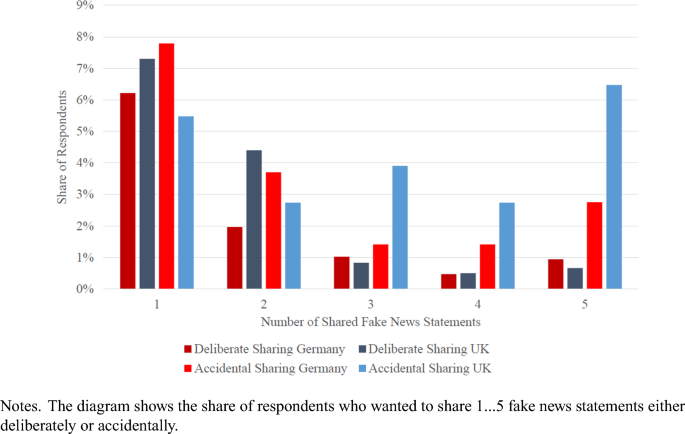
Fake news is pernicious as it spreads misleading and false information. Lazer et al.1 distinguish between misinformation (false or misleading information) and disinformation (false information that is purposely spread to deceive people). In both information contexts, fake news is likely to promote misperceptions. Recent studies show that the information overload during the COVID-19 pandemic increased the likelihood of fake news sharing by increasing consumers’ psychological strain2,3. By altering people’s perceptions and attitudes, fake news can shape public debates about critical policy issues such as vaccinations or immigration. For instance, Allcott and Gentzkow4 suggest that in the 2016 presidential election in the United States, fake news had a considerable impact and could even have been crucial in determining the election’s outcome. Brady et al.5 contend that moral-emotional language in political messages substantially increases their diffusion within (and less so between) ideological group boundaries.
In this paper, we conduct large-scale surveys in Germany and the United Kingdom to shed light on the individual-level determinants of the ability to detect fake news and the inclination to spread it, either deliberately or accidentally. The spread of fake news is becoming a public and global concern1. Fake news spreads “significantly farther, faster, deeper, and more broadly than the truth”6. According to Barthel, Mitchell, and Holcomb7, about two-in-three US adults state that fake news causes a great deal of confusion about contemporary issues and events. This perceived confusion is widely shared across incomes, education levels, partisan affiliations, and other demographic characteristics.
Academic literature lacks agreement on which individual factors contribute to the difficulty in detecting fake news and the tendency to spread it. Regarding detection, Allcott and Gentzkow4 found that partisan individuals have more difficulty identifying fake news that confirms their political stances. After the 2016 US presidential election, partisan individuals were more likely to believe headlines that favored their preferred candidate. This ideological bias was substantially more robust for those who relied on ideology-based social media networks. Bail et al.8 conducted a field experiment that offered a large group of Democrats and Republicans financial compensation to follow bots that retweeted messages by elected officials and opinion leaders with opposing political views. Surprisingly, Republican participants expressed substantially more conservative views after following a liberal Twitter bot. Pennycook and Rand9 concluded that it is primarily analytical thinking that matters for assessing of news headlines independent of whether a headline matches one’s political ideology. In the United Kingdom, Preston et al.10 found that higher levels of educational attainment and emotional intelligence go along with a better ability to detect fake news. However, there is still a lack of systematic evidence on the effect of age and other individual-level characteristics such as education, gender, or income on the ability to detect fake news. Such evidence may help target particularly vulnerable groups with appropriate policy measures such as fake news alerts that remind viewers of potentially misleading or false information.
Not all individuals who encounter fake news are also spreading it. Grinberg et al.11 examined the sharing of fake news in the US 2016 election and found that engagement with fake news sources was highly concentrated among specific sub-populations. Individuals most likely to engage with fake news sources were conservative-leaning, older, and those who were highly engaged in political news. Hopp, Ferucci and Vargo12 identified people with politically extreme views and distrust in mainstream media as the main disseminators of fake news. In a similar vein, Guess, Nagler, and Tucker13 found that conservative people and those older than 65 are more likely to share pro-Trump fake news. Older people are also over-represented among super-spreaders of fake news11. By contrast, Buchanan14 found that younger, male, and less educated individuals were more likely to spread disinformation they encountered on social media in the UK. In general, men share more unverified information15. Compared to the ability to detect fake news, more studies on sharing fake news have investigated individual factors. However, most of these studies focused on the United States. This immediately raises the question of whether findings are similar or different in politically less polarized countries and where a significant part of political and societal information comes from highly reputed nationwide public broadcasting (such as the BBC in the UK or ARD and ZDF in Germany).
Moreover, most previous studies did not differentiate whether fake news is shared deliberately or accidentally. The distinction is crucial when it comes to policy conclusions. If fake news is spread mostly accidentally, then the policy can focus on citizens’ ability to identify fake news. If fake news is mostly shared deliberately, improving identification will not help; a broader approach to overcoming the societal divide may be needed.
The contribution of the paper is twofold. First, our survey allows for comparing fake news detection and sharing across two major European countries: Germany and the United Kingdom. In contrast, the majority of the literature so far has focused on the United States. In their systematic literature review of 45 experimental studies that investigate the determinants of identifying fake news, Bryanov and Vziatysheva16 write: “The sample is heavily skewed towards the US” and “The comparative aspect of fake news perceptions, too, is conspicuously understudied.” Among the 45 articles reviewed, there is only one comparative study (US–India), and just three studies focus on a country other than the US. Even when taking into account the most recent publications and considering the broader literature using purely self-reported behavior regarding fake news, the focus is mainly on the US; exceptions are, e.g., Apuke and Omar3 for Nigeria, Islam et al.17 and Laato et al.15 for Bangladesh, Buchanan14 and Preston et al.10 for the UK.
For the comparative analysis, we conducted large-scale surveys in Germany (1223 respondents) and the United Kingdom (1156 respondents); see Table 1. The comparison between Germany and the UK is particularly interesting as the UK has experienced a wave of populist policies in the wake of Brexit—mirrored in the media landscape. In contrast, these populist debates have played a minor role in Germany. Hence, there may be a broader acceptance of fact-ignoring arguments in the UK. It is also useful to study these countries because of the extensive debate in Germany about limiting the spread of misinformation and hate via social media. Within four years, three bills passed in the German parliament that aimed to combat hate crimes more effectively, punishing false news and criminal content on social network platforms. For instance, social networks must report on their dealing with hate crimes and maintain an effective complaint management system. Even though the law did not address fake news in general but only the spread of hate via fake news, the controversial public debate around these government regulations18 may have sharpened the people’s senses when encountering fake news in general. Such a public debate was absent in the UK. Consequently, we hypothesize that there is less detection and more fake news sharing in the UK compared to Germany. This should be mostly a level effect, as it is unclear why particular sociodemographic groups would be affected differently by the public debates in the two countries.
Table 1 Descriptive statistics (N = 2379). Full size table
Our second contribution is that we simultaneously study detecting as well as accidental and deliberate sharing of fake news in an experimental setting. Deliberate sharing means that respondents know that the news they are willing to share is unlikely to be true; accidental sharing occurs if respondents share fake news, which they erroneously believe to be true. To distinguish between accidental and deliberate sharing, we must elicit whether respondents can correctly identify fake news items. Several papers focused on either the detection19,20,21,22,23 or on the sharing of fake news3,11,12,15,17,24, but not both. Further, Buchanan14 distinguishes between accidental and deliberate sharing of fake news but does so with a retrospective survey question only. Accidental and deliberate sharing is not measured through actual sharing behavior or through the intention to share an actual news item. Instead, respondents are asked in retrospect whether they have ever shared fake news accidentally or deliberately. We gave the respondents ten viral news headlines from the internet, five being “fake news” and the other five being true news stories. We selected headlines that avoided any national bias for the UK or Germany. None of the headlines deal with domestic affairs in Germany or the UK as this would facilitate the validation for respondents from the respective country. We also avoided headlines associated with national policy stances to avoid any partisan bias. We pretested the headlines among Ph.D. students to ensure sufficient variation in response.
The headlines were presented as a text and not combined with any visual material to avoid deception, e.g., falsely suggesting the appearance in specific (social) media outlets. We asked respondents to assess these headlines and created an index that quantifies their ability to detect fake news (for details, see “Methods” Section). We also asked respondents how likely they would spread each of the ten news headlines. By comparing the identification of fake news items with the intention to share them, we can distinguish accidental and deliberate sharing. We hypothesize that most sharing is due to a lack of detection, i.e., accidental sharing dominates. Recent research has shown that most people are overconfident in their own ability to spot fake news25. The overconfidence in one’s own ability to distinguish true and false information may contribute to spreading fake news26. Differences in overconfidence may explain why some groups fall more easily for fake news. As overconfidence is generally higher among men27, particularly in tasks with low-performance feedback28 such as news sharing, accidental sharing should be higher among male respondents. We also expect more accidental sharing among the younger individuals29.
Finally, we asked the retrospective questions of whether the respondents had shared fake news stories accidentally or deliberately in the past; this allowed us to check whether respondents had a good assessment of their sharing behavior. We compare the responses to the retrospective questions with the actual behavior in the experiment with the headlines. Due to the general overconfidence, we expect a low correlation between actual and perceived accidental sharing, i.e., low awareness of being a distributor of fake news. With respect to deliberate sharing, we hypothesize that respondents are frank about their behavior. Those who do not admit their deliberate sharing for reasons of social desirability will also mask this behavior in the experimental setting.