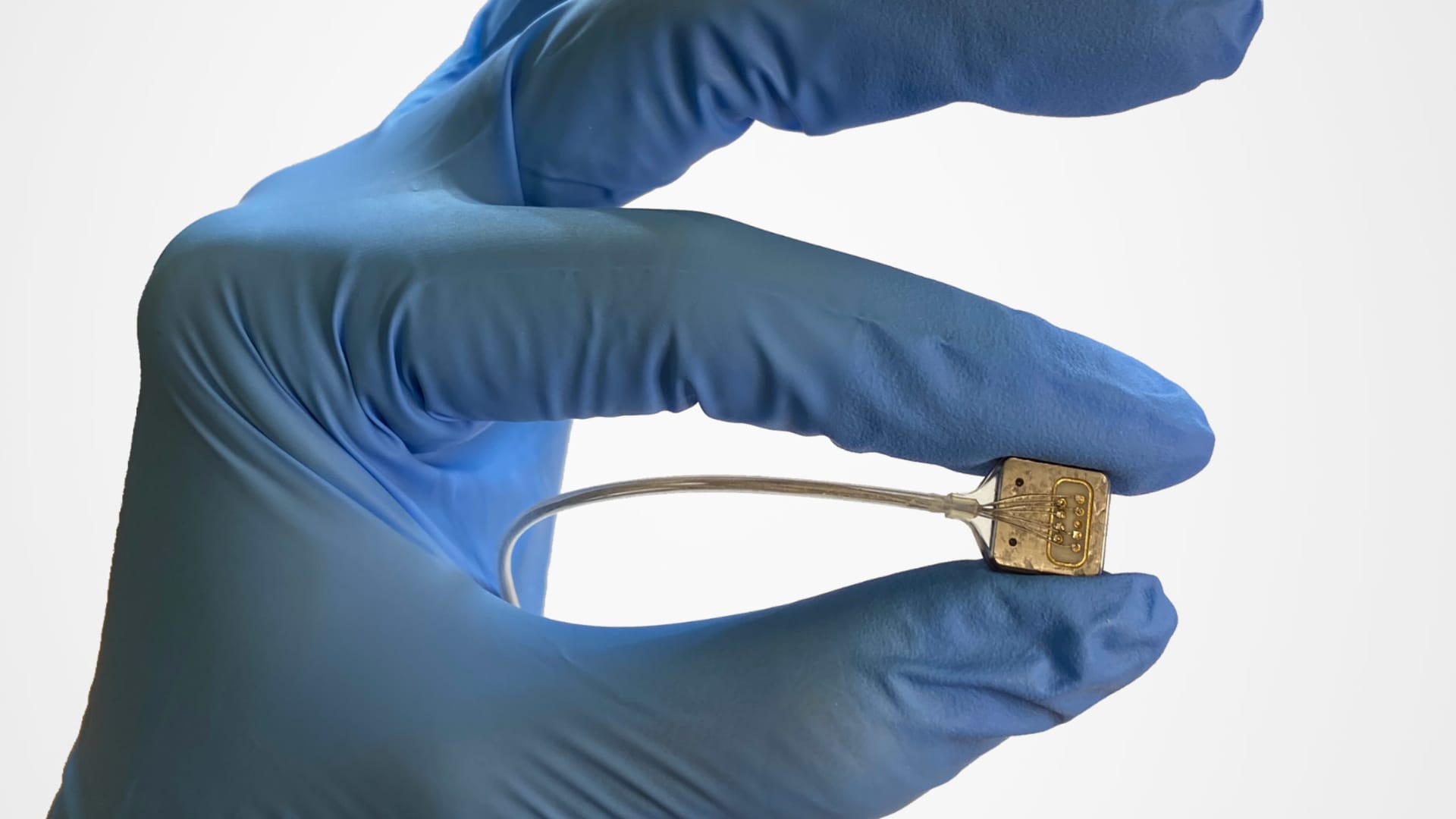
A growing team of nearly 50 employees at the neurotech startup Paradromics is working on a brain implant that sounds like the work of science fiction. And it has caught the attention of federal regulators.
Paradromics, founded in 2015, is developing a device that could help patients with severe paralysis regain their ability to communicate by deciphering their neural signals. And on Thursday, the Austin, Texas-based company announced that it has received the Breakthrough Device designation from the Food and Drug Administration for its flagship system, called the Connexus Direct Data Interface.
CEO Matt Angle said the designation, in addition to a $33 million funding round the company also announced Thursday, will help Paradromics bring its device to market.
Paradromics is part of the emerging brain-computer interface, or BCI, industry. A BCI is a system that deciphers brain signals and translates them into commands for external technologies. Experts believe the systems could someday help treat maladies like blindness and mental illness.
Perhaps the best-known name in the space is Neuralink, thanks to the high profile of its co-founder Elon Musk, who is also the CEO of Tesla, SpaceX and Twitter.
Scientists have been studying BCI technology for decades, and several companies have developed promising systems that they hope to bring to market. But receiving FDA approval for a commercial medical device is no small task — it requires companies to successfully conduct several extremely thorough rounds of testing and data safety collection.
As of May, no BCI company has managed to clinch the FDA's final seal of approval.
Paradromics' BCI, the Connexus Direct Data Interface, is an assistive communication device that translates neural signals into text or synthesized speech. An array of tiny electrodes is implanted directly into the brain tissue, where it measures and deciphers brain signals that are ultimately emitted to external devices through a transceiver that sits under the skin in the chest.
"It's essentially taking some of the things that have been successful in previous clinical trials, and then improving on them from an engineering standpoint to make them better," Angle told CNBC in an interview.