The following supporting information can be downloaded at: https://www.mdpi.com/article/10.3390/cancers15020497/s1 , Figure S1: Differential effect of different Cannabis extracts on the viability of HNSCC cells; Figure S2: Apoptotic effect of Cannabis extracts on HNSCC uncropped blots.
K.B., D.M. and O.B.: Conceptualization; K.B. and E.B.: Investigation; Methodology; Validation; K.B., E.B., S.P., O.S., Y.L. and J.A.T.: Resources; Data curation and Formal analysis; K.B., D.M. and O.B.: Writing—Original draft; K.B., S.P., D.M. and O.B.: Writing—Review & editing; D.M. and O.B.: Study supervision. All authors have read and agreed to the published version of the manuscript.
D.M. is an active member of the scientific advisory board and co-founder of Cannasoul Analytics. All other authors have no conflict of interest to declare.
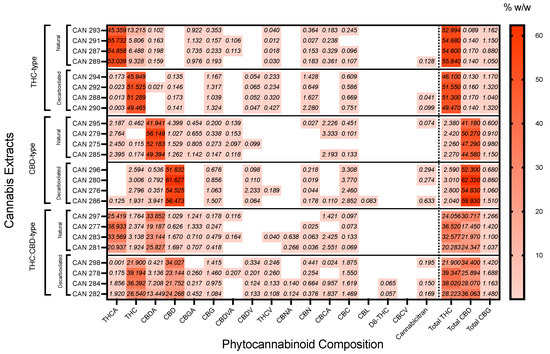
Figure 1. Heatmap clustering of the cannabinoid profile of 24 cannabis extracts. Matrix of the ESI-LC/MS composition. Phytocannabinoid analysis scores were scaled by column to range from 0 to 100. A low score (pale red) indicates that the % w / w ratio of the cannabinoid in the extract is meager compared to its percentage in the other extracts. A high score (darker red) indicates a high ratio in the extract compared to its percentage in the other extracts. The 24 extracts are segregated into six major clusters: THC-type (dominant THC over CBD content) decarboxylates/acid form, CBD-type (dominant CBD over THC content) decarboxylates/acid form, THC:CBD-type (equal THC and CBD content) decarboxylates/acid form.
Figure 1. Heatmap clustering of the cannabinoid profile of 24 cannabis extracts. Matrix of the ESI-LC/MS composition. Phytocannabinoid analysis scores were scaled by column to range from 0 to 100. A low score (pale red) indicates that the % w / w ratio of the cannabinoid in the extract is meager compared to its percentage in the other extracts. A high score (darker red) indicates a high ratio in the extract compared to its percentage in the other extracts. The 24 extracts are segregated into six major clusters: THC-type (dominant THC over CBD content) decarboxylates/acid form, CBD-type (dominant CBD over THC content) decarboxylates/acid form, THC:CBD-type (equal THC and CBD content) decarboxylates/acid form.
Figure 2. Differential effect of different Cannabis extracts on the viability of HNSCC cells. (A) Cell viability of HNSCC cell lines Scc4, Scc9, Scc25, and Cal27 following treatment with 24 cannabis extracts at 6 µg/mL concentration for 24 h. Cell viability was evaluated by MTT, and data are reported as mean ± SE (n = 3) of % dead cells compared to DMSO control, % Dead cells = 100 × ( Control − Sample ) Control . Differences were statistically analyzed with two-way ANOVA followed by Sidak’s multiple comparisons test (** p < 0.001, **** p < 0.0001). (B) Dose-response curve of cell lines Scc4, Scc9, Scc25, and Cal2, following 24 h of treatment with CAN296 (decarboxylated CBD-type) extract. Data are reported as mean ± SE (n = 3) of % Dead cells compared to DMSO control. Statistically analyzed with two-way ANOVA followed by Tukey’s multiple comparisons (* p < 0.05).
Figure 2. Differential effect of different Cannabis extracts on the viability of HNSCC cells. (A) Cell viability of HNSCC cell lines Scc4, Scc9, Scc25, and Cal27 following treatment with 24 cannabis extracts at 6 µg/mL concentration for 24 h. Cell viability was evaluated by MTT, and data are reported as mean ± SE (n = 3) of % dead cells compared to DMSO control, % Dead cells = 100 × ( Control − Sample ) Control . Differences were statistically analyzed with two-way ANOVA followed by Sidak’s multiple comparisons test (** p < 0.001, **** p < 0.0001). (B) Dose-response curve of cell lines Scc4, Scc9, Scc25, and Cal2, following 24 h of treatment with CAN296 (decarboxylated CBD-type) extract. Data are reported as mean ± SE (n = 3) of % Dead cells compared to DMSO control. Statistically analyzed with two-way ANOVA followed by Tukey’s multiple comparisons (* p < 0.05).
Figure 3. Apoptotic effect of Cannabis extracts on HNSCC. Extract CAN296 (2, 4, 8 µg/mL) was applied on Scc25 or Cal27 cells for 12 h, with DMSO as the control. (A) Apoptosis (early and late) was assessed by APC Annexin-V/PI staining with flow cytometry. (B) The percent of apoptotic cells was calculated as % of positive Annexin-V APC cells out of the total cells counted (events = 10,000) and presented as mean ± SE (n = 3). Statistically analyzed with two-way ANOVA followed by Tukey’s multiple comparisons test, and asterisks indicate significant differences compared to the control (**** p < 0.0001). (C) Cells were lysed and resolved on 15% SDS-PAGE, followed by western blotting with anti-Cleaved Caspase 3, c.PARP and GAPDH as the loading control. (D) Scc25 cells were treated with 0.5–8 µg/mL CAN296 extract for either 24 or 72 h, and cell proliferation was assessed according to WST-1 assay. The percent of vital cells relative to DMSO (control) is presented as mean ± SE (n = 3). Asterisks indicate statistical significance between 24 h and 72 h treatment (** p < 0.0005, **** p < 0.0001; two-way ANOVA with Sidak’s post-hoc multiple comparison test).
Figure 3. Apoptotic effect of Cannabis extracts on HNSCC. Extract CAN296 (2, 4, 8 µg/mL) was applied on Scc25 or Cal27 cells for 12 h, with DMSO as the control. (A) Apoptosis (early and late) was assessed by APC Annexin-V/PI staining with flow cytometry. (B) The percent of apoptotic cells was calculated as % of positive Annexin-V APC cells out of the total cells counted (events = 10,000) and presented as mean ± SE (n = 3). Statistically analyzed with two-way ANOVA followed by Tukey’s multiple comparisons test, and asterisks indicate significant differences compared to the control (**** p < 0.0001). (C) Cells were lysed and resolved on 15% SDS-PAGE, followed by western blotting with anti-Cleaved Caspase 3, c.PARP and GAPDH as the loading control. (D) Scc25 cells were treated with 0.5–8 µg/mL CAN296 extract for either 24 or 72 h, and cell proliferation was assessed according to WST-1 assay. The percent of vital cells relative to DMSO (control) is presented as mean ± SE (n = 3). Asterisks indicate statistical significance between 24 h and 72 h treatment (** p < 0.0005, **** p < 0.0001; two-way ANOVA with Sidak’s post-hoc multiple comparison test).
Figure 4. Cannabis extract CAN296 is selective to HNSCC. Scc25 and Hs895sk cell lines were treated with CAN296 extract at 2, 4, 6, or 8 µg/mL for 24 or 72 h. Cell viability was assessed via WST-1 cell toxicity assay. The percent of dead cells relative to the DMSO control is presented as mean ± SE (n = 3). Statistically analyzed by two-way ANOVA with Tukey’s multiple comparison test (**** p < 0.0001).
Figure 4. Cannabis extract CAN296 is selective to HNSCC. Scc25 and Hs895sk cell lines were treated with CAN296 extract at 2, 4, 6, or 8 µg/mL for 24 or 72 h. Cell viability was assessed via WST-1 cell toxicity assay. The percent of dead cells relative to the DMSO control is presented as mean ± SE (n = 3). Statistically analyzed by two-way ANOVA with Tukey’s multiple comparison test (**** p < 0.0001).
Figure 5. The cytotoxic effects of CAN296 are not mediated via common ECS receptors. (A) CNR1 (CB1), CNR2 (CB2), GPR55, TRPA1, TRPM8, TRPV1, and TRPV mRNA levels were evaluated by qPCR and normalized to the geomean of 7 house-keeping genes: BRAP, CSNK, cul3, EIF4, GUSB, SF3, and STK-1G. Expression levels are represented as ΔCT and color-coded (lower ΔCT values indicate higher receptor expression). Results are presented as a mean expression (n = 3). (B) Scc25 cells were left untreated or pretreated with endocannabinoid receptors antagonists for 1 h: 10 µM Rimonabant—CB1 (IA), 10 µM Am630—CB2(IA), 10 µM BIM46187—Gq (inh.), 20 µM AMG9810 TRPV1(ant.), or 20 µM SET2—TRPV2 (ant.). Then, cells were treated for 24 with 4 µg/mL CAN296 extract, and cell viability was evaluated by MTT relative to DMSO control. Data are reported as mean ± SE of % viable cells out of DMSO control untreated cells (n = 6).
Figure 5. The cytotoxic effects of CAN296 are not mediated via common ECS receptors. (A) CNR1 (CB1), CNR2 (CB2), GPR55, TRPA1, TRPM8, TRPV1, and TRPV mRNA levels were evaluated by qPCR and normalized to the geomean of 7 house-keeping genes: BRAP, CSNK, cul3, EIF4, GUSB, SF3, and STK-1G. Expression levels are represented as ΔCT and color-coded (lower ΔCT values indicate higher receptor expression). Results are presented as a mean expression (n = 3). (B) Scc25 cells were left untreated or pretreated with endocannabinoid receptors antagonists for 1 h: 10 µM Rimonabant—CB1 (IA), 10 µM Am630—CB2(IA), 10 µM BIM46187—Gq (inh.), 20 µM AMG9810 TRPV1(ant.), or 20 µM SET2—TRPV2 (ant.). Then, cells were treated for 24 with 4 µg/mL CAN296 extract, and cell viability was evaluated by MTT relative to DMSO control. Data are reported as mean ± SE of % viable cells out of DMSO control untreated cells (n = 6).
Figure 6. Chromatographic separation & heatmap clustering of the cannabinoid content of CAN296 and its fractions 1–4. (A) UHPLC chromatogram of cannabis extract CAN296; vertical lines indicate the retention time cutoff: fraction 1, 0–9.36 min; fraction 2, 9.36–10.393 min; fraction 3, 10.42–15.653 min; fraction 4, 15.657–21.963 min. (B) Heatmap of CAN296 and fraction 1–4 cannabinoids content. The values present the content percent w/w of each of the tested cannabinoids in the whole extract and each fraction according to ESI-LC/MS analysis. Higher scores (darker red) indicate a higher percentage of the cannabinoid.
Figure 6. Chromatographic separation & heatmap clustering of the cannabinoid content of CAN296 and its fractions 1–4. (A) UHPLC chromatogram of cannabis extract CAN296; vertical lines indicate the retention time cutoff: fraction 1, 0–9.36 min; fraction 2, 9.36–10.393 min; fraction 3, 10.42–15.653 min; fraction 4, 15.657–21.963 min. (B) Heatmap of CAN296 and fraction 1–4 cannabinoids content. The values present the content percent w/w of each of the tested cannabinoids in the whole extract and each fraction according to ESI-LC/MS analysis. Higher scores (darker red) indicate a higher percentage of the cannabinoid.
Figure 7. Differential effects of different fraction combinations on the survival of HNSCC cells. The oral Scc25 cell line was treated with 4, 6, and 8 µg/mL of each fraction or combinations of fractions for 24 h, and cell viability was assessed via MTT assay relative to the DMSO-treated control. Data are reported as mean ± SE (n = 3) of % dead cells out of the total cells. Asterisks represent statistically significant differences compared to CAN296 (* p < 0.05, ** p < 0.01, two-way ANOVA with Dunnett’s multiple comparisons test).
Figure 7. Differential effects of different fraction combinations on the survival of HNSCC cells. The oral Scc25 cell line was treated with 4, 6, and 8 µg/mL of each fraction or combinations of fractions for 24 h, and cell viability was assessed via MTT assay relative to the DMSO-treated control. Data are reported as mean ± SE (n = 3) of % dead cells out of the total cells. Asterisks represent statistically significant differences compared to CAN296 (* p < 0.05, ** p < 0.01, two-way ANOVA with Dunnett’s multiple comparisons test).
Figure 8. CBD and CBC combination (2:1 ratio) is more effective than CAN296. The Bliss model synergy distribution for (A) CBD-CBC, and (B) CBD-THC, was calculated with the SynergyFinder web application (v 2.0). Data are reported as a 3D Visualization synergy map in a bliss synergy mode, with multiplicative effect as if the two cannabinoids act independently. Cell death was assessed by MTT cell viability assay (n = 3). (C) A dose-response curve of cell line Scc25 following 24 h of treatment with CAN296 extract vs. treatment with CBD and CBC cannabinoid combination at the synergistic ratio of 2:1. Data are reported as mean ± SE (n = 6) of % viable cells compared to control. Asterisks indicate statistical significance in cell viability between treatments (**** p < 0.0001, two-way ANOVA with Sidak multiple comparison tests).