Alex: I mean, that would be where I would go. My own feeling would be like, the government could have just made its own Lyme vaccine—like, just have the government do it.
Rebecca: And then we’d come up with all kinds of problems, like how would they choose which ones to do? But at least we would have some sort of democratic control over it—question mark, possibly?
Alex: I always like to end any discussion with a question mark.
Rebecca: Nationalize, question mark?
Laura: No, I think that “nationalize” is always a good note to end on— probably one we’ve hit on previous episodes, too!
Alex: Well, thanks so much, Rebecca. Rebecca Onion’s article, “Where’s My Lyme Vaccine?” was published in Slate in July.
Laura: After the break, we’re going to talk with the writer Andrew Zaleski, whom you heard at the beginning of the show, about how much more widespread Lyme has gotten since the vaccine was last available, and whether any preventive Lyme treatments are on the horizon.
Alex: So Laura was wondering about a Lyme disease vaccine, and discovered there was one that has been withdrawn from the market. At this point, that was about 20 years ago. Since that vaccine was withdrawn, Lyme has gone from being something that was isolated to the Northeast and parts of the upper Midwest to being nationwide. Andrew, thank you so much for joining us. Can you tell us the scope of Lyme in the U.S. and how much worse or more widespread it has gotten in the last few decades?
Andrew: You’re correct, Alex. It used to be this weird regional infection; since then it’s just exploded. There are about a hundred million people in the U.S. who live in an area where they can get Lyme. The number of Lyme infections about a decade ago was around 300,000, which itself is a very large number. It’s ballooned. Almost half a million people, at least according to CDC figures, are diagnosed and treated for Lyme disease every year now.
Laura: So we were also talking about the period when the Lyme disease vaccine was available. Lyme disease was not particularly well understood, it wasn’t really considered a serious illness. What is the worst-case scenario for someone who contracts Lyme?
Andrew: It’s not caught early, and because it’s not caught early, it’s not treated, so it can start spreading. It could spread to the brain, it could spread to the heart, it could spread to other major organs. And from that point on, it just causes this never-ending cascade of symptoms and problems. Bart Yasso, this famous marathon runner, always has swollen joints, can never run without feeling arthritis of some sort.
Laura: Definitely something you do not want to get. You wrote your story for Outside magazine, which is a magazine that focuses on outdoor pursuits. Obviously Lyme disease is a big reason not to go out onto a trail. What have been the effects of Lyme on outdoor culture?
Andrew: There was this study conducted by some researchers at Yale a little while back that found that in order to avoid possibly contracting Lyme, people will take a billion fewer trips outside.
Laura: It’s pretty big numbers.
Alex: I would imagine, to go back to what I said at the beginning, that number would have been a lot smaller 20 years ago, when we had this Lyme vaccine. I know that when I was a kid, we gave basically no consideration to the threat of Lyme when we went outside—which is probably how I ended up contracting it! I’m fine now. But now if I’m doing certain stuff with my kid, I’m like, “All right, we’re going to tuck pants into the socks, we’re going to check you”—all these things that wouldn’t have occurred to my parents to do for me. And so, now that we have this awareness of it, awareness with no vaccine anymore, what do we do? Is there anything on the horizon that will save us from the huge spread of Lyme disease?
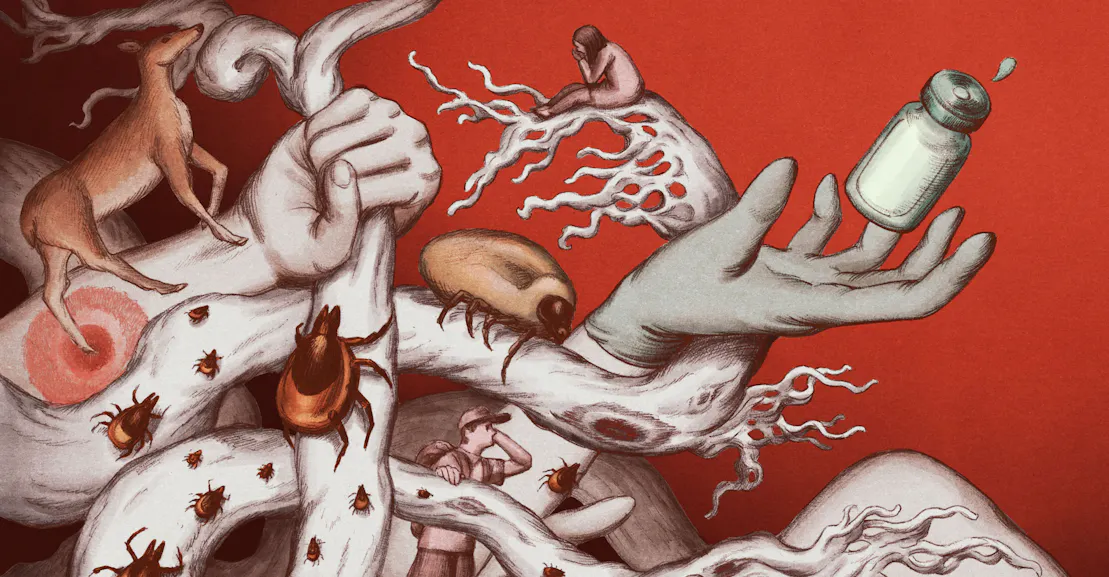
Andrew: The thrust of this Outside story was talking to Dr. Mark Klempner, who devised, along with a larger team, this pre-exposure prophylaxis that he calls Lyme PREP, PREP being the acronym. Basically, it’s a monoclonal antibody. The idea is you would get this annual injection. When a Lyme-carrying tick bites you, it sucks in your blood, and it would suck in this antibody that would immobilize the Lyme-causing bacteria, Borrelia, within its gut, which means it wouldn’t transfer to you, and presumably you would not get Lyme disease. He began a Phase I trial in February of this year and is hoping maybe this will be out in the market sometime in 2024.
Alex: This is a preventive Lyme treatment, but it’s not a vaccine.
Andrew: That’s right. It’s a preventive treatment that gives you an antibody. The difference is that a vaccine normally stimulates an immune response that will generate an antibody; this is the antibody itself.
Laura: When this eventually comes onto the market, do you foresee it encountering some of the problems that LYMErix had, with people not wanting to get vaccinated or having concerns about taking a treatment for this?
Andrew: Perhaps. Mark Klempner said that he thinks it’s going to fight some kind of acceptance battle because of the problems that emerged around LYMErix.
Alex: How far along is it in trials?
Andrew: The Phase I trials started with 60 participants in February 2021. That’s a dosage study: figure out how much of Lyme PREP people need in order to protect them. And then you gradually expand the participant population and start doing studies of the safety: How many people could take it safely? Does it work? Is it actually doing the thing that it’s supposed to do, which is prevent Lyme disease? I think Mark Klempner seems to think that all of this will progress at a reasonable clip and it will be able to go to market in a few years.
Alex: So this is interesting, because I feel like we’ve been highlighting the ways that PREP is different from a vaccine. We were talking with our previous guest, Rebecca, about LYMErix being withdrawn not solely because of anti-vax sentiments—also, in part, it was a story of a drug company not knowing how to market this vaccine, and not feeling like there was enough of a consumer base for it. I think that … the consumer base has grown since then, but also, do you expect that the fact that this is not a vaccine will be a selling point, if and when it is approved?
Andrew: I would imagine so, if you can very objectively and easily explain the difference between a vaccine, which would generate an immune response to create antibodies, versus here’s the antibody, you’re just getting the antibody, and if you have it in your body, it should presumably prevent your getting Lyme. You would think it would, but I don’t know.
Alex: Well, one thing that I found interesting is that I no longer have to be introduced to the concept of injecting antibodies—now that we know of that as a treatment for Covid-19 in this post-Covid world, like, oh, OK, one therapeutic treatment for Covid is directly injecting these antibodies. And even the concept of PREP, the other usage of prep for disease prevention that I know of is HIV, which is completely well-accepted. So I do wonder if, societally, we are more ready for this kind of treatment now than we would have been a decade or two ago, because we’re more familiar with these concepts.
Andrew: Hopefully. I mean I’m one guy, who cares about me, but if this is out there and I could take it, I would take it.
Laura: I have one last question about the way in which this is a public health issue, because the main subject of vaccine conversation in the last couple of years has obviously been the Covid vaccine. And it’s important with the Covid vaccine that everyone in the community gets it because you can spread Covid from person to person. Lyme disease is a little different because ticks spread Lyme disease to humans, but I’m not aware of any human to human transmission of Lyme. So is it a public health issue in the sense that there isn’t community spread, but that it is still a disease that is at large in many parts of the U.S.?
Andrew: Sure, in a way. Sam Telford, the Yale professor that I quote in the story, will give you a great diatribe about the spread of deer, the fact that the deer population has just exploded and deer are carriers, but it’s also just this growing suburbanization in America—the more you begin spreading where people live out into places in nature where they perhaps weren’t found before, you can come into contact with different types of diseases and infections. That’s been the story from the entirety of almost the last two years, zoonotic diseases or vector-borne diseases. And so that’s a piece of it too, if that fits into public health.
Alex: The more we talk about Lyme, the more I’m feeling that it has parallels to everything else that’s going on. It’s like this skeleton key—it’s about climate change and where these ticks are found, it’s about development patterns, it’s about the sort of sociological and economic reasons why drug companies develop the treatments they do and how they market them and what gets approved. It touches on so many other things. Andrew, thank you so much for taking the time to talk to us today.
Andrew: Sure. Thanks for having me on.
Laura: Andrew Zaleski’s article, “Finally, a Shot to Prevent Lyme Disease Could Be on Its Way” appeared in Outside magazine in August.