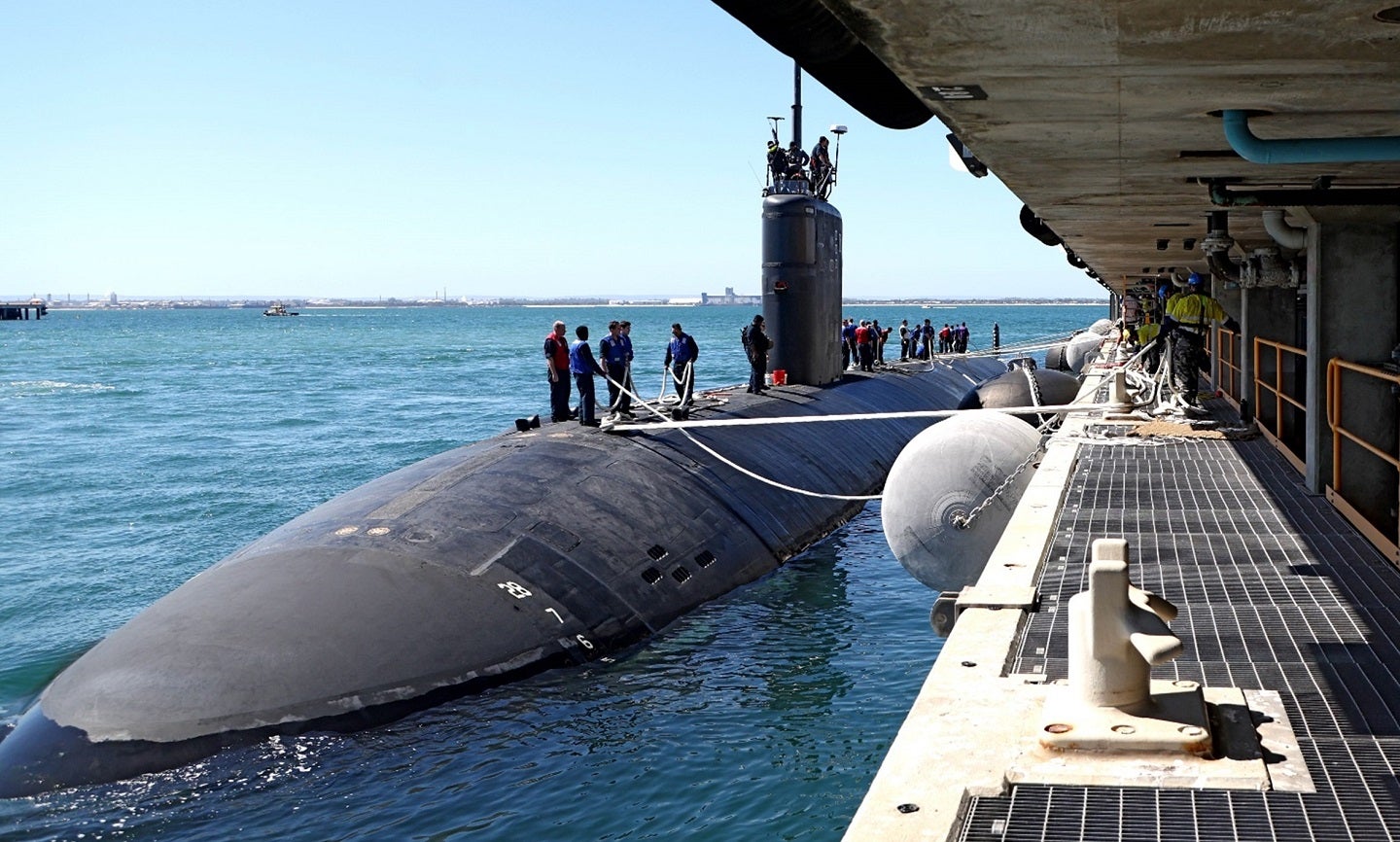
A Los Angeles-class submarine USS Annapolis (SSN 760) tied up alongside Diamantina Pier at Fleet Base West, HMAS Stirling, Western Australia. Credit: Australia Defence Forces.
The US has begun to overcome a major hurdle to defence integration with its AUKUS partners – Australia and the UK – with plans to exempt the two countries from its enduring International Traffic in Arms Regulations (ITAR).
In addition, the US Commerce Department also announced an expansion of the scope of licence-free trade to AUKUS nations by amending the Export Administration Regulations on 18 April 2024.
The department cited the need “to enhance technological innovation among the three countries and support the goals of the AUKUS Trilateral Security Partnership”.
It follows the passage of the US National Defense Authorization Act (NDAA) in December 2023, which established a list of criteria that needed to be fulfilled by the Australian and British governments before the exemptions came into effect.
These reforms will significantly reduce licensing requirements for both the UK and Australia, as well as facilitate public and private sector security institutions to deliver a more integrated defence industrial base.
The Australian Defence Forces (ADF) said that the new exemptions will remove licensing requirements for “most military goods and technology items”. This appears to include both Pillar I submarine components and Pillar II advanced technologies. The UK Ministry of Defence (MoD) did not immediately respond for comment on what specific parameters have been set in that regard.
How well do you really know your competitors? Access the most comprehensive Company Profiles on the market, powered by GlobalData. Save hours of research. Gain competitive edge. View profiles in store Company Profile – free sample Thank you! Your download email will arrive shortly Not ready to buy yet? Download a free sample We are confident about the unique quality of our Company Profiles. However, we want you to make the most beneficial decision for your business, so we offer a free sample that you can download by submitting the below form By GlobalData Submit Country * UK USA Afghanistan Åland Islands Albania Algeria American Samoa Andorra Angola Anguilla Antarctica Antigua and Barbuda Argentina Armenia Aruba Australia Austria Azerbaijan Bahamas Bahrain Bangladesh Barbados Belarus Belgium Belize Benin Bermuda Bhutan Bolivia Bonaire, Sint Eustatius and Saba Bosnia and Herzegovina Botswana Bouvet Island Brazil British Indian Ocean Territory Brunei Darussalam Bulgaria Burkina Faso Burundi Cambodia Cameroon Canada Cape Verde Cayman Islands Central African Republic Chad Chile China Christmas Island Cocos Islands Colombia Comoros Congo Democratic Republic of the Congo Cook Islands Costa Rica Côte d"Ivoire Croatia Cuba Curaçao Cyprus Czech Republic Denmark Djibouti Dominica Dominican Republic Ecuador Egypt El Salvador Equatorial Guinea Eritrea Estonia Ethiopia Falkland Islands Faroe Islands Fiji Finland France French Guiana French Polynesia French Southern Territories Gabon Gambia Georgia Germany Ghana Gibraltar Greece Greenland Grenada Guadeloupe Guam Guatemala Guernsey Guinea Guinea-Bissau Guyana Haiti Heard Island and McDonald Islands Holy See Honduras Hong Kong Hungary Iceland India Indonesia Iran Iraq Ireland Isle of Man Israel Italy Jamaica Japan Jersey Jordan Kazakhstan Kenya Kiribati North Korea South Korea Kuwait Kyrgyzstan Lao Latvia Lebanon Lesotho Liberia Libyan Arab Jamahiriya Liechtenstein Lithuania Luxembourg Macao Macedonia, The Former Yugoslav Republic of Madagascar Malawi Malaysia Maldives Mali Malta Marshall Islands Martinique Mauritania Mauritius Mayotte Mexico Micronesia Moldova Monaco Mongolia Montenegro Montserrat Morocco Mozambique Myanmar Namibia Nauru Nepal Netherlands New Caledonia New Zealand Nicaragua Niger Nigeria Niue Norfolk Island Northern Mariana Islands Norway Oman Pakistan Palau Palestinian Territory Panama Papua New Guinea Paraguay Peru Philippines Pitcairn Poland Portugal Puerto Rico Qatar Réunion Romania Russian Federation Rwanda Saint Helena, Ascension and Tristan da Cunha Saint Kitts and Nevis Saint Lucia Saint Pierre and Miquelon Saint Vincent and The Grenadines Samoa San Marino Sao Tome and Principe Saudi Arabia Senegal Serbia Seychelles Sierra Leone Singapore Slovakia Slovenia Solomon Islands Somalia South Africa South Georgia and The South Sandwich Islands Spain Sri Lanka Sudan Suriname Svalbard and Jan Mayen Swaziland Sweden Switzerland Syrian Arab Republic Taiwan Tajikistan Tanzania Thailand Timor-Leste Togo Tokelau Tonga Trinidad and Tobago Tunisia Turkey Turkmenistan Turks and Caicos Islands Tuvalu Uganda Ukraine United Arab Emirates US Minor Outlying Islands Uruguay Uzbekistan Vanuatu Venezuela Vietnam British Virgin Islands US Virgin Islands Wallis and Futuna Western Sahara Yemen Zambia Zimbabwe Kosovo Industry * Academia & Education Aerospace, Defense & Security Agriculture Asset Management Automotive Banking & Payments Chemicals Construction Consumer Foodservice Government, trade bodies and NGOs Health & Fitness Hospitals & Healthcare HR, Staffing & Recruitment Insurance Investment Banking Legal Services Management Consulting Marketing & Advertising Media & Publishing Medical Devices Mining Oil & Gas Packaging Pharmaceuticals Power & Utilities Private Equity Real Estate Retail Sport Technology Telecom Transportation & Logistics Travel, Tourism & Hospitality Venture Capital Tick here to opt out of curated industry news, reports, and event updates from Naval Technology. Submit and download Visit our Privacy Policy for more information about our services, how we may use, process and share your personal data, including information of your rights in respect of your personal data and how you can unsubscribe from future marketing communications. Our services are intended for corporate subscribers and you warrant that the email address submitted is your corporate email address.
Nonetheless, this will reduce the burden associated with US export licences for dual-use goods to Australia worth almost $2bn (A$3.1bn).
The Australian Government has already responded in kind with its law in March this year, which offers an exemption for the UK and the US from its export control permit requirements – this is expected to come into effect in September 2024.
Similarly, the UK will also release its Open General Export Licence in September 2024 to give effect to the exemption for Australia and the US.
These US reforms come at a time when the AUKUS roadmap is making some headway following news that the British company Rolls-Royce has already begun making components for the nuclear reactor due to be fitted into the first SSN-A (nuclear-powered attack submarine – AUKUS).
Deputy Prime Minister and Minister for Defence, Richard Marles, announces the build and sustainment partners for Australia’s nuclear-powered submarines during AUKMIN in Adelaide, South Australia. Credit, 22 March 2024: ADF.
However, the UK MoD noted that despite reaching the 120-day milestone set by the NDAA, the UK is in the process of finalising “the last technical steps” to benefit from the NDAA provisions. The MoD has yet to respond with details of these ‘last steps’.
“We are confident that by the next 120-day period we will have completed all the requirements for full implementation of the ITAR exemptions,” said the UK MoD in a release welcoming the reforms.
During the recent Undersea Defence Technology conference in London, the US director for AUKUS, Commander of Submarine Forces, Dan Packer, observed that the US is good when it comes to “government-to-government” relations, but they “have not got industry down yet” and this will require “baby steps”.
Although there are still details to be ironed out, scrapping the enduring ITAR restrictions for its close partners is a considerable step forward for the US – a country known for its guarded approach to knowledge and technology sharing.