Contents: What is Xanadu for - Basic Principles - Writings - chats - Projects
What is Xanadu for?
Also see - If Xanadu and Mirror Worlds are the answers, what are the questions?
See The Future of Information for a fuller expounding of these thoughts.
Adding useless complication, gimcracks and geegaws to keep you distracted from what really matters: worthwhile content and highly interconnected relationships as you and others see them.
A many lensed camera with many microphones and reels of film, cloned and spliced, being created, edited, and viewed by many people, with the Universe and its' inhabitants as stage and actors; semi-chaotic but being continuously reorganized.
A tool worthy of chronicaling and creating the achievements, documents, and discussions * of all mankind ( * scientific, political, artistic, literary, mathematical, personal, social, religious, etc.). Because no two people have ever lived the same life.
The freedom to be yourself, to express who you are, freely using the results of group efforts, and of other individuals' works, but recomposing them into artistic, scientific, religious, and philosophic works that don't force you to compromise what you believe (and allow you to combine all these disciplines). And you will get paid fairly for your work, as well as all those you quote, and whose work you borrow from. It will be groups working together, but without imposing group-think mentality upon anyone, as each person can individually publish and benefit from their own edition of any final products. But no document will be truly final, because it can always be corrected and improved upon by the author, and then modified and republished by other writers. The original author can then use the improvements added by collaborators in another version. Everyone gets credit for their work, gets paid, borrows freely, speaks freely, and works together while maintaining individuality. If you wish, you can even promote (or not) products, services, and artistic works you appreciate without being forced to lie about their weaknesses by your sponsors, since you will get paid for your evaluation by those who listen to and view and value your opinion. You can work with others to produce services that combine news, entertainment, and education without editorial quality being compromised by financial considerations from controlling forces bigger than you. These are the goals of Xanadu that are not possible with the tools we have today. These documents present and link to the methods and tools needed to accomplish these goals.
Basic Principles of the WWW's replacements - goals, paradigms, benchmarks:
Steve Jobs showed some amazing capabilities of the Mac OS 10.4 and applications, which has some eye-popping algorithms. But the other half of the computing picture are advanced data structures. Spotlight has some of the indexing capabilities of Mirror Worlds, but the basic features of Xanadu are still absent. See Jobs' keynote address
I expect the future of software to include some combination or merging of these; or a new data structure that will offer the benefits of both. Perhaps the ideas behind Mirror Worlds can be used to build a distributed archival system for Xanadu; as well as distributed processing, similar to that used in the Folding At Home Project .
Mirror Worlds will provide some of the above capabilities and the following as well.
"No one ever takes a photograph of something they want to forget" - from the movie - One Hour Photo.
What is wrong with the World Wide Web?
But it will not last. It does not have strong and flexible structure. It is a towering house of cards held up by hype and short-sighted expediency. It is collapsing.
The Web is the most popular form of hypertext, but one of the worst. The fact that this is a website pointing this out highlights it's greatest strengths. It was the first hypertext to use the Internet and it is cross-platform.
Links break when web pages move. Links are one-way (when you link to something, it doesn't link back to you. It is difficult or impossible to add your own notes and comments to the content you are accessing. The lack of transclusions makes royalty payments and copyright protection very difficult, thus excluding tens of millions of valuable documents from being on the web, despite the web's enormous efficiencies of distribution. Previous and alternate versions are almost never available. It is a mishmash of technologies that are virtually impossible for one person to learn. Most software today is like frosting with no cake underneath. The frosting looks and tastes good (is user-friendly), but without a solid structure underneath, it collapses. It lacks a structure that is strong, yet flexible. (In Xanadu, the back-end server software is the cake, the front-end client, always editable, is the frosting).
It violates or lacks all of the above principles.
What needs changing?
While watching a movie, you could add your own audio commentary or textual notes and links as a supplement. Someone watching the movie could have the option to listen or read your additions. When they do this, micropayments would automatically be deposited into your account and the movie maker would also receive royalties from each viewer. The same thing for all media: books, magazines, newspapers, radio and television programs, music. You could create a composite document of any or all these media, freely using everything available. When viewed or listened to, all the content creators would receive payments automatically, unless they want to give their content away.
* The words data, content, hypertext and hypermedia are often used interchangeably and include all forms of communication; including newspapers, television, radio, magazines, books, movies, virtual (realities, 3-D artistic creations, mathematical, geometrical, fractal, and topological universes in infinite dimensions, land-sea-planet-space scapes and travel, shared chat spaces where each participant can choose their environment and activity). These "documents" can be a new shared artistic medium: swimming, flying, dreaming, and imagining together. All made possible by a flexible and scalable data structure. My belief is that there will be VR environments where each person engaged in a conversation can at the same time be in the location and activity of their own choosing: spelunking, sitting on a beach or in a tree in a rain forest, bungee jumping, spinning a pottery wheel, exploring the Marianas Trench, or merely shopping.
Current software isn't totally worthless. Some of the best could become part of the front-end software for creatively interacting with the contents of a persistent data* store. Monthly subscriptions could be re-distributed proportionally to some of the content providers: writers, painters, animators, movie-makers, commentators, programmers, singers, musicians, translators, narrators, etc.
Our tools become extensions of ourselves.
How can you know if what you believe is the best of all possible alternatives if you haven't read the best presentations available of all the alternatives?
Here's how I think about what we need developed in software: When I am engaging in any form of human communication, (day)dreaming, or other sensory interaction, I think about how it could be done even better with software and hardware. I may be watching a movie in a theater or DVD, listening to a live orchestra, watching the news on TV, hiking in the woods, reading a math book, talking on the phone, whatever I may be doing. How could I record, share, link, annotate, enhance this experience? How can it be improved? What am I missing because of current design limitations? When I think of a movie, I think of one that is visually, aurally, and intellectually complex, but with some unifying structure (Lord of the Rings, for example). When I think about linking, I think of each word linked to dictionaries, thesauri, and encyclopedias; each footnote linked to the location in the book referred to; each reference to a work of music or video linked to the actual work. And of course, everything must be editable all the time by anyone (creating a new version). In other words, when I think of hypertext, the one thing I don't think of is the World Wide Web (except to think of limitations to overcome).
That's why we can develop such a personal attachment to them.
What Xanadu has that others don't:
When responding to any argument (for or against something), you will be able to comment on each and every relevant sentence. The document you are commenting on will automatically link to your analysis. Whether readers of the document see your comments or not is up to them. They will have filtering tools to include or exclude whoever they want. That is their decision to make. Thus every possible viewpoint can be heard and can cross-comment on each other as much as desired.
Several checklists created in altme summarizing the above are here
Writings
I have only a vague understanding of the structure of this design. Maybe someone will get Xanadu fully implemented this way. Time will eventually tell.
"It was designed to hold all the knowledge in the world. You tell it secrets, and they are dutifully stored away in an ever-branching, walking tree of long memory. It knows everything it's ever been told. It knows who told it. And if you change your mind, it remembers both the new secret, and the old, and what parts of the new secret were taken from the old. It remembers if you've combined two or more secrets. It can tell you what secrets contain other secrets, even secrets that have since been changed. It knows what secrets simply refer to other secrets. It knows every revision of everything it's ever been told to remember."
The Loaf Question "This is the data structure created for the Xanadu? project between 1988 and 1992, and may be the most complex data structure in the world. At the very least, it's fiendishly hard to comprehend by reading the literature and the code. Hence the pictures."
The Tyranny of Copyright Although it doesn't mention Xanadu as a solution, it is a good outline of some the problems. Costs $2.95 to read.
Automatic Hypertext is an interesting article about making every word have multiple links. This is how all hypertext should be. There are also many other good articles and links at LiquidInformation .
The Ingenuity Gap book. I haven't read it yet, but the first chapter and other material is online.
The New Amiga I wrote this before I used Mac OSX, Windows XP and 2000, so some things have improved since then. I explain some of my likes and dislikes of various operating systems over the years.
The OS and Software of the Future Imagine an operating system that allowed unlimited linking between any files or parts of files, renaming and reorganizing the files with no broken links, no restrictions on file naming, multiple names for the same file, the same document (or part of one) can be in many places at the same time, every word in every file is constantly indexed (including spoken and sung words). Viruses are a distant memory. The limits of our imaginations will be the limits of our software.
If Xanadu and Mirror Worlds are the answers, what are the questions?
What Changes and What Stays the Same
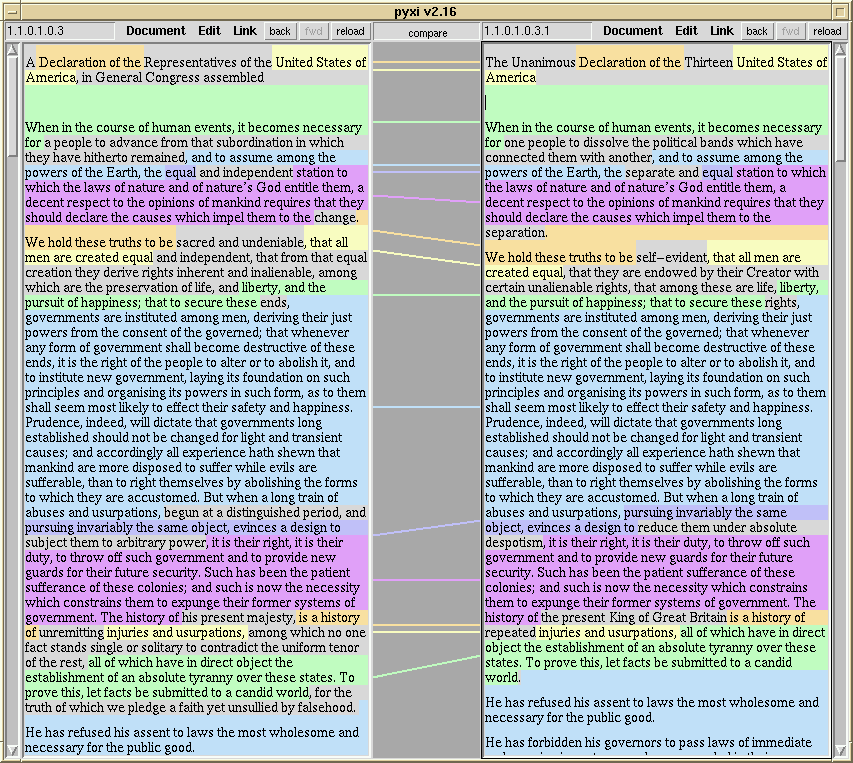
Example structure of a mindmap about philosophy and religion , showing how a lot of subjects might be linked from one person's viewpoint.
Xanadu Algorithms and description of a proposed movie to show what it will be like.
An excellent dissertation "Xanadu: a proposed solution to the problem of information retrieval on the World Wide Web"
Hypertext and Critical Discussion - A concise summary and links about what kind of hypertext is needed.
Also see The Postmodern Generator - Communications From Elsewhere
How To Write Parallel Programs: A First Course Could this be the way to create a virtual super-computer on the Internet to serve Xanadu and Zigzag?
The Open Society and its Media Excellent coverage of the goals of Xanadu.
Video interviews These crashed my Safari browser, but worked with Opera. The audio only is also available This website has much other good information, but I had many technical problems accessing it.
Computer Lib/Dream Machines - a pioneering book in the personal computing field. Now out of print, so it is a collector's item.
Not edited yet (has many spelling and grammatical errors), but explains many of the problems with the web.
Structure, Tradition and Possibility A concise explanation of the most important issues in software design.
INDIRECT DOCUMENTS AT LAST! Now for a Humanist Computer Agenda. - Ted at his wittiest and wisest. A must read!
Transclusion: Fixing Electronic Literature Google Tech Talks January 29, 2007. Ted demonstrates an early test of a 3D view of linked text documents. Unfortunately, the bio of Ted linked to from this page is one-sided and biased towards the negative. A much better write-up about him is by Katherine Phelps
The Future Of Information - If you read only one document to understand what this is all about, this would be a good one to choose. It is out of print, but can be accessed from the Internet Archive Wayback Machine at http://web.archive.org/web/20020209180825/http://www.sfc.keio.ac.jp/~ted/INFUTscans/INFUTscans.html It is in jfax format. The files can be renamed with the ".tif" extension. If you are on a Mac, the jfax files can also be opened using Graphic Converter .
To design the new structures of writing for screens is a profound issue of literary structure. It is important to provide the best literary structure that we can, for hypertext, as the literature of tomorrow, determines in part the new structure of civilization. Civilization is in large part about, and around, what is written. This is what we call literature. Literature is an endless river, connected, like water, in all directions. Document connections go forward and backward in time, and sideways between documents. Scholarship and fiction, political speeches and criticism, advertising, journalism and technical reports-- all affect each other and evolve in a constant flow of ideas and writings.
Ted Nelson - a pioneer in hypertext and designer of Xanadu, Zigzag, and Floating World. I recommend reading everything he has written.
Projects
Xanadu(like)
Mirror Worlds
Not yet created, but described in the book (a must read). A beautiful vision of how powerful a tool software can be for creativity and understanding. Implementation of some of it's features were available in Scopeware (Windows only), which is sadly no longer available.
Other Useful Software
Games
Continuum - low-gravity floating and bouncing on platforms, reminds me of using gzz. It was available on Amiga OS 1.3 and MS-DOS. My favorite game on any personal computer. Tranquility - a newer game similar to Continuum (but more floating and less bouncing), demo version downloadable, highly addictive.
Movies and Music
Hyperland - 1990 Douglas Adams documentary about the web before it was really there. Memento - very intelligent script, check out the special features on the DVD. Hypertext helps us in remembering and associating. That is what this movie is about. Nice ambient music, too. Pieces of April - The featurette has a nice grid browsing look showing movement between animated video segments. Xanadu music by Olivia Newton-John on the iTunes store. On my OSX system with Safari, this link works if iTunes is already running. G-force music visualizer. Can we make software interfaces that look like this? So beautiful it's scary.
Languages
Language qualities needed for these projects: scalable, cross-platform, easy to learn, support for Internet Hypercard-like (see also Other Useful Software above) Revolution An easy to learn graphical language that is very cross-platform. Good Internet and multi-media support. tk3 Not programmable like Revolution, but good for publishing books. NoteTaker Mac OSX only - personal organizer. Has scrolling windows, outlines, can record audio notes and include video. Rebol View and IOS - cross-platform. There are versions of Rebol to run on Windows, Linux/Unix, Mac OSX, server CGI, and a browser plug-in for Windows only. There are even versions for Amiga, Be, QNX, and Tao. Rebol has many fascinating qualities, and is exceptionally easy to install and program in. Of all the programming languages I have looked at, this is my favorite; as I can think about what I want to accomplish, not excessive mundane details. Tutorial Altme - Built from Rebol View. A private chat, file sharing, calender, check-list - collaborative system that is peer-to-peer. Windows, Linux and Mac OSX. This shows the power of the Rebol language. See altme below. Qtask is another collaboration set of tools written with Rebol Curl is similar to Rebol in many ways. Squeak - cross-platform Smalltalk. May be used in a future version of Abora . Python - open-source, cross-platform. Easy to learn, but suitable for large projects. Is being used for some Xanadu programming. At this time, it seems the most likely candidate for implementing Xanadu. It is, however, more difficult to install and upgrade than Rebol. Jython - used in the newest gzz. A Java implementation of Python. PyLinda Python version of the Linda language. A language for distributed computing. Flash has become a very versatile multimedia Internet language. It takes some time to learn, because it follows the syntax examples of C++ and Java. Flex is a programming environment that combines Flash (and it's ActionScript Language) and XML into an easy to learn system. It's not cheap, but is likely to become extremely popular for designing web pages. What I like best about it is how easy it is to create user-editable parts of programs. I wish all computer languages would implement that capability, since it seems so basic to me. Sheep - fast compiler, for the new Amiga, not cross-platform, but might be used for writing a front-end for Xanadu-like programs. Will be similar to ARexx and Applescript, a scripting language that can add capabilities to applications and exchange messages between them. Java - versatile, cross-platform, but difficult to learn. It hasn't lived up to all the hype that originally surrounded it, but is still important for many things. TSpaces - could be used in writing Mirror Worlds, from IBM Alice - Very easy to learn 3D animation programming environment. Free, works on Windows or Mac OSX. Scratch Drag and drop programming for beginners. A painless way to begin that offers instant gratification for those frustrated by the huge first stages of most languages. E - A project creating a highly secure distributed language. Many of those involved in Xanadu are working on this. I recommend reading Mark Miller's dissertation and E in a Walnut
Advanced Operating Systems
EROS - Extremely Reliable Operating System (based on KeyKOS ) A bullet-proof system still in development. Viruses can run on it harmlessly. The future of operating systems must be like this. Agorics also has GuardOS. The successors to EROS are CAPROS and Coyotos. Sphere Tunes is a project to replace existing Operating Systems, Languages, and User Interfaces ... Here is a page they have listing many OS's. The best writing I have found anywhere about the history of operating systems is at Roughly Drafted. There is an emphasis on Apple; but other desktop, PDA, and phone OS's are covered in depth. Daniel Eran Dilger deserves a Pulitzer for his writing. I have searched for years for writing of this quality.
3D Environments
How to make it all happen?
What principles and precautions need to be kept in mind to make Xanadu and/or Mirror Worlds a reality. Xanadu has been a dream and on and off project since 1961. It could become a working reality by business, non-profit group, or a university: anyone willing to supply the creativity, discipline, and resources to make it happen. Good business books I have read that dramatically changed my thinking (actually I listened to the audiobooks many times). Some books are far better than average and deserve repeated readings. Getting Things Done: The Art of Stress-Free Productivity, by David Allen - If there is one book I wish I could have read when I was 10 years old, it is this one. I first read (listened to) this book in 2008. For the past several years, I had given up hope that effective management and organization was a possibility. I have now regained hope. The World Is Flat How the Internet and fiber-optic cables are changing the world's economy. Good to Great: Why Some Companies Make the Leap... and Others Don't, by Jim Collins - In-depth research project into top long-term performing organizations. Many surprising findings. The Millionaire Next Door, by Thomas J. Stanley and William D. Danko - Research showing that most millionaires got that way and stay that way through frugality and discipline. Lifestyles of the rich and not famous (only the abnormal and rare is newsworthy). The Goal: A Process of Ongoing Improvement -- by Eliyahu M. Goldratt, Jeff Cox - The logical mind of a philosopher applied to manufacturing. Agile Management for Software Engineering: Applying the Theory of Constraints for Business Results
By David J. Anderson, Eli Schragenheim - Informit Informit Safari Online I just started reading this book, but it looks very promising. It applies Goldratt's theories (see above) to software project management. These books show that in the real world, reason, understanding of cause and effect, creativity, discipline, attention to customer needs, and persistence all pay off in the end. Other relevant books Dialogue Mapping: Building Shared Understanding of Wicked Problems The methods here have much in common with the goals of Xanadu: understanding complex problems and allowing for social diversity. Visualizing Argumentation: Software Tools for Collaborative and Educational Sense-Making The Farce of Physics What happens when only one viewpoint is allowed a hearing? Also see Caroline Thompson's Physics Jim Wingard interview "It seems that the real challenge (as with most software projects) is defining exactly what the requirements are and how to build your beast. Once you've nailed down the "what and how" of your project the actual implementation doesn't take too long. Beyond that, there is always the matter of coordinating schedules with outside help." "Get a good idea and stay with it. Dog it, and work at it until it's done right." - Walt Disney "First define, then refine". Bill Guild NZ Pioneer teacher "If you are looking for a big opportunity, find a big problem." Anon "Fall in love with your life's work again, my friend, or your energy will wane, your voice will falter and there will be nothing to prove but the fact that you are taking up valuable space." Anon "Just because something has been done wrong for ten years doesn't mean it can't be done right - it only means nobody's done it yet. - Makes you wonder what other 'tried and failed' opportunites are out there waiting for someone to find the magic combination of factors that will turn it into the next revolutionary idea." http://www.fortymedia.com/blog/opinion/11/why-podcasting-took-off
Hyperwords FAQ (new)
Recommended Training - I know, some of this teaches web design, but there will be a transition period, and the web will still be much used until the new software becomes mature.
VTC - Thousands of movies teaching various software. $30 a month. Lynda.com - Similar to VTC, but specializing in web design and graphics. $25 a month. Atomic Learning Informit - Excellent online source of programming books and videos. Wikipedia - Enormous collaborative project writing an encyclopedia. Will be excellent content source for more advanced Internet-based hypertext as it becomes available. Yourteacher Online video math courses. Mathfoundation Online math courses using Flash.
Obscure Humor
Five or ten years ago, I predicted privately that some newspaper would figure out it could save millions of dollars a year in printing costs by giving away hundred dollar computers to read it's "paper" and sell its' presses. Just think of the enourmous waste of resources newspapers are! Well, that may soon become a reality. See the WSJ article
See how this website has looked all the way back to 2003 using the Wayback Machine
Xanadu and ZigZag are trademarks and patents of Ted Nelson.
Jack Seay (webmeister and editor) - jackseay@sbcglobal.net
Skype name: jackseay
.
.
.
.
.
.
.
.
.
.
.
.
.
.
.
.
.
.