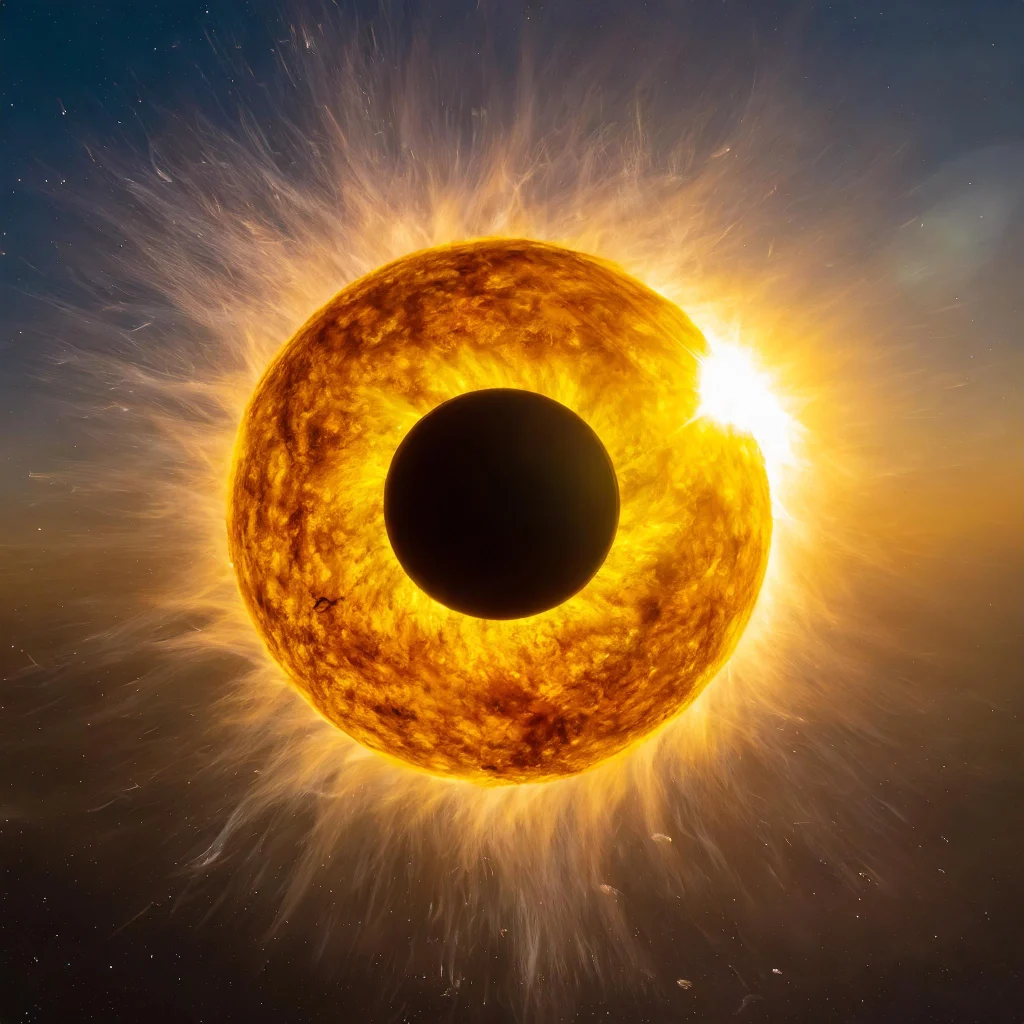
New solar measurements of trillion electron volt gamma ray emissions combined with recent published papers independently support the conclusion that the Sun may harbor a black hole at its core. Such evidence supports my unified physics-based stellar evolution model that stars, including the Sun, are black holes.
Black Holes at the Core
Black holes have been characterized as many things over the decades since their indisputable confirmation— transitioning from theory to fact— but their lesser-known characterizations include being the brightest objects in the known universe, called quasars, the sources of the highest emissions of matter and energy— seemingly quite contrary to their main qualities of being black and an inescapable hole— as well they have recently been characterized as potentially life-nurturing energy sources, and as engines of creation [1, see also Evidence of Black Holes Forming Galaxies is Mounting!]. In seeming attempts to grab attention, they are more commonly characterized as voracious devouring systems that only wreak chaos and destruction, and while this may be good for eye-catching headlines, it is not an accurate characterization of black holes, and has largely misled scientists and non-technical audiences alike.
What we know now, often via directly observing the dynamical systems that form around black holes, is that yes, they are tremendously energetic systems, but they also generate high coherence and ordering and are integral in the formation and development of organized matter. This is now well known for galaxies, but the concept is also beginning to extend to other organized systems of matter: like stars [2], atoms [3], and even the universe itself [see Dr. Inés Urdaneta’s article Is JWST Confirming Haramein’s Holographic Solution Predicting that the Universe is a Black Hole?]. One highly significant area of investigation is the possible role of black holes in the core of stars; a long-time prediction of mine that describes how stars are black hole systems, which may seem like a crazy idea, but then again remember that the predominant characterizations of black holes are incomplete (or outright wrong in some cases), and the more precise characterization of black holes is rarely considered: such as being the brightest objects in the universe, as the first objects to form in the universe, as possibly instrumental in the formation of life, and as galactic engines driving organized galaxy formation and development. So, with these numerous recent developments advancing a more precise characterization of black holes the idea that they may form the core of stars, like our Sun, becomes a surprisingly reasonable possibility with considerable likelihood for being detected and verified.
Indeed, multiple lines of evidence are now converging to corroborate my long-time model of black holes as the organizational nucleus for ordered matter across scales—a model which expounds that intrinsic black holes from the quantum to the cosmological scales are found at the heart of organized matter, whether at galactic and stellar scales, or at subatomic particles scales. In fact, the model predicts that black holes are found at the core of systems of organized matter, like atoms and galaxies, with such regularity and periodicity that the Schwarzschild condition—typically given as the radius at which a particular mass-energy density will generate an event horizon—when analyzed across scale forms a veritable universal scaling law. Examples of such scaling examining periodicity in the universal scales are many one of them can be seen in work from Reese and Carr published in Nature in 1979 [4] (Figure 1A) and another detailed in my publications Scale unification: a universal scaling law for organized matter [5] and the Schwarzschild Proton [6] (Figure 1B). When taken to its logical conclusion the universal scaling law predicts that black holes should be at the core of many primary systems: from particles (Are Atoms Black Holes?), to stars, galaxies, and even the universe, which is now being understood to indeed obey the condition of a black hole. One prediction that is in part directly implied by the universal scaling law—is that stars as well form from intrinsic black holes and that we should expect to find such primary systems at the cores of most stars, including our Sun. Now, it appears that evidence is mounting for exactly this observation.
Figure 1. (A) Image from Nature 1979 publication by Carr and Rees [4], showing that many significant natural structures of matter cluster close to the line delineating the “black hole region” across scale (from the instanton to the universe). Under the standard model, the proton is shown in the “quantum region”, however a black hole at the proton radius is also shown and labeled as the “Exploding hole”, as calculations show that proton sized primordial black holes should be nearing complete Hawking evaporation in the current epoch (at ~1017 seconds since the initial inflationary period of the universe). Note, that in Haramein’s scaling law (1B) the Instanton is the Planck scale fundamental unit, the Planck spherical unit (PSU), of spacetime and the Schwarzschild proton corresponds to the “exploding hole” of Carr and Rees. Note as well, that in our most recent paper [see previously cited reference number 3] it is demonstrated that with considerations of quantum vacuum fluctuations as a source of mass a Schwarzschild proton black hole would evaporate in a period of 1035 billion years, making the proton excessively stable and thus showing that the “exploding hole” would not explode at this epoch but approximately a billion trillion trillion trillion years from now. Figure 1. (B) The universal scaling Law from Haramein’s Schwarzschild Proton paper plotting Log Mass vs. Log Radius for objects from the universe to a Planck mass. The graph demonstrates a tendency for organized matter to fall along a linear progression delineated by the Schwarzschild condition of a black hole for mass and radius across scale. The Schwarzschild proton—a proton sized black hole—falls nicely on the trend line while the Standard Model proton is far from it.See as well that the Sun falls close to the trend line, indicating that its core may obey a Schwarzschild condition, i.e., the condition of a black hole. See, as well, our article Galactic Engines under the section A Unified Principle for Organized Matter Across Scale, for more discussion on the universal scaling law. Figure 1. (A) Image from Nature 1979 publication by Carr and Rees [4], showing that many significant natural structures of matter cluster close to the line delineating the “black hole region” across scale (from the instanton to the universe). Under the standard model, the proton is shown in the “quantum region”, however a black hole at the proton radius is also shown and labeled as the “Exploding hole”, as calculations show that proton sized primordial black holes should be nearing complete Hawking evaporation in the current epoch (at ~1017 seconds since the initial inflationary period of the universe). Note, that in Haramein’s scaling law (1B) the Instanton is the Planck scale fundamental unit, the Planck spherical unit (PSU), of spacetime and the Schwarzschild proton corresponds to the “exploding hole” of Carr and Rees. Note as well, that in our most recent paper [see previously cited reference number 3] it is demonstrated that with considerations of quantum vacuum fluctuations as a source of mass a Schwarzschild proton black hole would evaporate in a period of 1035 billion years, making the proton excessively stable and thus showing that the “exploding hole” would not explode at this epoch but approximately a billion trillion trillion trillion years from now. Figure 1. (B) The universal scaling Law from Haramein’s Schwarzschild Proton paper plotting Log Mass vs. Log Radius for objects from the universe to a Planck mass. The graph demonstrates a tendency for organized matter to fall along a linear progression delineated by the Schwarzschild condition of a black hole for mass and radius across scale. The Schwarzschild proton—a proton sized black hole—falls nicely on the trend line while the Standard Model proton is far from it.See as well that the Sun falls close to the trend line, indicating that its core may obey a Schwarzschild condition, i.e., the condition of a black hole. See, as well, our article Galactic Engines under the section A Unified Principle for Organized Matter Across Scale, for more discussion on the universal scaling law. Figure 1. (A) Image from Nature 1979 publication by Carr and Rees [4], showing that many significant natural structures of matter cluster close to the line delineating the “black hole region” across scale (from the instanton to the universe). Under the standard model, the proton is shown in the “quantum region”, however a black hole at the proton radius is also shown and labeled as the “Exploding hole”, as calculations show that proton sized primordial black holes should be nearing complete Hawking evaporation in the current epoch (at ~1017 seconds since the initial inflationary period of the universe). Note, that in Haramein’s scaling law (1B) the Instanton is the Planck scale fundamental unit, the Planck spherical unit (PSU), of spacetime and the Schwarzschild proton corresponds to the “exploding hole” of Carr and Rees. Note as well, that in our most recent paper [see previously cited reference number 3] it is demonstrated that with considerations of quantum vacuum fluctuations as a source of mass a Schwarzschild proton black hole would evaporate in a period of 1035 billion years, making the proton excessively stable and thus showing that the “exploding hole” would not explode at this epoch but approximately a billion trillion trillion trillion years from now. Figure 1. (B) The universal scaling Law from Haramein’s Schwarzschild Proton paper plotting Log Mass vs. Log Radius for objects from the universe to a Planck mass. The graph demonstrates a tendency for organized matter to fall along a linear progression delineated by the Schwarzschild condition of a black hole for mass and radius across scale. The Schwarzschild proton—a proton sized black hole—falls nicely on the trend line while the Standard Model proton is far from it.See as well that the Sun falls close to the trend line, indicating that its core may obey a Schwarzschild condition, i.e., the condition of a black hole. See, as well, our article Galactic Engines under the section A Unified Principle for Organized Matter Across Scale, for more discussion on the universal scaling law.
Instead of the characterization of “ravenous devouring monsters”, black holes, in some cases, are now being described and referred to as seeds. Indeed, black holes are seeds of creation, and as we discussed in our article Galactic Engines, for the last three decades I have been describing intrinsic black holes, what are popularly called primordial black holes (PBHs), as the organizational nuclei of physical systems. These systems of organized matter form around a core black hole (primordial black holes act as a nucleating center). This is a concept we have been exploring for many years now, as in our article Astrophysics Gets Turned on its Head: Black Holes Come First, in which we discussed my stellar evolution model that is contrary to the conventional model of black hole formation—that is to say that black holes do not form from collapsed stars but instead stars form around primordial black holes (Figure 2).
Figure 2. Diagrammatic comparison of conventional model versus Haramein’s model of star formation, from our 2018 article Astrophysics Gets Turned on its Head: Black Holes Come First, by astrophysicist Dr. Amira Val Baker and biophysicist William Brown. One of the primary differences is that in Haramein’s model a primordial black hole is responsible for seeding the star formation, initiating aggregation, and the black hole core subsequently supplies mass and energy to the star during its lifetime. Such increased mass-energy contribution from a core black hole could be observed as anomalously high gamma and x-ray emission from a main sequence class G star, like our Sun, which should not emit in the gamma ray frequency range. In the case where a star undergoes a supernova explosion, the outer layers are blown off to reveal the black hole core, but the black hole was there all along and did not form from the stellar collapse. Figure 2. Diagrammatic comparison of conventional model versus Haramein’s model of star formation, from our 2018 article Astrophysics Gets Turned on its Head: Black Holes Come First, by astrophysicist Dr. Amira Val Baker and biophysicist William Brown. One of the primary differences is that in Haramein’s model a primordial black hole is responsible for seeding the star formation, initiating aggregation, and the black hole core subsequently supplies mass and energy to the star during its lifetime. Such increased mass-energy contribution from a core black hole could be observed as anomalously high gamma and x-ray emission from a main sequence class G star, like our Sun, which should not emit in the gamma ray frequency range. In the case where a star undergoes a supernova explosion, the outer layers are blown off to reveal the black hole core, but the black hole was there all along and did not form from the stellar collapse. Figure 2. Diagrammatic comparison of conventional model versus Haramein’s model of star formation, from our 2018 article Astrophysics Gets Turned on its Head: Black Holes Come First, by astrophysicist Dr. Amira Val Baker and biophysicist William Brown. One of the primary differences is that in Haramein’s model a primordial black hole is responsible for seeding the star formation, initiating aggregation, and the black hole core subsequently supplies mass and energy to the star during its lifetime. Such increased mass-energy contribution from a core black hole could be observed as anomalously high gamma and x-ray emission from a main sequence class G star, like our Sun, which should not emit in the gamma ray frequency range. In the case where a star undergoes a supernova explosion, the outer layers are blown off to reveal the black hole core, but the black hole was there all along and did not form from the stellar collapse.
This theory, although seemingly outlandish—since black holes are erroneously characterized as “devouring monsters” in popular (mis)conceptions—has seen significant verifications in recent years from direct observations and studies. It is now becoming all but certain that in terms of the early formation of organized matter, the birth of stars and nascent galaxies, black holes came first (black holes not only existed at the dawn of time, they birthed new stars and supercharged galaxy formation). Empirical observations from the James Webb Space Telescope (JWST) are revealing that black holes not only served as the nucleation center for nascent galaxies but were directly responsible for driving star formation and growing early galaxies [7]. We are therefore seeing within astrophysics theory a reversal of the conventional order of things: instead of stars forming black holes, black holes form stars.
As far back as 1975 astrophysicists Clayton, Newman, and Talbot had pointed out the significance of “primeval black holes” in regards to stellar formation and evolution [8], stating:
Hawking (1971) has proposed the existence of microscopic black holes remaining from the big bang, and one could imagine a protostar forming about one of these. Indeed, the mechanism of star formation is so poorly understood (Talbot and Arnett 1973) that one could even postulate that the presence of a primordial black hole is required as a nucleus for star formation. D. D. Clayton, M. J. Newman, and R. J. Talbot Jr., “Solar models of low neutrino-counting rate – The central black hole,” ApJ, vol. 201, p. 489, Oct. 1975, doi: 10.1086/153910.
Primordial Black hole initiates new star formation.
Clayton et al., had pointed out that standard stellar formation models (to this day) have difficulty describing the formation of a star because contracting nebulae can stall for billions of years as thermodynamic radiative pressure equilibrates with the force of gravitational contraction, such that an external force, often a supernova, is required to complete contraction; a situation in which a star is required to form a star (an exploding star sends a shockwave that drives condensation of interstellar gas pass the equilibrium point and into a protostar). As can be seen in the image above, a primordial black hole can be the nucleating core structure that overcomes the equilibrium condition and initiates and orders protostar formation.
The idea of intrinsic, or primal black holes as being the seeds of the formation of structure in organized systems of matter is being explored beyond just the processes that have been directly observed and quantified for active galactic nuclei (AGN), seeding new star formation in nascent galaxies, i.e., primordial supermassive black holes driving and regulating new star formation, but as well recent studies are exploring if—just as we have discovered is the case for galaxies—stars form around primordial black holes as well [9, 10]. What would be the dynamics of such a system and would a star with a black hole at its core, a so-called Hawking star, be stable? Is there any reason to believe such a supposition and could we probe the nearest star, the Sun, to empirically identify if it hosts a primordial black hole at its core? What is being discovered is that the answer to all these inquiries is in the affirmative. Recent observational data is revealing that the Sun, a “standard ruler” against which all other stars are compared and characterized, is far from being fully understood, and is emitting electromagnetic radiation at energy and frequency levels that it simply should not be active in, raising the question (again) what is going on inside the Sun that the Standard Solar Model has totally missed?
The Physics of the Sun is Not Well Understood
“We thought we had this star figured out, but that’s not the case… the sun cannot be this bright at these energies”. Astrophysicist Mehr Un Nisa for article Sun blasts out highest-energy radiation ever recorded, raising questions for solar physics
An international team of astroparticle physicists have reported new data of an unexplained very high energy gamma ray flux coming from the Sun at tera-electron volt (TeV) energy levels [11]. This astounding observation deepens the mystery of the enigmatic gamma ray flux that has been known for some time now. Although gamma photons at trillion electron volt energy levels have never been observed until now, this is revealing that the Sun—the most well studied star—is far from being understood and astrophysics models of the core structure and solar magnetized plasma dynamics may be in need of some significant updates. The observation is the result of an analysis of 6 years of data of high energy gamma rays originating from the Sun, detected by the High Altitude Water Cherenkov (HAWC) observatory [12]. Back in 2019, a decade’s worth of telescope observations of the Sun had discovered gamma ray emissions that were 7 to 20 times greater and at higher frequencies (higher energies) than what conventional theoretical modeling predicted, a puzzling discovery that had left astrophysicists perplexed (The Sun is Stranger than Astrophysicists Imagined). Far from being resolved, the anomaly has only grown more pronounced as the latest data has revealed an even higher flux at tera-electron volt energies, photon energy levels that conventional theory stipulates should not be possible for the Sun. Yet, the anomalous gamma ray flux has now been detected under a variety of conditions by multiple observatories and sensors, so what is going on? It is very likely that this observation reveals something fundamental about the core structure and magnetosphere of the Sun.
Figure 3. At left, the High Altitude Water Cherenkov observatory in Mexico with an artistic depiction of a high-energy gamma ray from the Sun interesting the upper atmosphere and generating a shower of secondary particles that, due to the Cherenkov radiation they produce in the HAWC water chambers (depicted at right), are detected by the gamma photon observatory. Figure 3. At left, the High Altitude Water Cherenkov observatory in Mexico with an artistic depiction of a high-energy gamma ray from the Sun interesting the upper atmosphere and generating a shower of secondary particles that, due to the Cherenkov radiation they produce in the HAWC water chambers (depicted at right), are detected by the gamma photon observatory. Figure 3. At left, the High Altitude Water Cherenkov observatory in Mexico with an artistic depiction of a high-energy gamma ray from the Sun interesting the upper atmosphere and generating a shower of secondary particles that, due to the Cherenkov radiation they produce in the HAWC water chambers (depicted at right), are detected by the gamma photon observatory.
The observed ultra-high energy flux from the Sun is not well explained by current solar models and defies previous postulates about a cosmic ray influx as the source of the gamma ray emissions because the flux is 10 to 20 times greater than computed by that mechanism, as well the latest detections are at energy levels from 1 to 10 trillion electron volts (see the video below the Sun is blasting out gamma rays 30 times higher than ever before).
“A surprising discovery that scientists made about the sun: it is emitting gamma rays, the most energetic form of light in the universe, at a much higher level than expected. These gamma rays are so powerful that they can only be detected by a special observatory in Mexico, and they raise new questions about the sun’s inner workings and its role in cosmic phenomena. In this episode, we will explain how scientists detected these gamma rays, how the sun can produce such high-energy gamma rays, and what are the implications and applications of this discovery for solar physics and other fields of science. We will also show you some amazing images and animations of the sun and its gamma rays that will blow your mind. So don’t miss this opportunity to discover a new aspect of the sun that we didn’t know before.”
A tera-electron volt packs about as much force as the kinetic energy of a flying mosquito, however that is one TeV per photon—a wave packet about a quintillion (1018) times smaller than a mosquito—and in a gamma ray burst there are a “gazillion” photons being emitted, which cumulatively add up to a tremendous amount of energy. To compare: light in the visible range is less than 10 electron volts (eV), ultraviolet photons just above 10 eV already carry enough energy to ionize matter (which can result in a Sun “burn”), and a standard X-ray machine in a hospital has photons with an energy of about 2,000 eV. By comparison, the tera-electron volt gamma rays observed coming from the sun are a billion times stronger than the X-rays in a hospital.
Figure 4. The electromagnetic spectrum, showing that gamma radiation can reach energy levels in the tera- and peta-electron volt range, energies that correspond to photon wavelengths smaller than what can be “resolved” by the Large Hadron Collider, and at frequencies above 30 exahertz (up to a trillion trillion cycles per second). By comparison to other regions of the electromagnetic spectrum, gamma radiation involves the highest energy events in the universe. Figure 4. The electromagnetic spectrum, showing that gamma radiation can reach energy levels in the tera- and peta-electron volt range, energies that correspond to photon wavelengths smaller than what can be “resolved” by the Large Hadron Collider, and at frequencies above 30 exahertz (up to a trillion trillion cycles per second). By comparison to other regions of the electromagnetic spectrum, gamma radiation involves the highest energy events in the universe. Figure 4. The electromagnetic spectrum, showing that gamma radiation can reach energy levels in the tera- and peta-electron volt range, energies that correspond to photon wavelengths smaller than what can be “resolved” by the Large Hadron Collider, and at frequencies above 30 exahertz (up to a trillion trillion cycles per second). By comparison to other regions of the electromagnetic spectrum, gamma radiation involves the highest energy events in the universe.
Processes generating gamma rays are extremely high energy events, like nuclear fission, matter-antimatter annihilation, transmutation via nuclear fusion, or extremely high magnetic fields, in which relativistic charged particles accelerated in curved, toroidal paths of magnetic fields generate synchrotron or magnetobremsstrahlung radiation—in accretion discs around black holes synchrotron radiation can reach ultra-high energies. Nuclear fusion occurs within the core regions of stars and so gamma rays produced by that process are absorbed by the surrounding layers of plasma and downgraded to lower energy photons via absorption, reemission, scattering and conversion to thermal energy, this means that the extremely high energy quantum that started out as a gamma photon may take tens of thousands of years to diffuse through the plasma layers and be radiated as a quantum of comparatively lower energy light (the Sun radiates primarily in the optical color range of the EM spectrum, at a max of about 10 eV per photon).
This leaves magnetobremsstrahlung radiation as the most likely source for cosmic gamma rays, and indeed ultra high-energy gamma rays from 100 tera-electron volts to 1.4 peta-electron volts (1015 eV) have been detected emanating from Galactic Center [13], most likely from the supermassive blackhole Sagittarius A* [14], a confirmation of the existence of a PeVatron natural particle accelerator. As such, the only sources with magnetic fields strong enough to power gamma rays are black holes, pulsars, and magnetars (see our article on particle creation from the quantum vacuum and the accompanying Unified Science Review video where the Schwinger effect around black holes and neutron stars are discussed). So then, how are high energy gamma rays—as high as the trillion-electron volt range—being emitted from the Sun, which is neither recognized as a black hole nor a neutron star, right? As strange as it may sound, it is possible that there may be an unknown source within the sun powering its anomalously high energy profile. A couple of explanations have been postulated for what this unknown source of ultra-high energy could be; the most remarkable perhaps being that there is a black hole at the core—an idea which has a long history, from Hawking [15] to my own stellar evolution models developed in the early 90s—even being previously proffered to explain other anomalies in the Sun’s radiation spectrum like missing solar neutrinos (at 1/3 the flux rate expected) [see for example previously cited reference number 8]. One thing is certainly coming to light: the latest data revealing electromagnetic energy levels that should not be possible, in conjunction with several other poorly understood properties like the Sun’s aberrant lower than predicted metallicity, or the unexplained heating of the solar corona—with the corresponding high energy X-ray emissions—are beginning to indicate that the standard solar model needs to be revised or replaced.
Rise of the TeV Sun
We report the first detection of a TeV gamma-ray flux from the solar disk. HAWC Solar Gamma Ray Flux Analysis Team, The TeV Sun Rises, [11].
First, let’s examine the standard solar model and how recent observational data, like the tera-electron volt gamma rays, are beginning to throw this model into doubt, because the Sun should not be this “bright” at these energies according to the standard solar model. The Sun is transitioning through a period in its approximately 11-year solar cycle of increasing and decreasing activity called solar maximum, in which it is at a peak rate of activity. The solar cycle describes a period of solar activity driven by the sun’s magnetic field and is strongly correlated with the frequency and intensity of sunspots visible on the surface; the sunspots are a direct indicator of the strength of activity, which includes solar flares and plasma mass ejections. Interestingly, the anomalous gamma rays are anticorrelated with sunspot activity, (Figure 5), and therefore anticorrelated with the solar cycle [16]: the highest energy gamma rays are observed during solar minimum and emanate from the equatorial region and contain the 200+ giga-electron volt (1011 eV) up to the TeV gamma rays (1012 eV) that have been recently observed, while at solar maximum there are relatively lower energy gamma ray emissions that seem to originate mostly from the Sun’s poles. If these observed characteristics of the Sun were not enigmatic enough, there is also an unexplained dip in the spectral frequency at 30-50 GeV energy levels, as if gamma rays in this frequency range are being screened by some unknown process, all of which were not anticipated by theory.
Figure 5. Plots presenting the solar emission of gamma rays of energies between 5 and 150 GeV per photon. In the plot to the left, the lighter colors (yellow and orange) represent the density of emissions of these high energy photons. It is evident the tendency for this emission to occur on the polar regions, especially during the period of inversion of the signs of the solar magnetic field. This inversion coincides with the peak of the Sun’s activity (June 2014) and is registered in the plot on the right by the crossing of the colored bands that represent the strength of the magnetic field on the north and south poles. Data collected between August 2008 and January 2022 by the Fermi-LAT space telescope, of NASA. It was superimposed on the left a false color image of the Sun in ultraviolet light, obtained with NASA’s Solar Dynamics Observatory in December 2014. Credits: Arsioli e Orlando 2024 & NASA/SDO/Duberstein. Figure 5. Plots presenting the solar emission of gamma rays of energies between 5 and 150 GeV per photon. In the plot to the left, the lighter colors (yellow and orange) represent the density of emissions of these high energy photons. It is evident the tendency for this emission to occur on the polar regions, especially during the period of inversion of the signs of the solar magnetic field. This inversion coincides with the peak of the Sun’s activity (June 2014) and is registered in the plot on the right by the crossing of the colored bands that represent the strength of the magnetic field on the north and south poles. Data collected between August 2008 and January 2022 by the Fermi-LAT space telescope, of NASA. It was superimposed on the left a false color image of the Sun in ultraviolet light, obtained with NASA’s Solar Dynamics Observatory in December 2014. Credits: Arsioli e Orlando 2024 & NASA/SDO/Duberstein. Figure 5. Plots presenting the solar emission of gamma rays of energies between 5 and 150 GeV per photon. In the plot to the left, the lighter colors (yellow and orange) represent the density of emissions of these high energy photons. It is evident the tendency for this emission to occur on the polar regions, especially during the period of inversion of the signs of the solar magnetic field. This inversion coincides with the peak of the Sun’s activity (June 2014) and is registered in the plot on the right by the crossing of the colored bands that represent the strength of the magnetic field on the north and south poles. Data collected between August 2008 and January 2022 by the Fermi-LAT space telescope, of NASA. It was superimposed on the left a false color image of the Sun in ultraviolet light, obtained with NASA’s Solar Dynamics Observatory in December 2014. Credits: Arsioli e Orlando 2024 & NASA/SDO/Duberstein.
Figure 5 is from a new study published in the Astrophysical Journal by Bruno Arsioli and Elena Orlando entitled Yet Another Sunshine Mystery: Unexpected Asymmetry in GeV Emission from the Solar Disk [17], in which they compressed a 14-year movie of the sun observed in gamma rays that reveals—contrary to what was expected—a nonuniform distribution of high-energy emissions. As can be seen in the video below, during the maximum of solar activity cycle gamma rays are being radiated more often at higher latitudes. They were particularly concentrated on the solar poles in June of 2014, upon the reversal of the solar magnetic field, when the sun’s magnetic field dipole swaps its two signs. There is therefore a strong correlation of the asymmetry in solar gamma-ray emission in coincidence with the solar magnetic field flip.
This anisotropic or nonuniform gamma ray flux is confounding to the conventional hadronic explanation (i.e., cosmic rays) as the source of the high-energy EM radiation. Rather, since the gamma radiation is not isotropic and is directly anti-correlated with sunspots, it strongly implicates these known nonuniform structures on the Sun’s surface involving the highly localized magnetic structures—like sunspots and polar vortexes—as what may be the source of the mechanism resulting in large gamma ray emissions. This, in turn, implies that the energetic source within the Sun of these high-energy magnetic structures might be a dynamic that concentrates energy at the equator and poles, similar to an accreting black hole.
Of particular note, similar activity in Earth’s ionosphere have been observed, called terrestrial gamma ray flashes (TGFs), which are associated with thunderstorms and produce high-energy 20 MeV emissions as well as generating matter-antimatter particle pairs seen as electron-positron beams (Figure 6). It was not thought that the electromagnetic and plasma activity in Earth’s atmosphere were of sufficient strength to result in processes like matter-antimatter particle pair production and high energy gamma rays, and like the anomalous gamma ray emission from the Sun, the mechanism and processes involved with terrestrial gamma ray flashes is not well understood. What may be missing from current theory is considerations of the quantum vacuum coupling that occurs in large thunderstorms, as well as the vortex dynamics that can result in tornadoes and hurricanes, from which spin in ionized and plasma systems couple with quantum vacuum fluctuations [18, 19] and may stimulate matter-antimatter emissions leading to gamma ray bursts.
Figure 6.Upper image: depiction of observed terrestrial gamma ray bursts involving high atmospheric plasma events associated with thunderstorms. Lower Image: photograph from space of actual Sprite formation above a terrestrial lightning discharge, these events are often accompanied by gamma ray and matter-antimatter emissions. Figure 6.Upper image: depiction of observed terrestrial gamma ray bursts involving high atmospheric plasma events associated with thunderstorms. Lower Image: photograph from space of actual Sprite formation above a terrestrial lightning discharge, these events are often accompanied by gamma ray and matter-antimatter emissions. Figure 6.Upper image: depiction of observed terrestrial gamma ray bursts involving high atmospheric plasma events associated with thunderstorms. Lower Image: photograph from space of actual Sprite formation above a terrestrial lightning discharge, these events are often accompanied by gamma ray and matter-antimatter emissions.
Old Theory Does Not Hold up to New Data
So, what is the standard explanation for gamma radiation from the Sun? The current explanation is comprised of two components: (1) cosmic ray cascades in the solar atmosphere, and (2) inverse Compton scattering of cosmic ray electrons on solar photons in the heliosphere, whereby the kinetic energy of cosmic ray electrons is imparted to solar photons transforming them into high-energy gamma rays [20]. This dual-component mechanism is also postulated to possibly account for the anisotropic distribution of gamma ray emission as well.
The Sun as a gamma ray source was first predicted in 1991 when a team of physicists at the University of Delaware modeled how the continual influx of galactic cosmic rays on the Sun’s surface would result in a faint glow of gamma rays [21]. The proposal was an interesting one, as it required that incoming cosmic rays be reversed or “mirrored” by the strong magnetic fields of the Sun. As the cosmic ray particles, like relativistic protons and electrons, were occasionally turned around from incoming to outgoing, they would collide with plasma in the solar atmosphere, generating a cascade of high-energy quanta conversion ultimately resulting in gamma radiation (Figure 7).
Figure 7. Top image: the conventional solar model had a two-component explanation for anisotropic gamma ray emission. Some cosmic rays would come in at a glancing angle at the poles, where their trajectory is oriented towards intercepting Earth in its orbit, and undergo inverse Compton scattering, boosting solar photons and converting them from lower energy visible or ultraviolet photons to gamma rays. The second part of the explanation, which seems untenable, is that cosmic rays in the equatorial regions could be stopped, turned around, and then somehow regain sufficient energy to cause gamma radiation when they collide with native particles in the Sun’s atmosphere (proton to proton collisions that generate a pi-meson, which then decays into gamma rays). Bottom Image: because this cosmic ray hypothesis is untenable for all but the lowest energy gamma rays and those coming from the poles, it leaves a big questions mark, seen at the Sun’s equator, for the majority emission of gamma rays, especially the high energy TeV gamma photons from the Sun’s equatorial region. Bottom image, credit: 5W Infographics for Quanta Magazine The Sun is Stranger than Astrophysicists Imagined, by Natalie Walchover. Figure 7. Top image: the conventional solar model had a two-component explanation for anisotropic gamma ray emission. Some cosmic rays would come in at a glancing angle at the poles, where their trajectory is oriented towards intercepting Earth in its orbit, and undergo inverse Compton scattering, boosting solar photons and converting them from lower energy visible or ultraviolet photons to gamma rays. The second part of the explanation, which seems untenable, is that cosmic rays in the equatorial regions could be stopped, turned around, and then somehow regain sufficient energy to cause gamma radiation when they collide with native particles in the Sun’s atmosphere (proton to proton collisions that generate a pi-meson, which then decays into gamma rays). Bottom Image: because this cosmic ray hypothesis is untenable for all but the lowest energy gamma rays and those coming from the poles, it leaves a big questions mark, seen at the Sun’s equator, for the majority emission of gamma rays, especially the high energy TeV gamma photons from the Sun’s equatorial region. Bottom image, credit: 5W Infographics for Quanta Magazine The Sun is Stranger than Astrophysicists Imagined, by Natalie Walchover. Figure 7. Top image: the conventional solar model had a two-component explanation for anisotropic gamma ray emission. Some cosmic rays would come in at a glancing angle at the poles, where their trajectory is oriented towards intercepting Earth in its orbit, and undergo inverse Compton scattering, boosting solar photons and converting them from lower energy visible or ultraviolet photons to gamma rays. The second part of the explanation, which seems untenable, is that cosmic rays in the equatorial regions could be stopped, turned around, and then somehow regain sufficient energy to cause gamma radiation when they collide with native particles in the Sun’s atmosphere (proton to proton collisions that generate a pi-meson, which then decays into gamma rays). Bottom Image: because this cosmic ray hypothesis is untenable for all but the lowest energy gamma rays and those coming from the poles, it leaves a big questions mark, seen at the Sun’s equator, for the majority emission of gamma rays, especially the high energy TeV gamma photons from the Sun’s equatorial region. Bottom image, credit: 5W Infographics for Quanta Magazine The Sun is Stranger than Astrophysicists Imagined, by Natalie Walchover.
The physicists calculated the mirroring process to be roughly one percent efficient, so the Sun would be a faint gamma ray source. Their prediction was correct, it has been known for some time now that the Sun is indeed a gamma ray source, continuously emitting gamma photons between 0.1-200 GeV [22], and now seen to emit as high as the tera-electron volt range. This, however, was not what the team predicted. Gamma ray emissions from 0.1 to 10 GeV can be accounted for in this standard explanation by cosmic ray electrons undergoing inverse Compton scattering off solar photons, but the very bright emission of multi-giga and tera-electron volt radiation is not understood or well-described by the putative cosmic ray model (Figure 7, bottom image).
This, however, is only if the hypothesis is taken as plausible, which may not be the case. The “mirroring” process seems to have a core defect that has gone unacknowledged: the extremely high mass-energy of cosmic rays comes almost entirely from their kinetic energy (their momentum). If you slow them down and turn them around from incoming to outgoing, like what is postulated to occur in the Sun’s magnetic fields, then their primary source of mass-energy is diffused, and they become just like the other protons and electrons in the Sun’s outer plasma atmosphere. It is very unlikely this is the explanation for the Sun’s hard gamma ray spectrum, and indeed this is why such a process cannot account for the actual observed characteristics of gamma ray emission spectrum and anisotropic distribution, even if we account for the fraction of the low energy gamma radiation that may be produced from cosmic ray mixing at the poles where the cosmic rays do not have to be reversed.
If the situation were not bad enough for the conventional model of cosmic ray “mirroring” to explain the anomalous gamma rays, the recent TeV detections have all but thrown this explanation into doubt. The fluxes of isotropic electron cosmic rays and the directional gamma rays they produce by inverse-Compton scattering of solar photons are both negligible in the TeV range, and at best can account for a faint “gamma ray glow”. The hadronic component under-predicts the observed gamma-ray flux in GeV range and is contradicted by the nonuniform and anticorrelated gamma ray emission, leaving TeV gamma ray flux totally unaccounted for by the putative mechanism. There must be an additional unexplained high-energy gamma ray source involved.
With the mounting observations of perplexing high-energy electromagnetic phenomena, one thing is becoming apparent: the magnetic fields of the Sun are more powerful and dynamic than the standard solar model predicts and beyond what most astrophysicists anticipated to be possible and there is reasonable evidence to believe there is a core structure within the Sun driving higher energy dynamics than what is accounted for by the standard solar model. This raises the question, why has the conventional model failed to predict the high energy magnetic fields and electromagnetic radiation that are being observed, and what physics can account for the anomalous behavior?
Is a New Astrophysics Model Needed?
According to the standard solar model the Sun is not able to emit the gamma radiation that is generated by its internal processes like thermonuclear fusion. It is reasoned, therefore, that the gamma rays that are being observed must come from external sources. So, setting aside for a moment mechanisms that may involve localized transfer from a high-energy core component—like a black hole—to the surface, for instance via magnetic flux tubes, such that an internal process could account for the high-energy photon emissions being observed, conventional thought reasons that the most likely external source that could provide the kind of ultra-high energy required to generate gamma photon emissions are cosmic rays. Yet, this reasoning appears to have been flawed. As more detailed data has been compiled and the analysis refined, it is now apparent that the cosmic ray model cannot account for the observed characteristics of the Sun’s anomalous radiation in the gamma frequency range of the electromagnetic spectrum.
This has led cause for alternative explanations that better fit observations and the data that has been compiled. One of the proposals from Michigan State University particle astrophysicist Mehr Un Nisa, along with her collaborators in the latest study on the TeV Sun, is that the anomalous electromagnetic energy spectrum may be explained by elusive (putative) dark matter particles concentrated within the Sun. In such a conception, at high concentrations of dark matter particles—much higher than the relatively diffuse distribution in free space—there would be a higher frequency of otherwise exceedingly rare interactions, like particle-to-particle annihilations, resulting in the generation of gamma rays within the Sun from a source other than the conventional source of thermonuclear fusion. However, such a scheme of dark matter annihilation within the Sun faces the same problem as nuclear fusion (and fission events of naturally occurring radionuclides) in terms of the radiation properties of the Sun’s plasma layers: any gamma rays produced from dark matter particle annihilations will be absorbed and downgraded via thermal conversion as the energy diffuses through the Sun’s thick envelope of plasma. Without a model for how gamma rays from unknown dark matter particles tunnel through the Sun’s plasma envelope, it is not clear how this solves the puzzle of the anomalous high-energy gamma ray emission.
Considering the diffusion problem, and that dark matter in the form of invisible particles is becoming an increasingly unlikely possibility, the dark matter hypothesis seems untenable, or at best incomplete. This brings us back to the original proposition, a theory that might be surprising to many, but which originated with a prediction by Hawking (previously cited, reference number 14), is well founded in the literature (albeit unknown to most), and which I independently came to the same inference based on my research into black holes and fundamentals of spacetime and the quantum vacuum: it is possible that the anomalous gamma ray emissions could be due to a primordial black hole at the core of the Sun. Despite the (erroneous) picture typically presented to the public of black holes as voracious devouring monsters, it is possible to have a stable stellar evolution with a black hole at the core, what has been labeled as a Hawking star. Could some of the anomalous behaviors of the Sun be accounted for by an ultra-high energy source at its core? Could the Sun be a Hawking star or a black hole?
Black Hole Sun
“Stars harboring a black hole at their center can live surprisingly long. Our Sun could even have a black hole as massive as the planet Mercury at its center without us noticing.” -Earl Patrick Bellinger, MPA Postdoc and now Assistant Professor at Yale University. What happens if you put a black hole into the Sun? Max Planck Institute for Astrophysics.
The idea that the heart of the Sun is a black hole might seem outrageous to many who are not well versed in cosmology and astrophysics, perhaps because anything involving black holes just seems far-out, but what is coming to light from the work of Haramein and the research team at the International Space Federation (ISF) is that black holes are the organizational nucleus for info-energy-matter across scale: bringing order to chaos, not vice-versa. So, despite the popular conception, black holes are not as far-out as many may presume.
Indeed, the idea of the Sun harboring a black hole was first posited by the preeminent physicist Stephen Hawking, who during an evaluation of primordial black hole (PBH) formation calculated that we should anticipate finding a PBH in the Sun at a mass of around 1016 kg (about the mass of a large comet or asteroid) whose accretion supplies some of the solar luminosity. Back in 1971, with his exploratory investigation Gravitationally Collapsed Objects of Very Low Mass, Hawking discussed how very low mass primordial black holes, formed via direct accretion from the high energy density Planck plasma of the earliest epoch of the universe, would behave much like particles and even form stable atoms with orbiting electrons. Importantly, he described how a significant amount of such material could have accumulated within the Sun. Although it may seem like a bizarre idea (because anything involving black holes is seemingly extraordinary, even though they are possibly much more ubiquitous than commonly understood), even under the most simplistic models our Sun could harbor a relatively small mass black hole—like around the mass of the planet Mercury—without us noticing it (Figure 8).
Figure 8. A Hawking Star: artistic depiction of a small mass primordial black hole in the center of the Sun. Calculations and solar dynamic modeling show that such a “black hole sun” would be long-lived and that the core black hole would have consequences to the luminosity of the star. © MPA, background image: Wikimedia/Creative Commons. Figure 8. A Hawking Star: artistic depiction of a small mass primordial black hole in the center of the Sun. Calculations and solar dynamic modeling show that such a “black hole sun” would be long-lived and that the core black hole would have consequences to the luminosity of the star. © MPA, background image: Wikimedia/Creative Commons. Figure 8. A Hawking Star: artistic depiction of a small mass primordial black hole in the center of the Sun. Calculations and solar dynamic modeling show that such a “black hole sun” would be long-lived and that the core black hole would have consequences to the luminosity of the star. © MPA, background image: Wikimedia/Creative Commons.
Since most predictions have low-mass primordial black holes as being abundant (see PBS Spacetime’s episode, are black holes everywhere?), the suggestion that such objects could be at the core of stars is well founded in the physics literature and after Hawking’s initial most exploratory examination there were real proposals to account for then-anomalous emission properties of the Sun. For example, in the 1975 study by Clayton, it was detailed how two-thirds of the Sun’s luminosity may be provided by accretion onto a central core black hole, rather than via fusion, thus explaining the observed deficit of neutrinos [previously cited, reference 8]. This idea was abandoned when helioseismic analyses seemed to discount any deviations from the Standard Solar model in terms of the Sun’s interior core structure and a new proposal of neutrino “flavor switching” became popular. However, as we will see in the section on the Solar Abundance Problem, the helioseismological analysis techniques were grossly inaccurate and neutrino flavor switching introduced violations in CP symmetry, the weak force, and have relies on a host of adjustable parameters that allow the model to be tuned to match any observations. While the solar neutrino problem— which we will review in more detail in the next section— is considered resolved, other mounting anomalies are pointing again to the possibility of a black hole at the core of the Sun.
As previously discussed, the authors of the study describing the discovery of TeV gamma ray emissions from the Sun have postulated that—similar to Hawking’s prediction—dark matter particles (of which primordial black holes are a candidate) could accrete and agglomerate within the Sun (a process which itself could hypothetically produce a core black hole). While in their conception the accretion would enable the rare interaction of dark matter to occur with a greater frequency than normal, and subsequent annihilation of dark matter particles would be the source of high energy gamma radiation, if the “dark matter” particles were instead a primordial black hole—PBHs have been shown to have a non-negligible likelihood of capture by stars like the Sun [23]—its gravitomagnetic hydrodynamics within the Sun could account for the gamma ray emission via the generation of magnetic field strengths much stronger than thought possible, which may carry energy from the core to the surface as magnetic flux tubes without dissipating the energy in the convective zones (not entirely dissimilar from the magnetic flux tubes connecting the Sun and Earth). As well, the high energy plasma accretion and emission dynamics at the poles and equatorial regions, where the gamma ray blasts appear to be emanating are an energy emission distribution highly characteristic of massively compact objects like black holes, which can account for the observed anomalous anisotropic distribution of gamma ray flux from the Sun’s surface.
According to researchers from the Max Planck Institute for Astrophysics and Yale, Bellinger et al., who authored Solar Evolution Models with a Central Black Hole, the so-called Hawking stars can be so stable that it may be difficult to distinguish them from the more conventional “non-black hole” variety. For example, a star with a black hole nucleus surrounded by accreting rotational plasma would have radiative pressure as well as a centrifugal and magnetic equilibrium condition, which push back against in-falling matter (the angular momentum forming a stable torus-like structure, i.e., an accretion torus [24]) making the star long-lived while at the same time supplying high-energy luminosity and generating the magnetic field strengths that can penetrate to the surface as magnetic structures (sunspots and polar vortexes), resulting in the accelerations of charged particles in the Sun’s outer layers necessary for tera-electron volt synchrotron gamma radiation. As well, high energy magnetic flux from the core black hole that propagates through the outer layers radiating from the surface and transferring thermal energy to the solar corona can explain the anomalous high temperature and X-ray emission of the Sun’s solar corona (the Sun’s corona is hotter than the Sun’s surface, one million Kelvin versus about 6000 Kelvin, respectively).
The Solar Neutrino Problem
The current giga- and tera-electron volt gamma ray radiation is not the first time an anomalous radiation profile has been discovered for the Sun. For about forty years— from its first discovery in 1960 to around 2002— the solar neutrino problem presented astrophysicists with a perplexing discrepancy between the measured flux of electron neutrinos from the Sun with what was predicted from the standard solar model. While considered as an issue that has been resolved via a different explanation, albeit by applying some interesting modifications to quantum mechanics that were in contradiction to what the theory initially stipulated, it is interesting to revisit the discrepancy in light of other mounting anomalies and see how a stellar model with a black hole at the center may provide a better fit to the observational data.
When first discovered, the solar electron neutrino flux was found to be about 1/3rd of what theory predicted it should be based on the rate of electron neutrinos generated when hydrogen is transmuted into helium via thermonuclear fusion. This meant that something was wrong with the model. Either solar neutrinos were being generated at the abundances that correspond to the calculated rates, what are empirically known fluxes for thermonuclear fusion, and were subsequently somehow coming up “missing”, or that there were lower levels of thermonuclear fusion than thought to be occurring within the Sun such that its luminosity was not being entirely generated by hydrogen transmutation, a condition that Haramein had pointed out could be well accounted for by an accreting nuclear black hole.
With the latter possibility, an accreting black hole generates high-energy radiation—greater than that produced by thermonuclear fusion—so that the Sun’s apparent luminosity is accounted for even with overall lower levels of hydrogen transmutation, so the solar electron neutrino deficit is accounted for. However, early (rudimentary) data from helioseismology seemed to discount any proposals for alternative internal core structure for the Sun. Helioseismology is the analysis of propagation of acoustic waves in the solar interior—which we will see in later discussion has been misinterpreted and given rise to a solar composition problem—the data of which enables inferences to be made about the possible interior temperatures of the Sun, and so it seemed that the former option, that thermonuclear fusion rates were in fact not different than what theory postulated and instead something was happening to the electron neutrinos after being generated to account for the lower than expected flux. So, it was reasoned, the neutrinos must be there… just somehow unaccounted for by the detection methods available at that time.
The solar neutrino problem was considered resolved by an amendment to the Standard Model, adding mass to neutrinos, which allowed flavor “mixing” between the three varieties of neutrinos: electron, muon, and tau, even though both quantum physics and general relativity stipulated that neutrinos must be massless. The standard model of electroweak interactions did not allow for massive neutrinos or their “mixing”, as well massless neutrinos would travel at the speed of light, and therefore according to relativity would not experience time, and a timeless entity cannot change or “switch flavor”. Nevertheless, it has become popular to assert that neutrinos have a small mass, which allows for the postulation of a phenomenon called neutrino oscillation, whereby electron neutrinos “change flavor” on their way to the Earth and hence the electron neutrino “flavor” is not detected because all electron neutrinos have oscillated to mixtures with muon and tau flavors. This explanation is considered proven, and Nobel prizes have even been awarded for work in coming up with the “oscillating neutrino” solution.
However, it is still an interesting thought experiment to consider how the solar neutrino problem would look if the Sun was centered around a black hole core, as I have posited and has been reasoned by other physicists as prominent as Hawking. Previously detailed observations of the solar neutrino spectrum revealed that while the overall lower neutrino flux required a reduction in the rate of thermonuclear fusion, details in the energy spectrum of the neutrinos required a higher core temperature [25], which taken together would require an energy source other than hydrogen transmutation. Enter the black hole Sun: the accreting nuclear black hole would account for a significant portion of the Sun’s luminosity (and energy) that was previously thought to be produced by conventional nuclear reactions. There would therefore be a lower overall amount of thermonuclear fusion, exactly corresponding to the lower neutrino flux, while at the same time having a higher core temperature because the accretion process of a core black hole can convert about 10 percent to over 40 percent of the mass of an object into energy as compared to around 0.7 percent for nuclear fusion processes. This is sufficient energy levels to produce the higher energy muon and tau neutrinos, explaining their detections, and with an accreting black hole core generating ultra-high energy while at the same time with lower overall levels of thermonuclear fusion, the energy flux would be accompanied by electron neutrinos at a higher energy level but fewer in number, just as is observed, therefore being accounted for without the introduction of an ad hoc mechanism of “flavor changing”, which has parameters that can be adjusted to fit observations and the underlying mechanism of which has been pointed out by experts to not actually even be associated with the emission of solar neutrinos (neutrino experiment honored in 2015 didn’t do what prize says, theorist argues; “Solar neutrinos: Almost No-oscillations” ), in that because of the electron density of the Sun all solar neutrinos are electron neutrinos and there are no “flavor oscillations”, so the accepted consensus explanation of deviation from prediction among experts is due to an entirely different mechanism than what is often cited to the general public.
The Solar Abundance Problem
“If we get the sun wrong, we get everything wrong”, Sarbani Basu at Yale University, remarks recorded in “Hiding in plain sight: The mystery of the Sun’s missing matter”, by NewScientist, 2017.
The emission spectrum of the Sun, from TeV gamma rays to solar neutrinos, are not its only outstanding anomalies, there is also the problem of the “missing matter” or low heavy element abundance, called the solar abundance problem [26, 27], which reveals thatastronomers still don’t know exactly what the Sun is made of. As we reported back in 2017 in the article Missing Matter in the Sun’s Interior, updated modeling of helioseismic data using 3D radiative-hydrodynamic simulations with spectrophotometric analysis of the solar disc-center intensity had revealed that the previous model had critically miscalculated the abundances of heavy elements in the Sun [28].
The standard solar model, informed by analysis of sound and light emissions from the Sun had constructed a make-up for the Sun of primarily hydrogen and helium with about 1.4% of its mass comprised of heavier elements like carbon, oxygen, nitrogen, magnesium, iron and just like on Earth trace elements including radionuclides like uranium (the Sun is thought to be a population I star, so it is enriched in metals from previous supernovae). However, in a 2009 paper led by astronomer Martin Asplund the updated analysis of the data revealed that there were significantly lower abundances of carbon, nitrogen, oxygen and neon than what was thought, leading to a “stark conflict with standard models of the solar interior according to helioseismology, a discrepancy that has yet to find a satisfactory resolution” [29].
…Asplund’s updated calculations suggested a highly different chemical composition for the Sun—essentially the now absentee heavy elements account for several billion megatons of missing matter (the equivalent of around 1500 Earths). The solution to the seeming conundrum is to posit that there is some form of matter at the center of the Sun—about 1027 kilograms of it—that does not behave like ordinary states of matter. William Brown, 2017, Missing Matter in the Sun’s Interior.
To be clear, it is not that the equivalent of 1500 Earths worth of mass was there and then literally suddenly disappeared, this is only figuratively the case, the revelation of the lower metallicity of the Sun meant that this amount of mass that was thought to be heavier elements was in fact discovered not to be, it must be something other than oxygen, nitrogen, carbon, and other multi-nucleon elements (what astronomers call “metals”).
Although such heavy elements were thought to only make-up about 1.4% of the Sun’s mass, that equates to several billion megatons, so with the higher-resolution model the equivalent of about 1500 Earths-worth of mass that the Standard Solar Model said was accounted for by heavy elements was in need of an alternative explanation, and just like the early days of the solar neutrino problem and the current gamma ray flux anomaly astrophysicists are looking within the Sun to see if perhaps there is an additional source of mass and energy at the core that can account for the mounting anomalies. Like the approach taken with the other solar anomalies, researchers have approached the solar problem by positing that perhaps there is a significant amount of dark matter within the core of the Sun [30]. However, again if we supplant the supposition of a dark matter particle, like weakly interacting massive particles (WIMPs), with primordial black holes we come to a model that is consistent with early PBH formation, that was pointed out by Hawking as being a real possibility, and which I have elaborated in my unified physics model of star formation and development to account for properties of the Sun in a more cohesive, satisfactory manner. If the Sun were a so-called “Hawking star” or black hole it may resolve the solar abundance problem with the corresponding adjustment in the interior sound speed profil