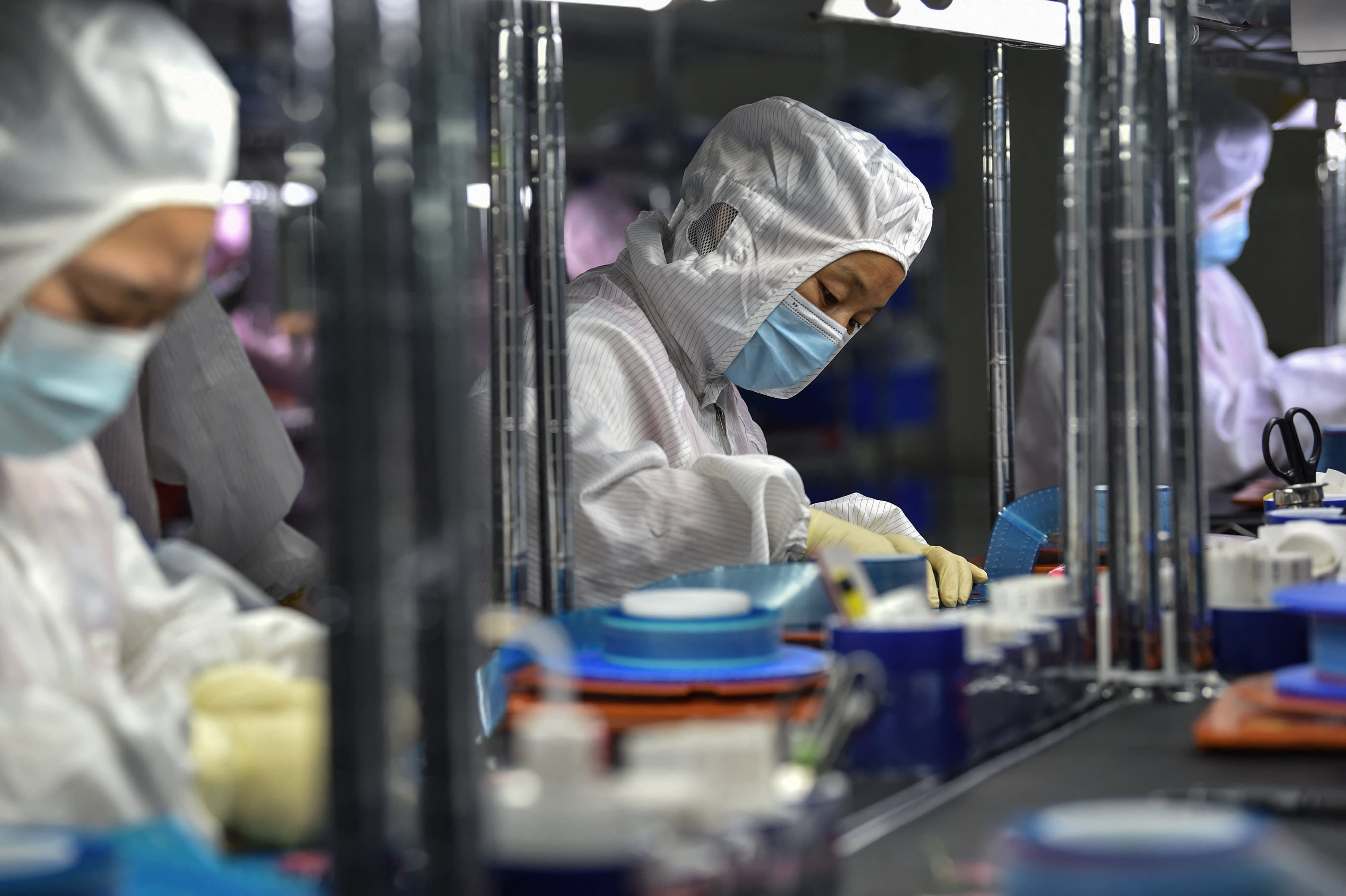
Workers produce adhesive tapes for flexible printed circuits (FPC) at a factory in Yancheng in China's eastern Jiangsu province on September 15, 2021. STR | AFP | Getty Images
BEIJING — Nomura's Chief China Economist Ting Lu cut his forecast for Chinese GDP growth this year as factories shut down to comply with carbon emissions reduction targets. "Markets now are so perplexed by the fallout of the property sector that they may ignore Beijing's unprecedented curbs on energy consumption and energy intensity," Lu said in a note Friday. As a result, he expects China's GDP to grow by 7.7% this year, down from 8.2% previously forecast.
Power supply crunch
On the supply side, he pointed to a "game changer" in mid-August when the national economic planning agency announced that 20 regions — accounting for about 70% of China's GDP — failed to meet carbon-related targets, prompting local authorities to quickly take action. "Regarding demand shocks," Lu said, "China's recent, sweeping regulatory crackdown on internet platforms, fintech, video games, off-campus tutoring, ride-hailing, data privacy, food delivery, crypto miners and e-cigarettes have been significant. The crackdown on off-campus tutoring may be especially negative for growth in Q3 and Q4 this year, as the entire sector has been decimated" He lowered quarterly GDP forecasts to 4.7% year-on-year growth in the third quarter and 3% in the fourth. China's official release on third-quarter GDP is due out Oct. 18. The accuracy of government data is frequently doubted.
Spillover from Evergrande and real estate
Chinese authorities' efforts to reduce high reliance on debt in the massive real estate sector in the last year have sent shares of indebted developer China Evergrande tumbling. The company has remained silent on an $83 million interest payment on its U.S. dollar-denominated debt that was due Thursday. The firm has a 30-day grace period. If Evergrande's troubles prompt a 10 percentage point slowdown in residential property activity, that could drag GDP growth down by roughly 1 percentage point, Morgan Stanley's Chief Asia Economist Chetan Ahya said in a note Sunday, citing analysis from the firm's chief China economist Robin Xing. Ahya added the slowdown could result in a decline in private consumption and a drop in property investment that subsequently lowers fixed asset investment in related manufacturing sectors. "These spillover effects are creating downward pressure on growth at the same time that production cuts to meet energy intensity targets are weighing on growth," Ahya said. "The regulatory reset is weighing on corporate sentiment and consumption is softening because of intermittent Covid-related restrictions." If the constraints on energy-intensive production remain, the Morgan Stanley analysts expect fourth-quarter GDP growth will be dragged down by about 1 percentage point. The investment bank currently forecasts 4.5% GDP growth in the third quarter from a year ago, and a slower 4% pace in the fourth quarter.
Expecting policy support