In February, Wang Huiwen, co-founder of China’s delivery giant Meituan, publicly announced his plans to build China’s OpenAI. But instead of announcing the news on China’s most popular microblogging site Weibo or its ubiquitous messaging app WeChat, he published a post on Jike — a niche social media platform little known to most Chinese internet users, but beloved among tech workers, investors, and industry experts. In a post titled “AI Heroes wanted,” Wang invited Jike users to contact him and join his new venture.
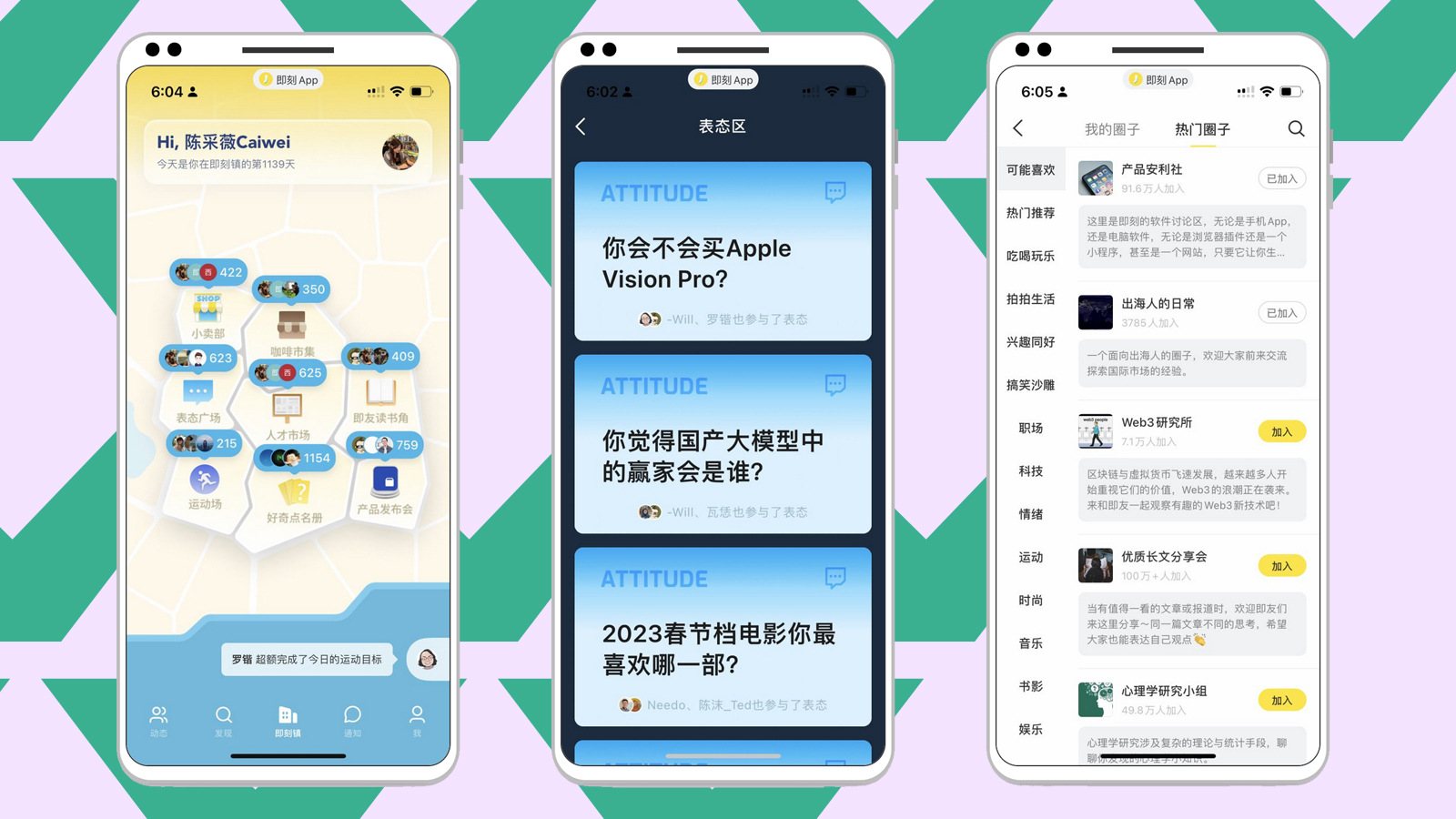
A variety of activities can be found on an interactive map of Jikeville, including a coffee shop rating zone and an in-app job market.
Jike encourages users to join interest-based discussion “circles”. The topics are often fine-grained and curated by human editors.
In the “Attitudes” section, Jike users vote on trending topics on the app like “Who do you think will win the Large Language Model race in China?”.
Launched in 2015 as an information aggregator, Jike has since grown into a social media platform indispensable to young Chinese tech workers. It combines the timely discourse of Twitter and the interest-based communities of Reddit: On the Jike app, users can follow each other and join discussion “circles”’ centered around specific topics (popular ones include “AI Exploration Club,” “Reality Show Lovers,” and “A Regular Day as a Product Manager”). Although Jike’s user base (2 million in 2019) is marginal compared to other platforms — Weibo has 593 million and WeChat has 1.67 billion — the app is a favorite among founders of big internet companies, such as Meituan’s Wang Xing, and partners at top venture capital firms including ZhenFund’s Dai Yusen.
Part of Jike’s appeal is its tightly knit community. Unlike most platforms today, Jike does not use in-app ads to lure users or algorithms to push content, but encourages active engagement through carefully curated topics and in-depth discussions across the app. Within the Jike community, dubbed “Jikeville,” users call each other “Ji You” (translated as Jike Friends), and organize in-person meetups. They share new software they’ve developed, track workouts with one another, and vote on whether or not they should buy the new Apple Vision Pro.
In 2019, Jike was shut down for a year because of “content moderation issues,” but made a quick comeback in 2020, according to its CEO Ye Xidong in an interview with a Chinese media outlet. As the ChatGPT frenzy hit China this year, Jike became the go-to-hub for people to discuss the rise of generative artificial intelligence and share ideas for AI startups. In March, Xidong announced that the company would organize an AI hackathon as part of “Hack Engine” — an accelerator that aimed to be China’s Y Combinator — and invited high-profile entrepreneurs to mentor the next generation. “The next AI revolution is happening on Jike,” Dai Yusen, managing partner of ZhenFund, posted on the app.